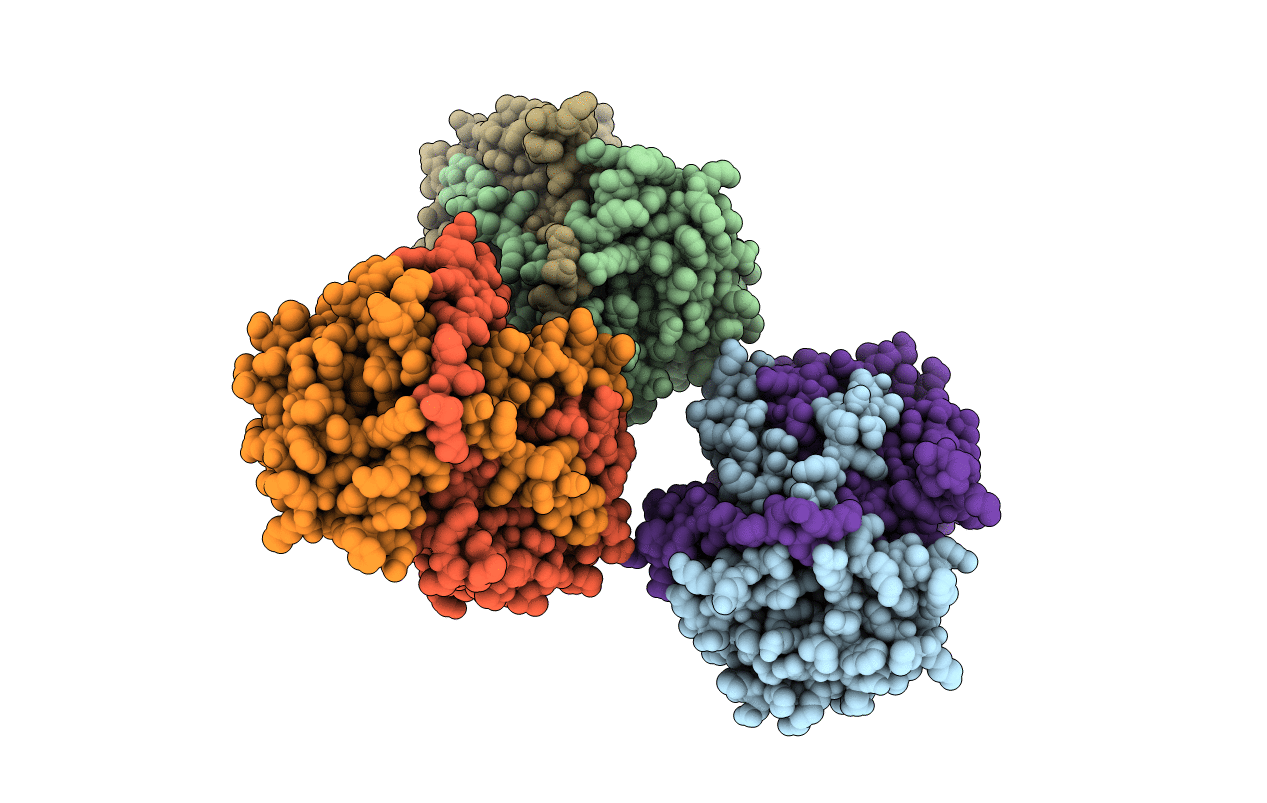
5YAK image
Deposition Date 2017-09-01
Release Date 2018-08-08
Last Version Date 2023-11-22
Entry Detail
PDB ID:
5YAK
Keywords:
Title:
The crystal structure of human IYD Thr239 mutant with ligand 3-Fluorotyrosine (F-Tyr)
Biological Source:
Source Organism:
Homo sapiens (Taxon ID: 9606)
Host Organism:
Method Details:
Experimental Method:
Resolution:
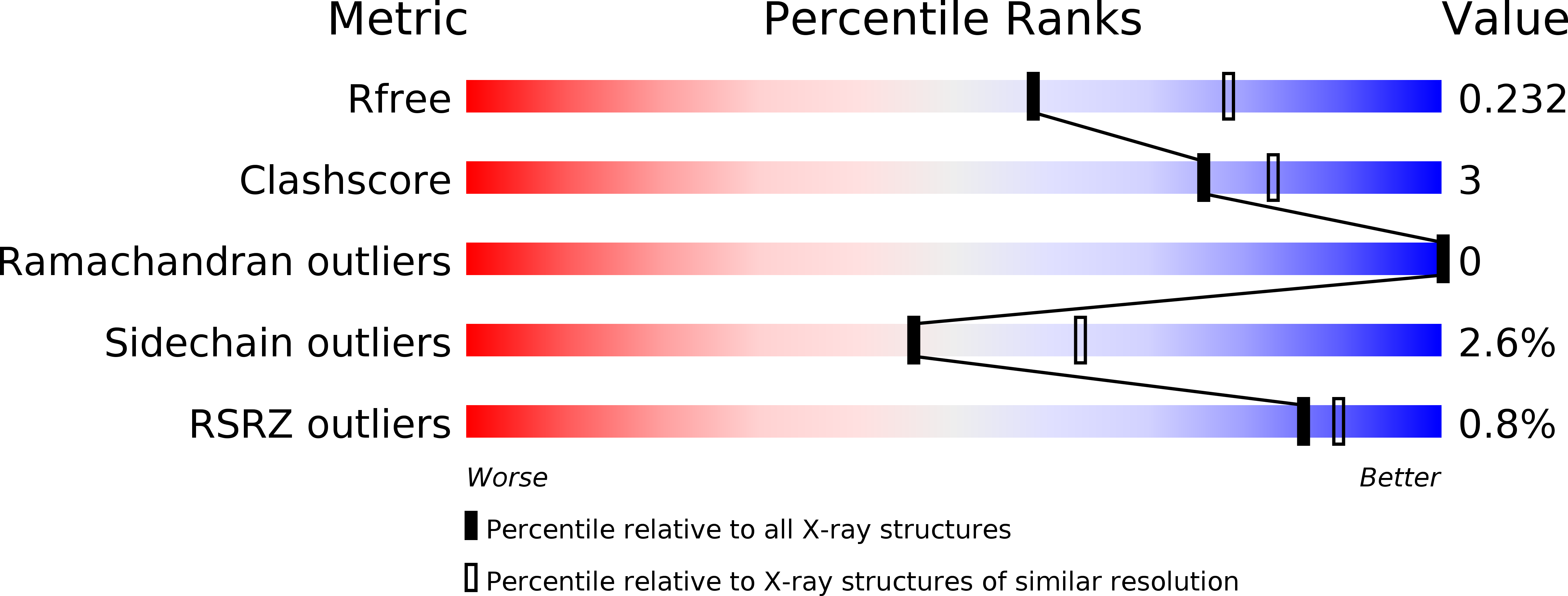
2.30 Å
R-Value Free:
0.22
R-Value Work:
0.18
R-Value Observed:
0.18
Space Group:
P 61
Macromolecular Entities
Structures with similar UniProt ID
Protein Blast
Polymer Type:polypeptide(L)
Molecule:Iodotyrosine deiodinase 1
Gene (Uniprot):IYD
Mutagens:T239A
Chain IDs:A, B, C, D, E, F
Chain Length:264
Number of Molecules:6
Biological Source:Homo sapiens
Primary Citation
Redox control of iodotyrosine deiodinase
Protein Sci. 28 68 78 (2019)
PMID: 30052294 DOI: 10.1002/pro.3479

Abstact

The redox chemistry of flavoproteins is often gated by substrate and iodotyrosine deiodinase (IYD) has the additional ability to switch between reaction modes based on the substrate. Association of fluorotyrosine (F-Tyr), an inert substrate analog, stabilizes single electron transfer reactions of IYD that are not observed in the absence of this ligand. The co-crystal of F-Tyr and a T239A variant of human IYD have now been characterized to provide a structural basis for control of its flavin reactivity. Coordination of F-Tyr in the active site of this IYD closely mimics that of iodotyrosine and only minor perturbations are observed after replacement of an active site Thr with Ala. However, loss of the side chain hydroxyl group removes a key hydrogen bond from flavin and suppresses the formation of its semiquinone intermediate. Even substitution of Thr with Ser decreases the midpoint potential of human IYD between its oxidized and semiquinone forms of flavin by almost 80 mV. This decrease does not adversely affect the kinetics of reductive dehalogenation although an analogous Ala variant exhibits a 6.7-fold decrease in its kcat /Km . Active site ligands lacking the zwitterion of halotyrosine are not able to induce closure of the active site lid that is necessary for promoting single electron transfer and dehalogenation. Under these conditions, a basal two-electron process dominates catalysis as indicated by preferential reduction of nitrophenol rather than deiodination of iodophenol.

Legend

Protein

Chemical

Disease

Primary Citation of related structures
Feedback Form
Name
Email
Institute
Feedback