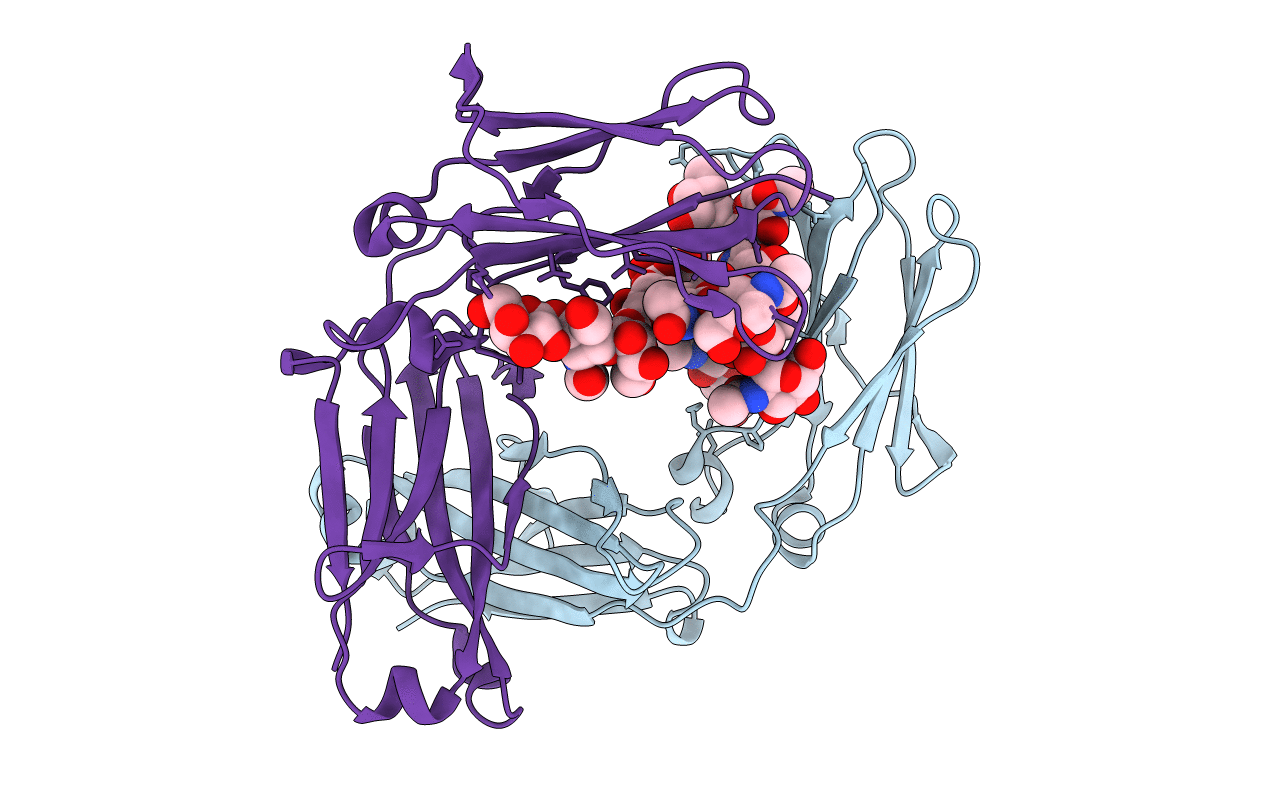
5Y56 image
Deposition Date 2017-08-07
Release Date 2017-09-13
Last Version Date 2024-11-13
Entry Detail
PDB ID:
5Y56
Keywords:
Title:
Fc mutant (K392D/K409D/D399K)
Biological Source:
Source Organism(s):
Homo sapiens (Taxon ID: 9606)
Expression System(s):
Method Details:
Experimental Method:
Resolution:
2.65 Å
R-Value Free:
0.29
R-Value Work:
0.26
R-Value Observed:
0.26
Space Group:
P 65 2 2

Macromolecular Entities
Structures with similar UniProt ID
Protein Blast
Polymer Type:polypeptide(L)
Molecule:Immunoglobulin gamma-1 heavy chain
Mutagens:K392D/K409D/D399K
Chain IDs:A, B
Chain Length:208
Number of Molecules:2
Biological Source:Homo sapiens
Primary Citation
A rational approach to enhancing antibody Fc homodimer formation for robust production of antibody mixture in a single cell line
J. Biol. Chem. 292 17885 17896 (2017)
PMID: 28878018 DOI: 10.1074/jbc.M116.771188

Abstact

Combinations of different antibodies have been shown to be more effective for managing certain diseases than monotherapy. Co-expression of the antibody mixture in a single cell line is key to reducing complexity during antibody development and manufacturing. However, co-transfection of multiple light and heavy chains into cells often leads to production of mismatched, heterodimeric by-products that are inactive, making the development of co-expression systems that robustly and efficiently produce highly active antibody mixtures a high priority. In this study, we modified the CH3 domain interface of the antibody fragment crystallizable (Fc) region by changing several charge pairs to create electrostatic interactions favoring Fc homodimer formation and disfavoring Fc heterodimer formation. When co-expressed, these modified antibodies with altered charge polarity across the Fc dimer interface preferentially formed homodimers that fully preserved the functions of each component, rather than inactive heterodimers whose formation was reduced because of rationally designed repulsive interactions. We designed eight different combinations and experimentally screened the best one, which enabled us to produce a binary antibody mixture against the EGF receptor with a minimal heterodimer contaminant. We further determined the crystal structure of a triple-mutated Fc variant in the best combination, and we elucidated the molecular interactions favoring Fc homodimer over heterodimer formation, which provided a structural basis for further optimization. The approach presented here demonstrates the feasibility of rational antibody modification for efficient and consistent production of monoclonal antibody mixtures in a single cell line and thus broadens our options for manufacturing more effective antibody-based therapeutic agents.

Legend

Protein

Chemical

Disease

Primary Citation of related structures
Feedback Form
Name
Email
Institute
Feedback