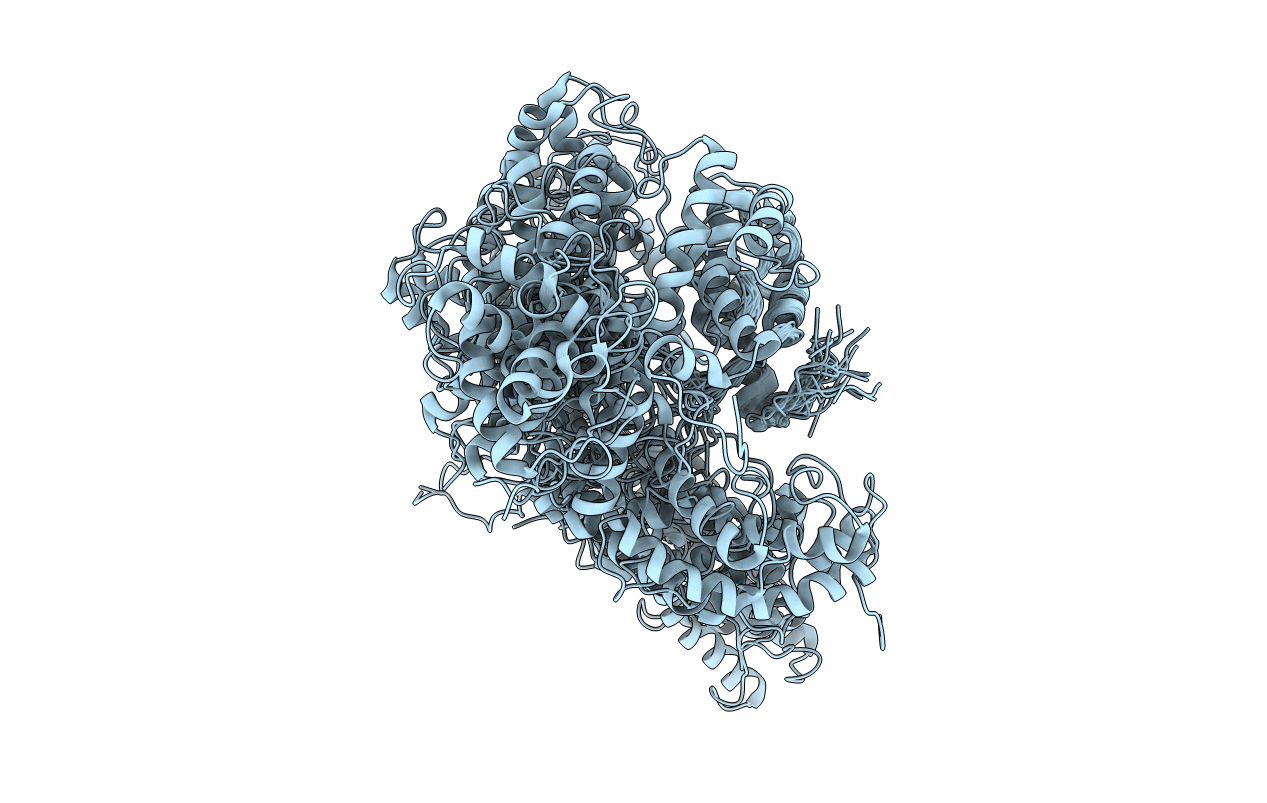
5Y08 image
Deposition Date 2017-07-15
Release Date 2018-12-12
Last Version Date 2024-05-15
Entry Detail
PDB ID:
5Y08
Title:
Solution structure of the apo doublet acyl carrier protein from prodigiosin biosynthesis
Biological Source:
Source Organism:
Method Details:
Experimental Method:
Conformers Calculated:
200
Conformers Submitted:
20
Selection Criteria:
structures with the lowest energy

Macromolecular Entities
Structures with similar UniProt ID
Protein Blast
Polymer Type:polypeptide(L)
Molecule:4-hydroxy-2,2'-bipyrrole-5-methanol synthase PigH
Gene (Uniprot):pigH
Chain IDs:A
Chain Length:205
Number of Molecules:1
Biological Source: Serratia sp. ATCC 39006
Ligand Molecules
Primary Citation
Solution Structure and Conformational Dynamics of a Doublet Acyl Carrier Protein from Prodigiosin Biosynthesis.
Biochemistry ? ? ? (2021)
PMID: 33416314 DOI: 10.1021/acs.biochem.0c00830

Abstact

The acyl carrier protein (ACP) is an indispensable component of both fatty acid and polyketide synthases and is primarily responsible for delivering acyl intermediates to enzymatic partners. At present, increasing numbers of multidomain ACPs have been discovered with roles in molecular recognition of trans-acting enzymatic partners as well as increasing metabolic flux. Further structural information is required to provide insight into their function, yet to date, the only high-resolution structure of this class to be determined is that of the doublet ACP (two continuous ACP domains) from mupirocin synthase. Here we report the solution nuclear magnetic resonance (NMR) structure of the doublet ACP domains from PigH (PigH ACP1-ACP2), which is an enzyme that catalyzes the formation of the bipyrrolic intermediate of prodigiosin, a potent anticancer compound with a variety of biological activities. The PigH ACP1-ACP2 structure shows each ACP domain consists of three conserved helices connected by a linker that is partially restricted by interactions with the ACP1 domain. Analysis of the holo (4'-phosphopantetheine, 4'-PP) form of PigH ACP1-ACP2 by NMR revealed conformational exchange found predominantly in the ACP2 domain reflecting the inherent plasticity of this ACP. Furthermore, ensemble models obtained from SAXS data reveal two distinct conformers, bent and extended, of both apo (unmodified) and holo PigH ACP1-ACP2 mediated by the central linker. The bent conformer appears to be a result of linker-ACP1 interactions detected by NMR and might be important for intradomain communication during the biosynthesis. These results provide new insights into the behavior of the interdomain linker of multiple ACP domains that may modulate protein-protein interactions. This is likely to become an increasingly important consideration for metabolic engineering in prodigiosin and other related biosynthetic pathways.

Legend

Protein

Chemical

Disease

Primary Citation of related structures
Feedback Form
Name
Email
Institute
Feedback