5XZJ image
Deposition Date 2017-07-12
Release Date 2017-12-20
Last Version Date 2024-11-13
Entry Detail
PDB ID:
5XZJ
Title:
Crystal structure of the Zn-directed tetramer of the engineered cyt cb562 variant, C96T/AB5
Biological Source:
Source Organism:
Escherichia coli (Taxon ID: 562)
Host Organism:
Method Details:
Experimental Method:
Resolution:
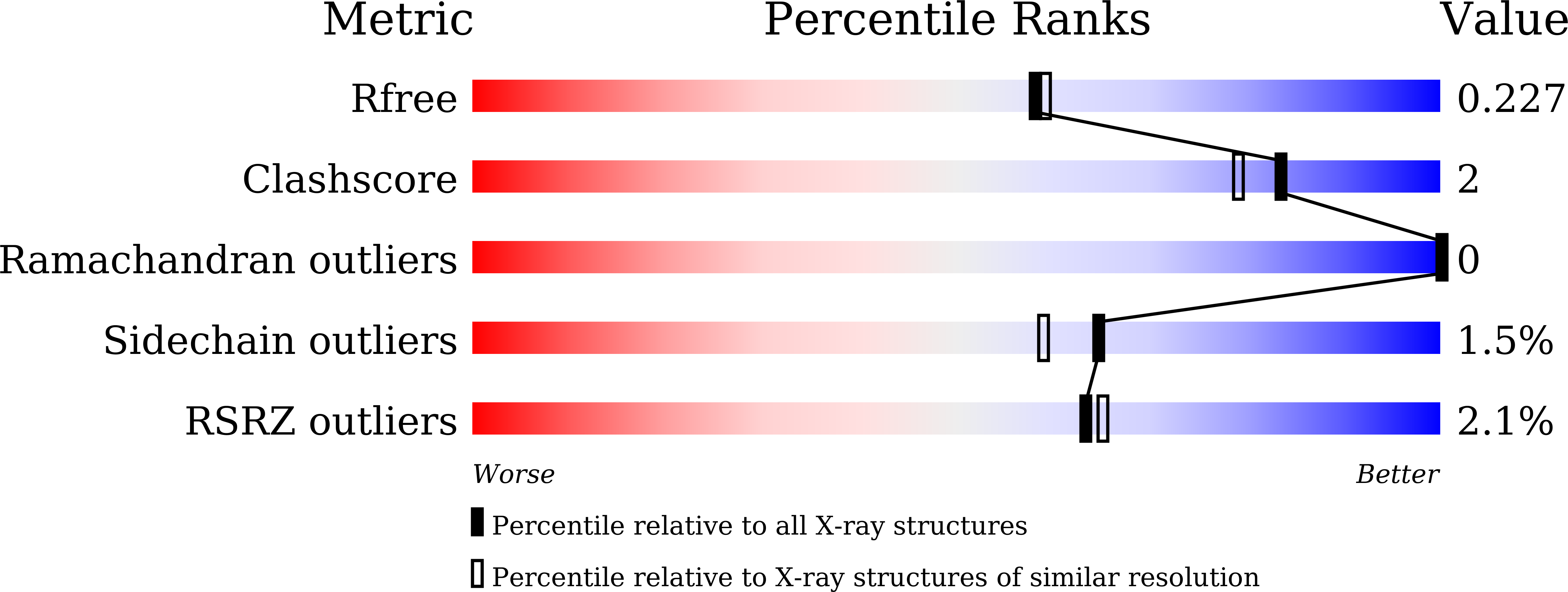
1.98 Å
R-Value Free:
0.21
R-Value Work:
0.17
R-Value Observed:
0.17
Space Group:
P 21 21 21
Macromolecular Entities
Structures with similar UniProt ID
Protein Blast
Polymer Type:polypeptide(L)
Molecule:Soluble cytochrome b562
Gene (Uniprot):cybC
Mutagens:R34A, L38A, Q41W, K42S, K59H, D66W, V69I, D73H, K77H, E86D, A89E, Q93H, R98C, A100H, Y101C
Chain IDs:A, B, C, D
Chain Length:106
Number of Molecules:4
Biological Source:Escherichia coli
Primary Citation
Importance of Scaffold Flexibility/Rigidity in the Design and Directed Evolution of Artificial Metallo-beta-lactamases.
J. Am. Chem. Soc. 139 16772 16779 (2017)
PMID: 28992705 DOI: 10.1021/jacs.7b08981

Abstact

We describe the design and evolution of catalytic hydrolase activity on a supramolecular protein scaffold, Zn4:C96RIDC14, which was constructed from cytochrome cb562 building blocks via a metal-templating strategy. Previously, we reported that Zn4:C96RIDC14 could be tailored with tripodal (His/His/Glu), unsaturated Zn coordination motifs in its interfaces to generate a variant termed Zn8:A104AB34, which in turn displayed catalytic activity for the hydrolysis of activated esters and β-lactam antibiotics. Zn8:A104AB34 was subsequently subjected to directed evolution via an in vivo selection strategy, leading to a variant Zn8:A104/G57AB34 which displayed enzyme-like Michaelis-Menten behavior for ampicillin hydrolysis. A criterion for the evolutionary utility or designability of a new protein structure is its ability to accommodate different active sites. With this in mind, we examined whether Zn4:C96RIDC14 could be tailored with alternative Zn coordination sites that could similarly display evolvable catalytic activities. We report here a detailed structural and functional characterization of new variant Zn8:AB54, which houses similar, unsaturated Zn coordination sites to those in Zn8:A104/G57AB34, but in completely different microenvironments. Zn8:AB54 displays Michaelis-Menten behavior for ampicillin hydrolysis without any optimization. Yet, the subsequent directed evolution of Zn8:AB54 revealed limited catalytic improvement, which we ascribed to the local protein rigidity surrounding the Zn centers and the lack of evolvable loop structures nearby. The relaxation of local rigidity via the elimination of adjacent disulfide linkages led to a considerable structural transformation with a concomitant improvement in β-lactamase activity. Our findings reaffirm previous observations that the delicate balance between protein flexibility and stability is crucial for enzyme design and evolution.

Legend

Protein

Chemical

Disease

Primary Citation of related structures
Feedback Form
Name
Email
Institute
Feedback