5XR8 image
Deposition Date 2017-06-07
Release Date 2017-07-12
Last Version Date 2023-11-22
Entry Detail
PDB ID:
5XR8
Title:
Crystal structure of the human CB1 in complex with agonist AM841
Biological Source:
Method Details:
Experimental Method:
Resolution:
2.95 Å
R-Value Free:
0.27
R-Value Work:
0.25
R-Value Observed:
0.25
Space Group:
P 21 2 21
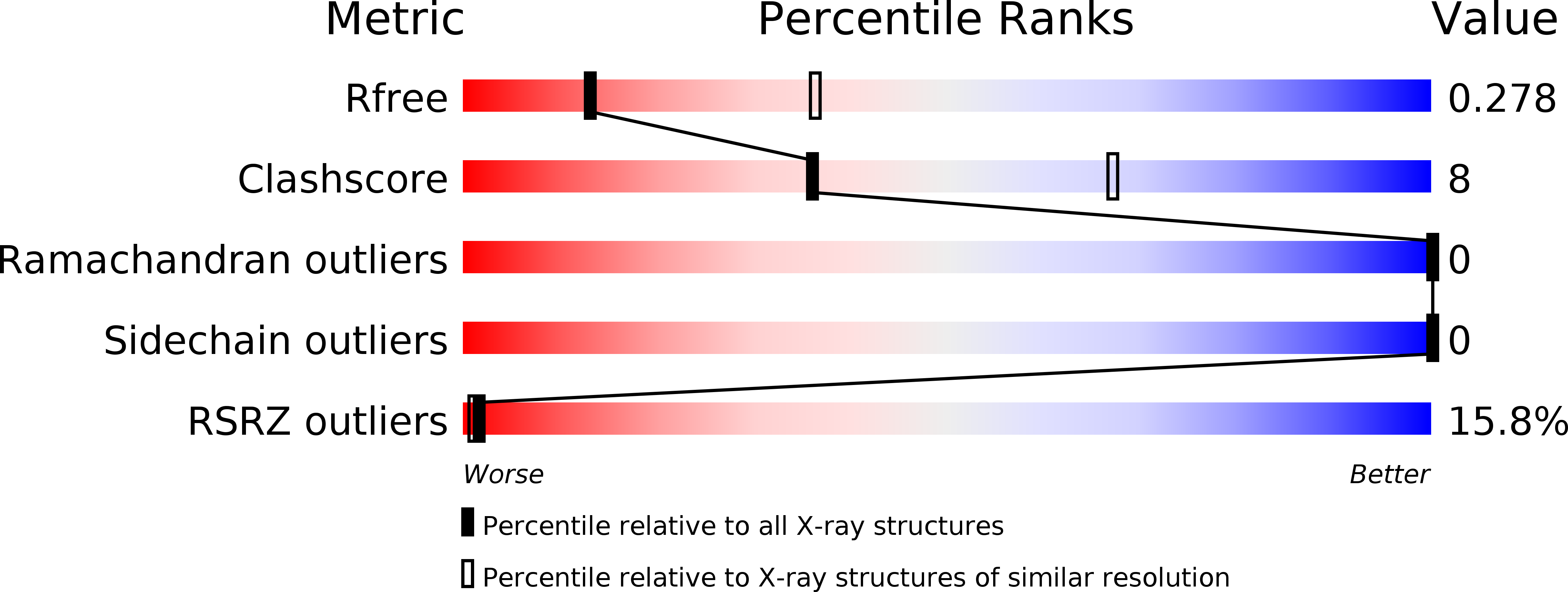
Macromolecular Entities
Protein Blast
Polymer Type:polypeptide(L)
Molecule:Cannabinoid receptor 1,Flavodoxin,Cannabinoid receptor 1
Gene (Uniprot):DVU_2680, CNR1
Mutagens:T210A,E273K,T283V,Y1098W,R340E
Chain IDs:A
Chain Length:438
Number of Molecules:1
Biological Source:Homo sapiens, Desulfovibrio vulgaris (strain Hildenborough / ATCC 29579 / DSM 644 / NCIMB 8303)
Primary Citation
Crystal structures of agonist-bound human cannabinoid receptor CB1.
Nature 547 468 471 (2017)
PMID: 28678776 DOI: 10.1038/nature23272

Abstact

The cannabinoid receptor 1 (CB1) is the principal target of the psychoactive constituent of marijuana, the partial agonist Δ9-tetrahydrocannabinol (Δ9-THC). Here we report two agonist-bound crystal structures of human CB1 in complex with a tetrahydrocannabinol (AM11542) and a hexahydrocannabinol (AM841) at 2.80 Å and 2.95 Å resolution, respectively. The two CB1-agonist complexes reveal important conformational changes in the overall structure, relative to the antagonist-bound state, including a 53% reduction in the volume of the ligand-binding pocket and an increase in the surface area of the G-protein-binding region. In addition, a 'twin toggle switch' of Phe2003.36 and Trp3566.48 (superscripts denote Ballesteros-Weinstein numbering) is experimentally observed and appears to be essential for receptor activation. The structures reveal important insights into the activation mechanism of CB1 and provide a molecular basis for predicting the binding modes of Δ9-THC, and endogenous and synthetic cannabinoids. The plasticity of the binding pocket of CB1 seems to be a common feature among certain class A G-protein-coupled receptors. These findings should inspire the design of chemically diverse ligands with distinct pharmacological properties.

Legend

Protein

Chemical

Disease

Primary Citation of related structures
Feedback Form
Name
Email
Institute
Feedback