5X41 image
Deposition Date 2017-02-09
Release Date 2017-04-19
Last Version Date 2024-03-27
Entry Detail
PDB ID:
5X41
Title:
3.5A resolution structure of a cobalt energy-coupling factor transporter using LCP method-CbiMQO
Biological Source:
Source Organism:
Host Organism:
Method Details:
Experimental Method:
Resolution:
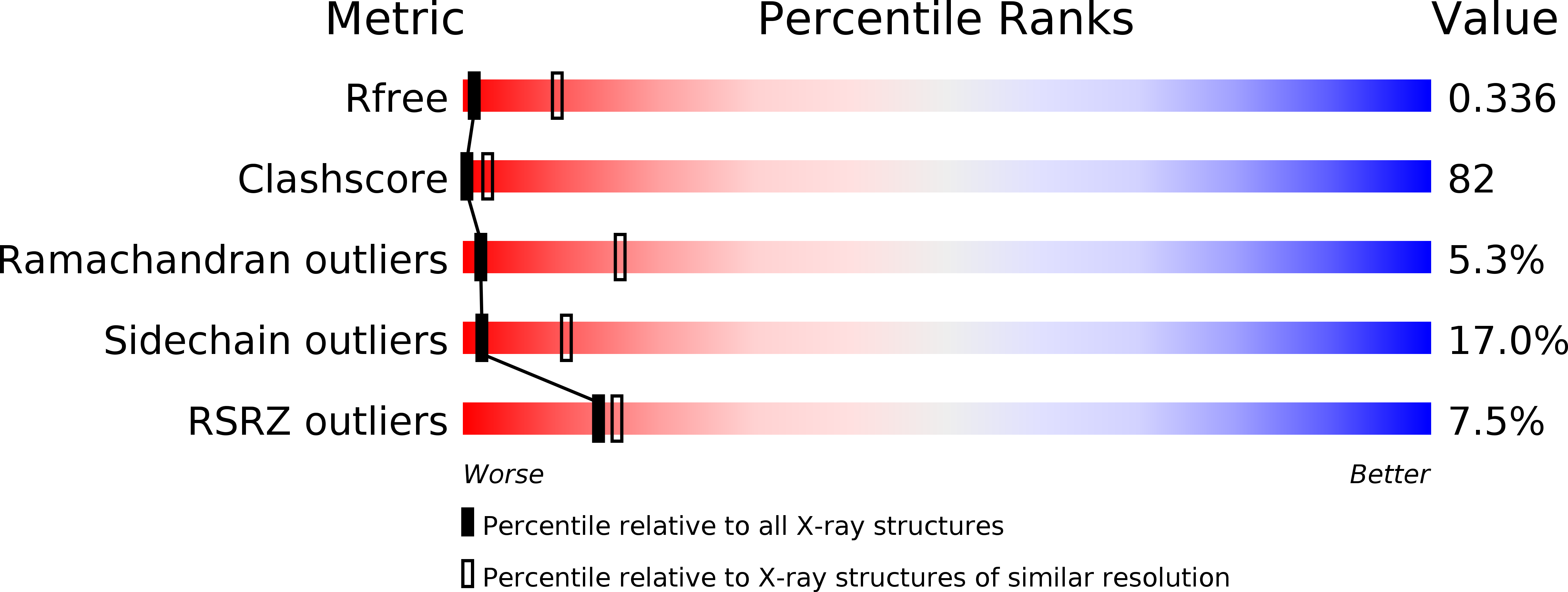
3.47 Å
R-Value Free:
0.33
R-Value Work:
0.29
R-Value Observed:
0.30
Space Group:
P 21 21 21
Macromolecular Entities
Structures with similar UniProt ID
Protein Blast
Polymer Type:polypeptide(L)
Molecule:Cobalt ABC transporter ATP-binding protein
Chain IDs:A, B, E (auth: C), F (auth: D)
Chain Length:280
Number of Molecules:4
Biological Source:Rhodobacter capsulatus
Structures with similar UniProt ID
Protein Blast
Polymer Type:polypeptide(L)
Molecule:Cobalt transport protein CbiM
Gene (Uniprot):cbiM
Chain IDs:C (auth: M), G (auth: E)
Chain Length:222
Number of Molecules:2
Biological Source:Rhodobacter capsulatus
Structures with similar UniProt ID
Protein Blast
Polymer Type:polypeptide(L)
Molecule:Uncharacterized protein CbiQ
Chain IDs:D (auth: Q), H (auth: F)
Chain Length:256
Number of Molecules:2
Biological Source:Rhodobacter capsulatus
Ligand Molecules
Primary Citation
Structure and mechanism of a group-I cobalt energy coupling factor transporter
Cell Res. 27 675 687 (2017)
PMID: 28322252 DOI: 10.1038/cr.2017.38

Abstact

Energy-coupling factor (ECF) transporters are a large family of ATP-binding cassette transporters recently identified in microorganisms. Responsible for micronutrient uptake from the environment, ECF transporters are modular transporters composed of a membrane substrate-binding component EcfS and an ECF module consisting of an integral membrane scaffold component EcfT and two cytoplasmic ATP binding/hydrolysis components EcfA/A'. ECF transporters are classified into groups I and II. Currently, the molecular understanding of group-I ECF transporters is very limited, partly due to a lack of transporter complex structural information. Here, we present structures and structure-based analyses of the group-I cobalt ECF transporter CbiMNQO, whose constituting subunits CbiM/CbiN, CbiQ, and CbiO correspond to the EcfS, EcfT, and EcfA components of group-II ECF transporters, respectively. Through reconstitution of different CbiMNQO subunits and determination of related ATPase and transporter activities, the substrate-binding subunit CbiM was found to stimulate CbiQO's basal ATPase activity. The structure of CbiMQO complex was determined in its inward-open conformation and that of CbiO in β, γ-methyleneadenosine 5'-triphosphate-bound closed conformation. Structure-based analyses revealed interactions between different components, substrate-gating function of the L1 loop of CbiM, and conformational changes of CbiO induced by ATP binding and product release within the CbiMNQO transporter complex. These findings enabled us to propose a working model of the CbiMNQO transporter, in which the transport process requires the rotation or toppling of both CbiQ and CbiM, and CbiN might function in coupling conformational changes between CbiQ and CbiM.

Legend

Protein

Chemical

Disease

Primary Citation of related structures
Feedback Form
Name
Email
Institute
Feedback