5WV3 image
Deposition Date 2016-12-21
Release Date 2017-02-15
Last Version Date 2025-03-12
Entry Detail
PDB ID:
5WV3
Keywords:
Title:
Crystal structure of bovine lactoperoxidase with a partial Glu258-heme linkage at 2.07 A resolution.
Biological Source:
Source Organism:
Bos taurus (Taxon ID: 9913)
Method Details:
Experimental Method:
Resolution:
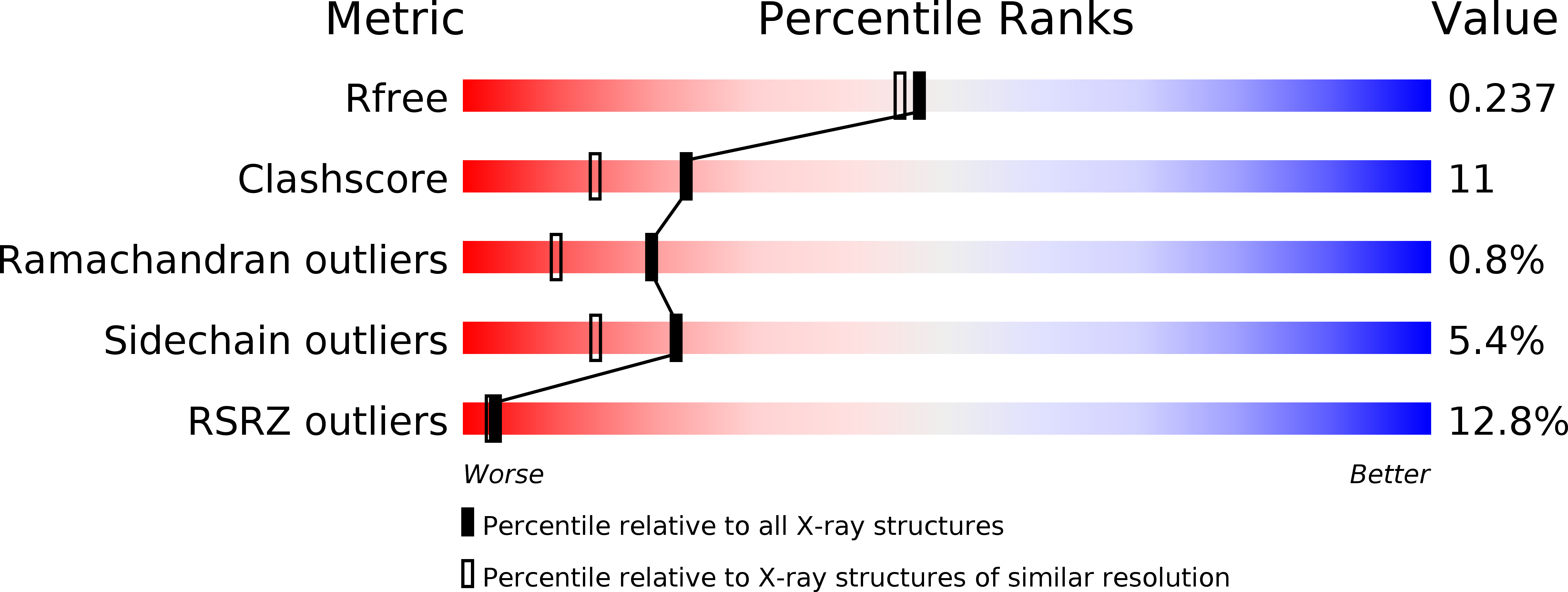
2.07 Å
R-Value Free:
0.23
R-Value Work:
0.16
R-Value Observed:
0.16
Space Group:
P 1 21 1
Macromolecular Entities
Structures with similar UniProt ID
Protein Blast
Polymer Type:polypeptide(L)
Molecule:Lactoperoxidase
Gene (Uniprot):LPO
Chain IDs:A
Chain Length:595
Number of Molecules:1
Biological Source:Bos taurus
Modified Residue
Compound ID Chain ID Parent Comp ID Details 2D Image
SEP A SER modified residue
Primary Citation
Structural basis of activation of mammalian heme peroxidases
Prog. Biophys. Mol. Biol. 133 49 55 (2018)
PMID: 29174286 DOI: 10.1016/j.pbiomolbio.2017.11.003

Abstact

The mammalian heme peroxidases including lactoperoxidase (LPO), myeloperoxidase (MPO), eosinophil peroxidase (EPO) and thyroid peroxidase (TPO) contain a covalently linked heme moiety. Initially, it was believed that the heme group was fully cross-linked to protein molecule through at least two ester linkages involving conserved glutamate and aspartate residues with 1-methyl and 5-methyl groups of pyrrole rings A and C respectively. In MPO, an additional sulfonium ion linkage was present between 2-vinyl group of pyrrole ring A of the heme moiety and a methionine residue of the protein. These linkages were formed through a self processing mechanism. Subsequently, biochemical studies indicated that the heme moiety was partially attached to protein. The recent structural studies have shown that the covalent linkage involving glutamate and 1-methyl group of pyrrole ring of heme moiety was partially formed. When glutamate is not covalently linked to heme moiety, its side chain occupies a position in the substrate binding site on the distal heme side and blocks the substrate binding site leading to inactivation. However, an exposure to H2O2 converts it to a fully covalently linked state with heme. Thus in mammalian heme peroxidases, the Glu-heme linkage is essential for catalytic action.

Legend

Protein

Chemical

Disease

Primary Citation of related structures
Feedback Form
Name
Email
Institute
Feedback