5WHQ image
Deposition Date 2017-07-18
Release Date 2018-01-17
Last Version Date 2024-11-13
Entry Detail
PDB ID:
5WHQ
Keywords:
Title:
Crystal structure of the catalase-peroxidase from Neurospora crassa at 2.9 A
Biological Source:
Source Organism:
Host Organism:
Method Details:
Experimental Method:
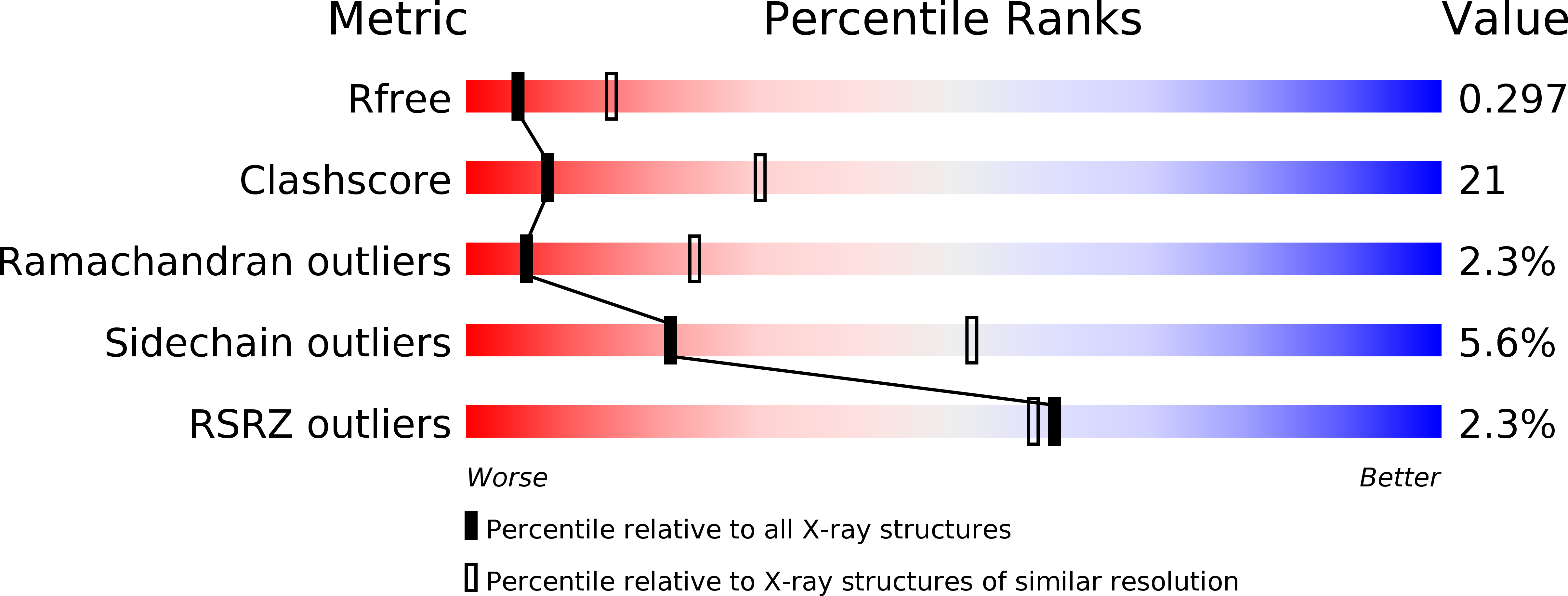
Resolution:
2.90 Å
R-Value Free:
0.29
R-Value Work:
0.22
R-Value Observed:
0.22
Space Group:
P 21 21 21
Macromolecular Entities
Structures with similar UniProt ID
Protein Blast
Polymer Type:polypeptide(L)
Molecule:Catalase-peroxidase
Gene (Uniprot):katG
Chain IDs:A, B
Chain Length:768
Number of Molecules:2
Biological Source:Neurospora crassa
Primary Citation
Structure, kinetics, molecular and redox properties of a cytosolic and developmentally regulated fungal catalase-peroxidase.
Arch. Biochem. Biophys. 640 17 26 (2018)
PMID: 29305053 DOI: 10.1016/j.abb.2017.12.021

Abstact

CAT-2, a cytosolic catalase-peroxidase (CP) from Neurospora crassa, which is induced during asexual spore formation, was heterologously expressed and characterized. CAT-2 had the Met-Tyr-Trp (M-Y-W) adduct required for catalase activity. Its KM for H2O2 was micromolar for peroxidase and millimolar for catalase activity. A Em = -158 mV reduction potential value was obtained and the Soret band shift suggested a mixture of low and high spin ferric iron. CAT-2 EPR spectrum at 10 K indicated an axial and a rhombic component. With peroxyacetic acid (PAA), formation of Compound I* was observed with EPR. CAT-2 homodimer crystallographic structure contained two K+ ions; Glu107 residues were displaced to bind them. CAT-2 showed the essential amino acid residues for activity in similar positions to other CPs. CAT-2 Arg426 is oriented towards the M-Y-W adduct, interacting with the deprotonated Tyr238 hydroxyl group. A perhydroxy modification of the indole nitrogen of Trp90 was oriented toward the catalytic His91. In contrast to cytochrome c peroxidase and ascorbate peroxidase, the catalase-peroxidase heme propionates are not exposed to the solvent. Together with other N. crassa enzymes that utilize H2O2 as a substrate, CAT-2 has many tryptophan and proline residues at its surface, probably related to H2O2 selection in water.

Legend

Protein

Chemical

Disease

Primary Citation of related structures
Feedback Form
Name
Email
Institute
Feedback