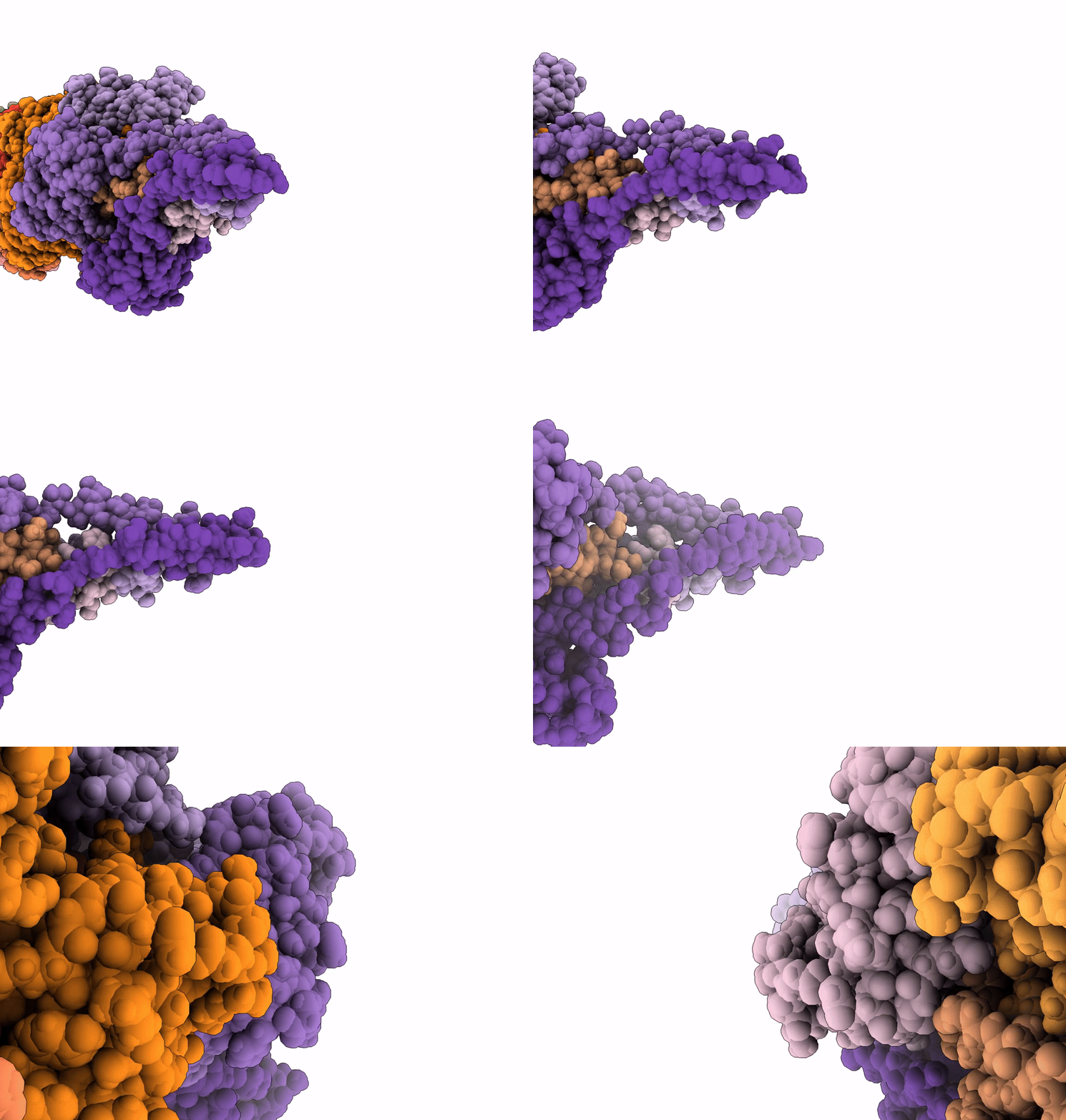
5WDA image
Deposition Date 2017-07-04
Release Date 2017-10-25
Last Version Date 2025-05-28
Entry Detail
PDB ID:
5WDA
Title:
Structure of the PulG pseudopilus
Biological Source:
Source Organism:
Host Organism:
Method Details:
Experimental Method:
Resolution:
5.00 Å
Aggregation State:
FILAMENT
Reconstruction Method:
HELICAL

Macromolecular Entities
Polymer Type:polypeptide(L)
Molecule:General secretion pathway protein G
Chain IDs:A, B, C, D, E, F, G, H, I, J, K, L, M, N, O, P, Q, R, S, T, U, V, W, X, Y
Chain Length:134
Number of Molecules:25
Biological Source:Klebsiella oxytoca
Modified Residue
Compound ID Chain ID Parent Comp ID Details 2D Image
MEA A PHE modified residue
Ligand Molecules
Primary Citation
Structure of the calcium-dependent type 2 secretion pseudopilus.
Nat Microbiol 2 1686 1695 (2017)
PMID: 28993624 DOI: 10.1038/s41564-017-0041-2

Abstact

Many Gram-negative bacteria use type 2 secretion systems (T2SSs) to secrete proteins involved in virulence and adaptation. Transport of folded proteins via T2SS nanomachines requires the assembly of inner membrane-anchored fibres called pseudopili. Although efficient pseudopilus assembly is essential for protein secretion, structure-based functional analyses are required to unravel the mechanistic link between these processes. Here, we report an atomic model for a T2SS pseudopilus from Klebsiella oxytoca, obtained by fitting the NMR structure of its calcium-bound subunit PulG into the ~5-Å-resolution cryo-electron microscopy reconstruction of assembled fibres. This structure reveals the comprehensive network of inter-subunit contacts and unexpected features, including a disordered central region of the PulG helical stem, and highly flexible C-terminal residues on the fibre surface. NMR, mutagenesis and functional analyses highlight the key role of calcium in PulG folding and stability. Fibre disassembly in the absence of calcium provides a basis for pseudopilus length control, essential for protein secretion, and supports the Archimedes screw model for the type 2 secretion mechanism.

Legend

Protein

Chemical

Disease

Primary Citation of related structures
Feedback Form
Name
Email
Institute
Feedback