5WCU image
Deposition Date 2017-07-02
Release Date 2018-10-31
Last Version Date 2023-10-04
Entry Detail
PDB ID:
5WCU
Title:
Crystal structure of 167 bp nucleosome bound to the globular domain of linker histone H5
Biological Source:
Source Organism:
Host Organism:
Method Details:
Experimental Method:
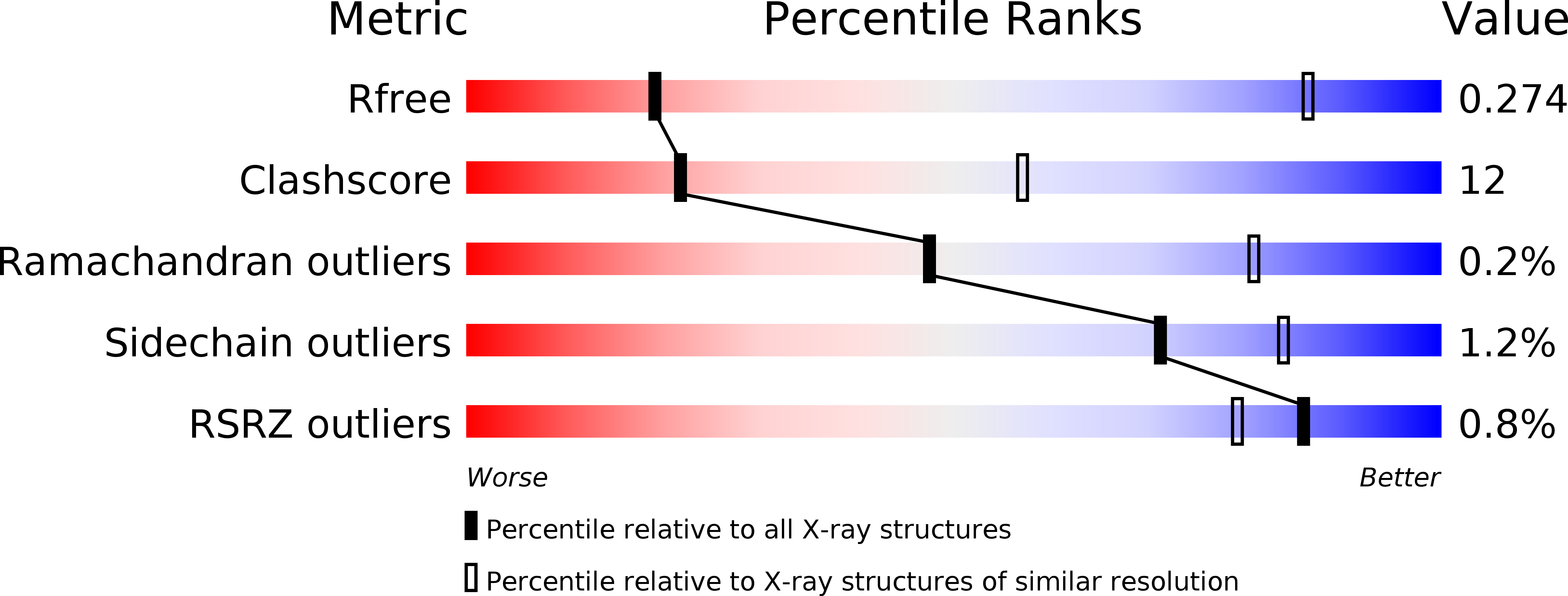
Resolution:
5.53 Å
R-Value Free:
0.23
R-Value Work:
0.18
R-Value Observed:
0.19
Space Group:
P 1
Macromolecular Entities
Structures with similar UniProt ID
Protein Blast
Polymer Type:polypeptide(L)
Molecule:Histone H3
Gene (Uniprot):His3, His3:CG31613, His3:CG33803, His3:CG33806, His3:CG33809, His3:CG33812, His3:CG33815, His3:CG33818, His3:CG33821, His3:CG33824, His3:CG33827, His3:CG33830, His3:CG33833, His3:CG33836, His3:CG33839, His3:CG33842, His3:CG33845, His3:CG33848, His3:CG33851, His3:CG33854, His3:CG33857, His3:CG33860, His3:CG33863, His3:CG33866
Chain IDs:A, E, K, O
Chain Length:98
Number of Molecules:4
Biological Source:Drosophila melanogaster
Structures with similar UniProt ID
Protein Blast
Polymer Type:polypeptide(L)
Molecule:Histone H4
Gene (Uniprot):His4, His4r, His4:CG31611, His4:CG33869, His4:CG33871, His4:CG33873, His4:CG33875, His4:CG33877, His4:CG33879, His4:CG33881, His4:CG33883, His4:CG33885, His4:CG33887, His4:CG33889, His4:CG33891, His4:CG33893, His4:CG33895, His4:CG33897, His4:CG33899, His4:CG33901, His4:CG33903, His4:CG33905, His4:CG33907, His4:CG33909
Chain IDs:B, F, L, P
Chain Length:82
Number of Molecules:4
Biological Source:Drosophila melanogaster
Structures with similar UniProt ID
Protein Blast
Polymer Type:polypeptide(L)
Molecule:Histone H2A
Gene (Uniprot):His2A, His2A:CG31618, His2A:CG33808, His2A:CG33814, His2A:CG33817, His2A:CG33820, His2A:CG33823, His2A:CG33826, His2A:CG33829, His2A:CG33832, His2A:CG33835, His2A:CG33838, His2A:CG33841, His2A:CG33844, His2A:CG33847, His2A:CG33850, His2A:CG33862, His2A:CG33865
Chain IDs:C, G, M, Q
Chain Length:104
Number of Molecules:4
Biological Source:Drosophila melanogaster
Structures with similar UniProt ID
Protein Blast
Polymer Type:polypeptide(L)
Molecule:Histone H2B
Gene (Uniprot):His2B, His2B:CG17949, His2B:CG33868, His2B:CG33870, His2B:CG33872, His2B:CG33874, His2B:CG33876, His2B:CG33878, His2B:CG33880, His2B:CG33882, His2B:CG33884, His2B:CG33886, His2B:CG33888, His2B:CG33890, His2B:CG33892, His2B:CG33894, His2B:CG33896, His2B:CG33898, His2B:CG33900, His2B:CG33902, His2B:CG33904, His2B:CG33906, His2B:CG33908, His2B:CG33910
Chain IDs:D, H, N, R
Chain Length:94
Number of Molecules:4
Biological Source:Drosophila melanogaster
Polymer Type:polydeoxyribonucleotide
Molecule:DNA (167-MER)
Chain IDs:I, S
Chain Length:167
Number of Molecules:2
Biological Source:synthetic construct
Polymer Type:polydeoxyribonucleotide
Molecule:DNA (167-MER)
Chain IDs:J, T
Chain Length:167
Number of Molecules:2
Biological Source:synthetic construct
Structures with similar UniProt ID
Protein Blast
Polymer Type:polypeptide(L)
Molecule:Histone H5
Chain IDs:U, V
Chain Length:76
Number of Molecules:2
Biological Source:Gallus gallus
Ligand Molecules
Primary Citation
Revisit of Reconstituted 30-nm Nucleosome Arrays Reveals an Ensemble of Dynamic Structures.
J. Mol. Biol. 430 3093 3110 (2018)
PMID: 29959925 DOI: 10.1016/j.jmb.2018.06.020

Abstact

It has long been suggested that chromatin may form a fiber with a diameter of ~30 nm that suppresses transcription. Despite nearly four decades of study, the structural nature of the 30-nm chromatin fiber and conclusive evidence of its existence in vivo remain elusive. The key support for the existence of specific 30-nm chromatin fiber structures is based on the determination of the structures of reconstituted nucleosome arrays using X-ray crystallography and single-particle cryo-electron microscopy coupled with glutaraldehyde chemical cross-linking. Here we report the characterization of these nucleosome arrays in solution using analytical ultracentrifugation, NMR, and small-angle X-ray scattering. We found that the physical properties of these nucleosome arrays in solution are not consistent with formation of just a few discrete structures of nucleosome arrays. In addition, we obtained a crystal of the nucleosome in complex with the globular domain of linker histone H5 that shows a new form of nucleosome packing and suggests a plausible alternative compact conformation for nucleosome arrays. Taken together, our results challenge the key evidence for the existence of a limited number of structures of reconstituted nucleosome arrays in solution by revealing that the reconstituted nucleosome arrays are actually best described as an ensemble of various conformations with a zigzagged arrangement of nucleosomes. Our finding has implications for understanding the structure and function of chromatin in vivo.

Legend

Protein

Chemical

Disease

Primary Citation of related structures
Feedback Form
Name
Email
Institute
Feedback