5VRF image
Deposition Date 2017-05-10
Release Date 2018-03-14
Last Version Date 2024-03-13
Entry Detail
PDB ID:
5VRF
Title:
CryoEM Structure of the Zinc Transporter YiiP from helical crystals
Biological Source:
Source Organism:
Method Details:
Experimental Method:
Resolution:
4.10 Å
Aggregation State:
HELICAL ARRAY
Reconstruction Method:
HELICAL
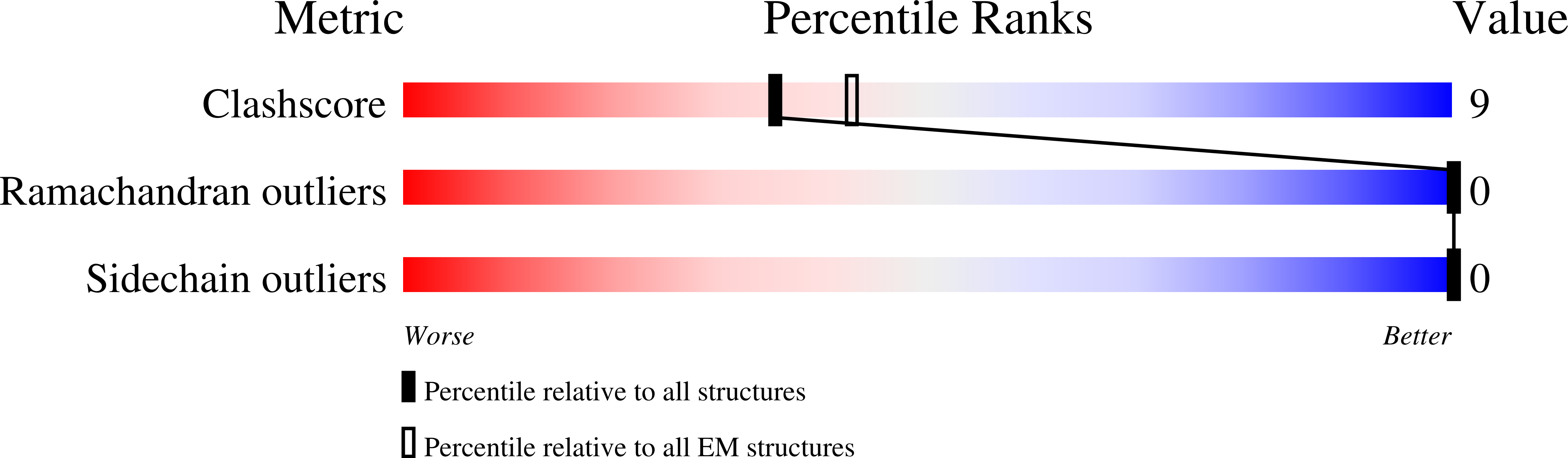
Macromolecular Entities
Structures with similar UniProt ID
Protein Blast
Polymer Type:polypeptide(L)
Molecule:Cadmium and zinc efflux pump FieF
Gene (Uniprot):fieF
Chain IDs:A (auth: B), B (auth: A)
Chain Length:296
Number of Molecules:2
Biological Source:Shewanella oneidensis MR-1
Ligand Molecules
Primary Citation
Structural basis for the alternating access mechanism of the cation diffusion facilitator YiiP.
Proc. Natl. Acad. Sci. U.S.A. 115 3042 3047 (2018)
PMID: 29507252 DOI: 10.1073/pnas.1715051115

Abstact

YiiP is a dimeric antiporter from the cation diffusion facilitator family that uses the proton motive force to transport Zn2+ across bacterial membranes. Previous work defined the atomic structure of an outward-facing conformation, the location of several Zn2+ binding sites, and hydrophobic residues that appear to control access to the transport sites from the cytoplasm. A low-resolution cryo-EM structure revealed changes within the membrane domain that were associated with the alternating access mechanism for transport. In the current work, the resolution of this cryo-EM structure has been extended to 4.1 Å. Comparison with the X-ray structure defines the differences between inward-facing and outward-facing conformations at an atomic level. These differences include rocking and twisting of a four-helix bundle that harbors the Zn2+ transport site and controls its accessibility within each monomer. As previously noted, membrane domains are closely associated in the dimeric structure from cryo-EM but dramatically splayed apart in the X-ray structure. Cysteine crosslinking was used to constrain these membrane domains and to show that this large-scale splaying was not necessary for transport activity. Furthermore, dimer stability was not compromised by mutagenesis of elements in the cytoplasmic domain, suggesting that the extensive interface between membrane domains is a strong determinant of dimerization. As with other secondary transporters, this interface could provide a stable scaffold for movements of the four-helix bundle that confers alternating access of these ions to opposite sides of the membrane.

Legend

Protein

Chemical

Disease

Primary Citation of related structures
Feedback Form
Name
Email
Institute
Feedback