5VJB image
Deposition Date 2017-04-19
Release Date 2017-06-28
Last Version Date 2024-03-13
Entry Detail
PDB ID:
5VJB
Keywords:
Title:
Guanidine-II riboswitch P2 hairpin dimer with 5-bromoU substitution from Pseudomonas aeruginosa
Biological Source:
Source Organism:
Method Details:
Experimental Method:
Resolution:
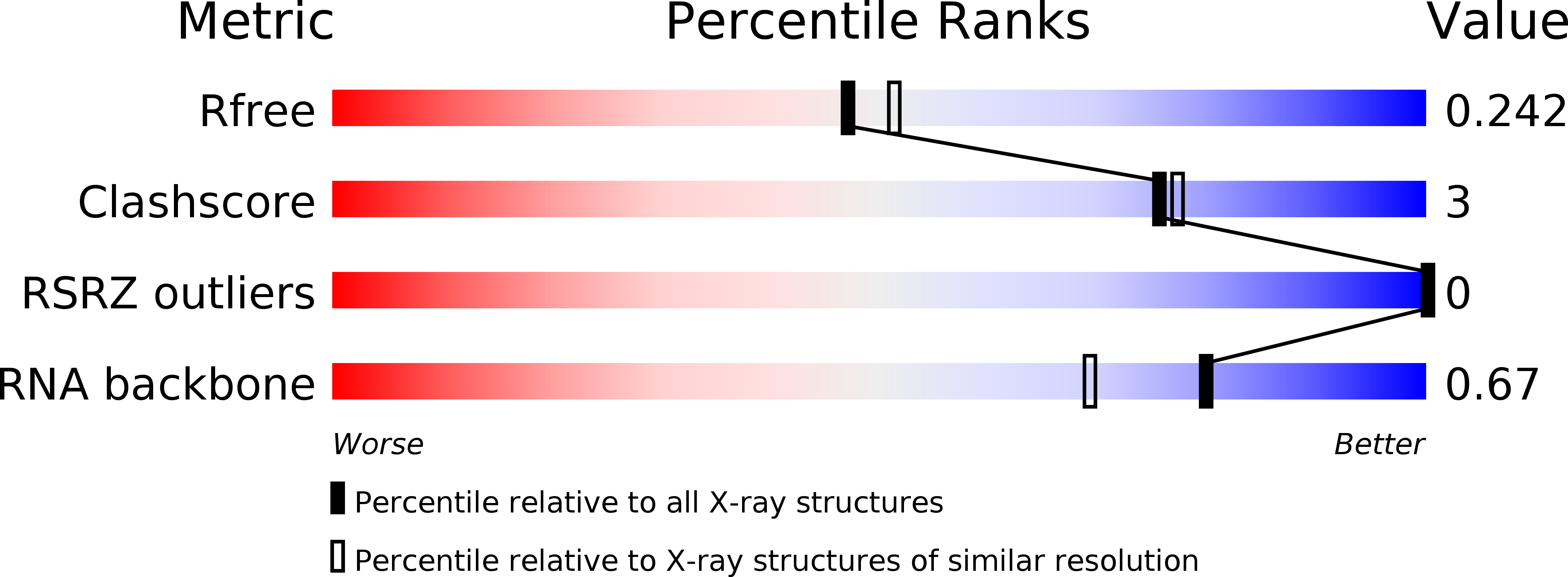
2.10 Å
R-Value Free:
0.23
R-Value Work:
0.21
R-Value Observed:
0.21
Space Group:
P 21 21 21
Macromolecular Entities
Polymer Type:polyribonucleotide
Molecule:RNA (5'-R(*GP*CP*GP*GP*GP*GP*AP*CP*GP*AP*CP*CP*CP*(5BU)P*GP*C)-3')
Chain IDs:A, B, C, D
Chain Length:16
Number of Molecules:4
Biological Source:Pseudomonas aeruginosa
Primary Citation
Structural basis for ligand binding to the guanidine-II riboswitch.
RNA 23 1338 1343 (2017)
PMID: 28600356 DOI: 10.1261/rna.061804.117

Abstact

The guanidine-II riboswitch, also known as mini-ykkC, is a conserved mRNA element with more than 800 examples in bacteria. It consists of two stem-loops capped by identical, conserved tetraloops that are separated by a linker region of variable length and sequence. Like the guanidine-I riboswitch, it controls the expression of guanidine carboxylases and SugE-like genes. The guanidine-II riboswitch specifically binds free guanidinium cations and functions as a translationally controlled on-switch. Here we report the structure of a P2 stem-loop from the Pseudomonas aeruginosa guanidine-II riboswitch aptamer bound to guanidine at 1.57 Å resolution. The hairpins dimerize via the conserved tetraloop, which also contains the binding pocket. Two guanidinium molecules bind near the dimerization interface, one in each tetraloop. The guanidinium cation is engaged in extensive hydrogen bonding to the RNA. Contacts include the Hoogsteen face of a guanine base and three nonbridging phosphate oxygens. Cation-π interactions and ionic interactions also stabilize ligand binding. The guanidine-II riboswitch utilizes the same recognition strategies as the guanidine-I riboswitch while adopting an entirely different and much smaller RNA fold.

Legend

Protein

Chemical

Disease

Primary Citation of related structures
Feedback Form
Name
Email
Institute
Feedback