5VF1 image
Deposition Date 2017-04-06
Release Date 2017-06-21
Last Version Date 2025-04-02
Entry Detail
PDB ID:
5VF1
Keywords:
Title:
X-ray Crystallographic Structure of a Giant Double-Walled Peptide Nanotube Formed by a Macrocyclic Beta-Sheet Containing ABeta16-22
Biological Source:
Source Organism:
Homo sapiens (Taxon ID: 9606)
Method Details:
Experimental Method:
Resolution:
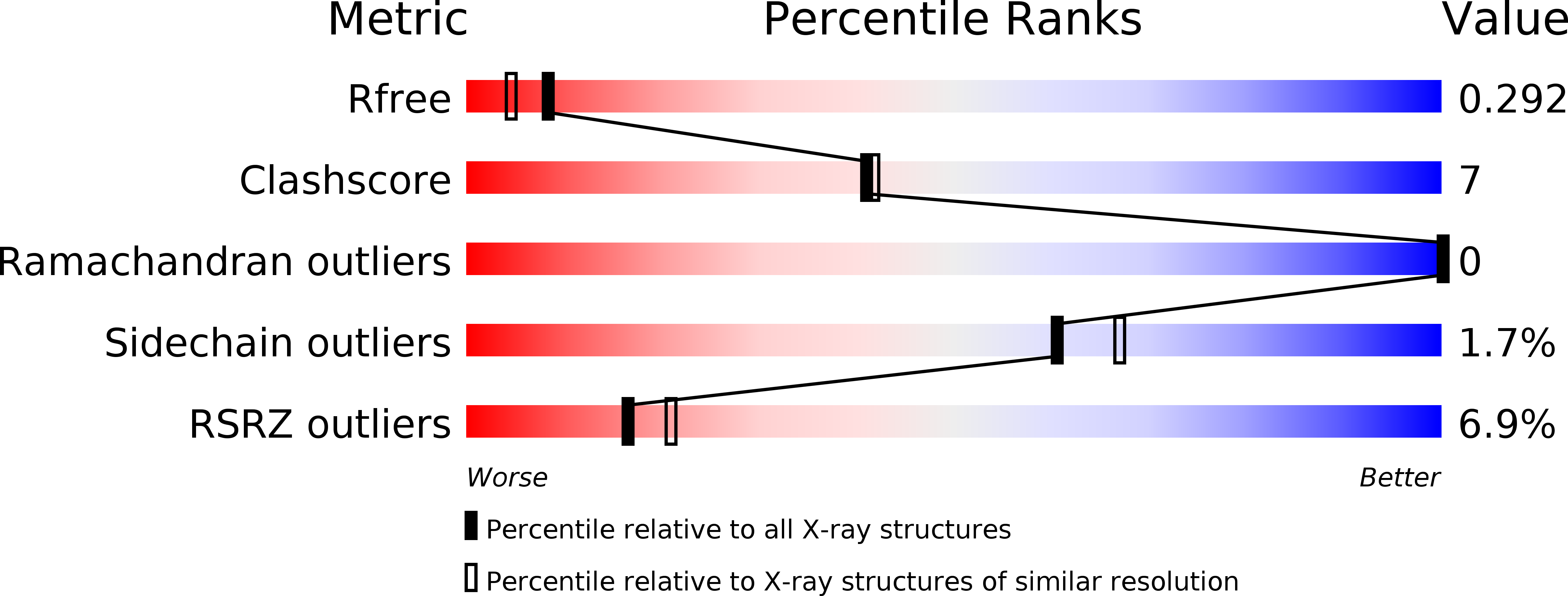
2.10 Å
R-Value Free:
0.27
R-Value Work:
0.21
R-Value Observed:
0.22
Space Group:
P 61 2 2
Macromolecular Entities
Polymer Type:polypeptide(L)
Molecule:ORN-LYS-LEU-VAL-PHI-PHE-ALA-GLU-ORN-GLU-ALA-PHE-MEA-VAL-LEU-LYS
Chain IDs:A, B, C, D, E, F
Chain Length:16
Number of Molecules:6
Biological Source:Homo sapiens
Primary Citation
X-ray Crystallographic Structure of a Giant Double-Walled Peptide Nanotube Formed by a Macrocyclic beta-Sheet Containing A beta 16-22.
J. Am. Chem. Soc. 139 8102 8105 (2017)
PMID: 28598147 DOI: 10.1021/jacs.7b03890

Abstact

This paper describes the supramolecular assembly of a macrocyclic β-sheet containing residues 16-22 of the β-amyloid peptide, Aβ. X-ray crystallography reveals that the macrocyclic β-sheet assembles to form double-walled nanotubes, with an inner diameter of 7 nm and outer diameter of 11 nm. The inner wall is composed of an extended network of hydrogen-bonded dimers. The outer wall is composed of a separate extended network of β-barrel-like tetramers. These large peptide nanotubes pack into a hexagonal lattice that resembles a honeycomb. The complexity and size of the peptide nanotubes rivals some of the largest tubular biomolecular assemblies, such as GroEL and microtubules. These observations demonstrate that small amyloidogenic sequences can be used to build large nanostructures.

Legend

Protein

Chemical

Disease

Primary Citation of related structures
Feedback Form
Name
Email
Institute
Feedback