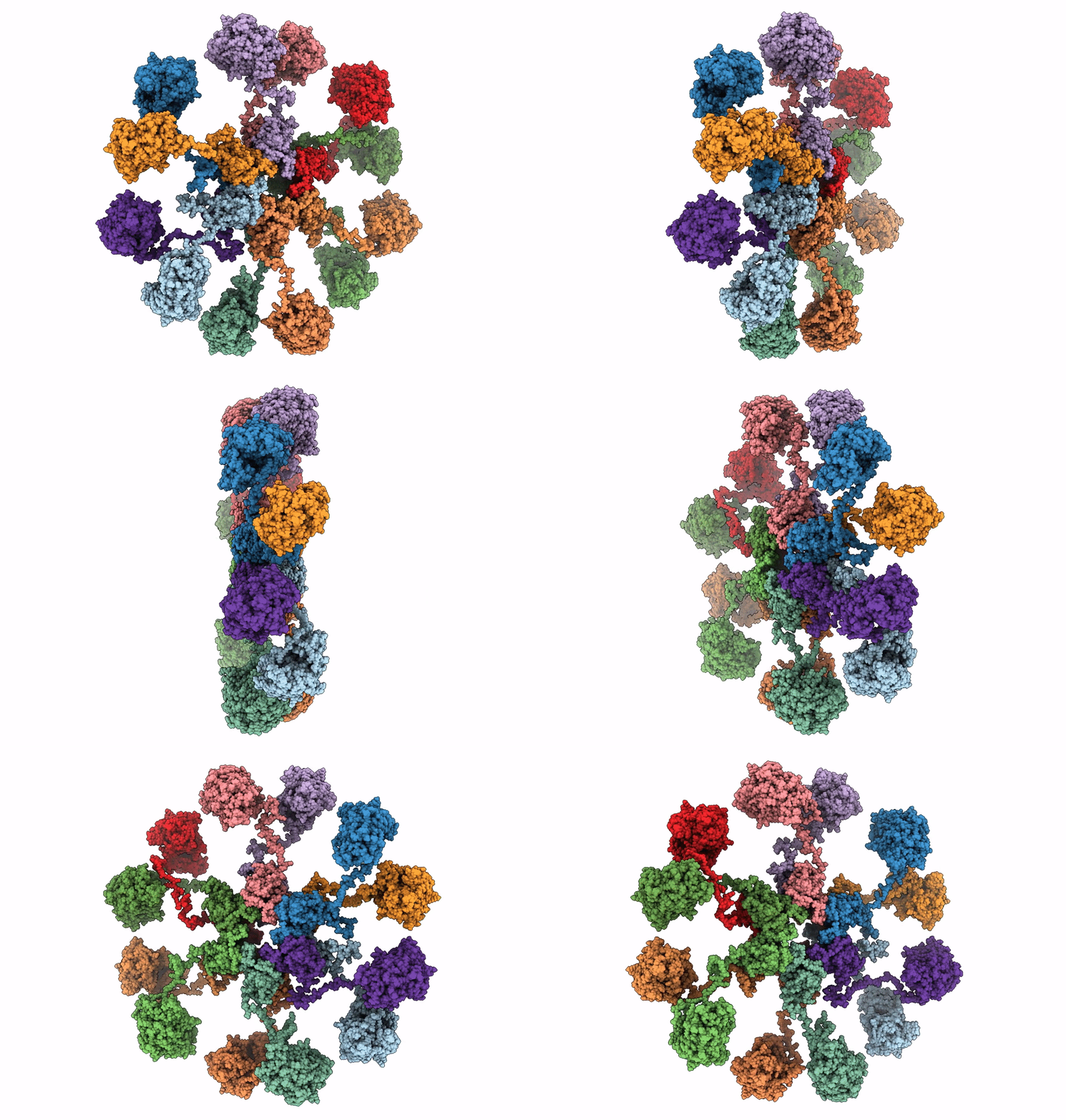
5U6Y image
Deposition Date 2016-12-09
Release Date 2017-06-21
Last Version Date 2024-03-13
Entry Detail
PDB ID:
5U6Y
Keywords:
Title:
Pseudo-atomic model of the CaMKIIa holoenzyme.
Biological Source:
Source Organism:
Host Organism:
Method Details:
Experimental Method:
Resolution:
20.00 Å
Aggregation State:
PARTICLE
Reconstruction Method:
SINGLE PARTICLE
Macromolecular Entities
Structures with similar UniProt ID
Protein Blast
Polymer Type:polypeptide(L)
Molecule:Calcium/calmodulin-dependent protein kinase type II subunit alpha
Gene (Uniprot):Camk2a
Chain IDs:A, B, C, D, E, F, G, H, I, J, K, L
Chain Length:461
Number of Molecules:12
Biological Source:Rattus norvegicus
Ligand Molecules
Primary Citation
The CaMKII holoenzyme structure in activation-competent conformations.
Nat Commun 8 15742 15742 (2017)
PMID: 28589927 DOI: 10.1038/ncomms15742

Abstact

The Ca2+/calmodulin-dependent protein kinase II (CaMKII) assembles into large 12-meric holoenzymes, which is thought to enable regulatory processes required for synaptic plasticity underlying learning, memory and cognition. Here we used single particle electron microscopy (EM) to determine a pseudoatomic model of the CaMKIIα holoenzyme in an extended and activation-competent conformation. The holoenzyme is organized by a rigid central hub complex, while positioning of the kinase domains is highly flexible, revealing dynamic holoenzymes ranging from 15-35 nm in diameter. While most kinase domains are ordered independently, ∼20% appear to form dimers and <3% are consistent with a compact conformation. An additional level of plasticity is revealed by a small fraction of bona-fide 14-mers (<4%) that may enable subunit exchange. Biochemical and cellular FRET studies confirm that the extended state of CaMKIIα resolved by EM is the predominant form of the holoenzyme, even under molecular crowding conditions.

Legend

Protein

Chemical

Disease

Primary Citation of related structures
Feedback Form
Name
Email
Institute
Feedback