5U1C image
Deposition Date 2016-11-28
Release Date 2017-01-11
Last Version Date 2024-03-13
Entry Detail
PDB ID:
5U1C
Keywords:
Title:
Structure of tetrameric HIV-1 Strand Transfer Complex Intasome
Biological Source:
Source Organism:
Host Organism:
Method Details:
Experimental Method:
Resolution:
3.90 Å
Aggregation State:
PARTICLE
Reconstruction Method:
SINGLE PARTICLE
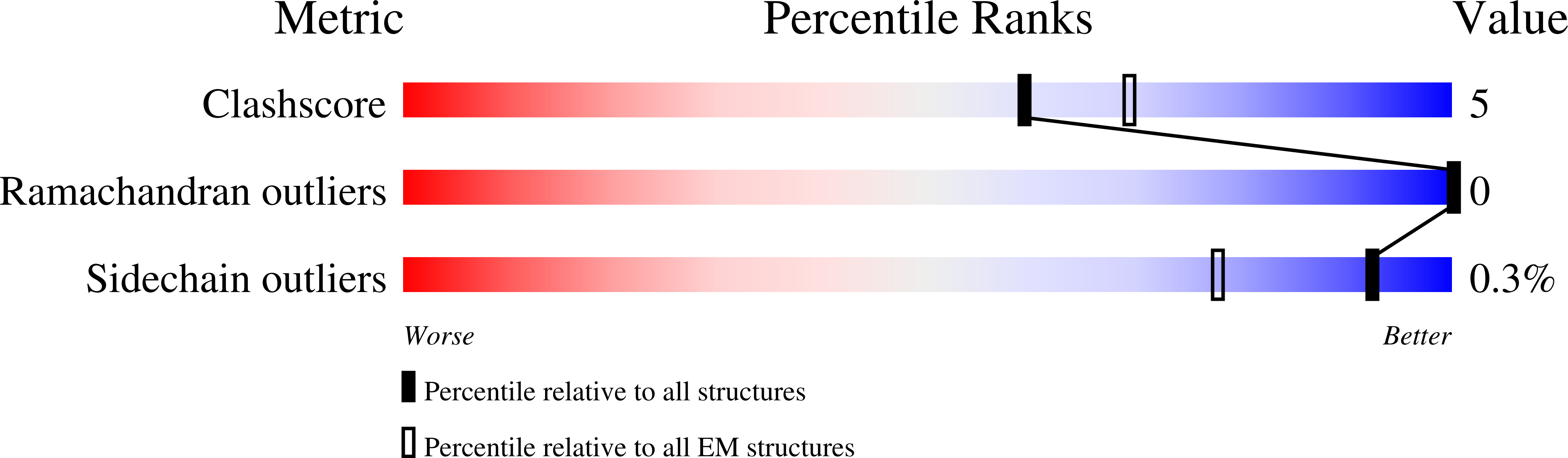
Macromolecular Entities
Structures with similar UniProt ID
Protein Blast
Polymer Type:polypeptide(L)
Molecule:HIV-1 Integrase, Sso7d chimera
Mutagens:E152Q
Chain IDs:A, B, F (auth: C), G (auth: D)
Chain Length:383
Number of Molecules:4
Biological Source:Sulfolobus solfataricus, Human immunodeficiency virus 1
Polymer Type:polydeoxyribonucleotide
Molecule:DNA (23-MER)
Chain IDs:D (auth: E), I
Chain Length:23
Number of Molecules:2
Biological Source:Human immunodeficiency virus 1
Polymer Type:polydeoxyribonucleotide
Molecule:DNA (37-MER)
Chain IDs:E (auth: F), J
Chain Length:37
Number of Molecules:2
Biological Source:Human immunodeficiency virus 1, Homo sapiens
Polymer Type:polydeoxyribonucleotide
Molecule:DNA (11-MER)
Chain IDs:C (auth: G), H
Chain Length:11
Number of Molecules:2
Biological Source:Homo sapiens
Primary Citation
Cryo-EM structures and atomic model of the HIV-1 strand transfer complex intasome.
Science 355 89 92 (2017)
PMID: 28059769 DOI: 10.1126/science.aah5163

Abstact

Like all retroviruses, HIV-1 irreversibly inserts a viral DNA (vDNA) copy of its RNA genome into host target DNA (tDNA). The intasome, a higher-order nucleoprotein complex composed of viral integrase (IN) and the ends of linear vDNA, mediates integration. Productive integration into host chromatin results in the formation of the strand transfer complex (STC) containing catalytically joined vDNA and tDNA. HIV-1 intasomes have been refractory to high-resolution structural studies. We used a soluble IN fusion protein to facilitate structural studies, through which we present a high-resolution cryo-electron microscopy (cryo-EM) structure of the core tetrameric HIV-1 STC and a higher-order form that adopts carboxyl-terminal domain rearrangements. The distinct STC structures highlight how HIV-1 can use the common retroviral intasome core architecture to accommodate different IN domain modules for assembly.

Legend

Protein

Chemical

Disease

Primary Citation of related structures
Feedback Form
Name
Email
Institute
Feedback