5TI9 image
Deposition Date 2016-10-01
Release Date 2016-10-26
Last Version Date 2023-11-15
Entry Detail
PDB ID:
5TI9
Keywords:
Title:
Crystal structure of human TDO in complex with Trp and dioxygen, Northeast Structural Genomics Consortium Target HR6161
Biological Source:
Source Organism:
Homo sapiens (Taxon ID: 9606)
Host Organism:
Method Details:
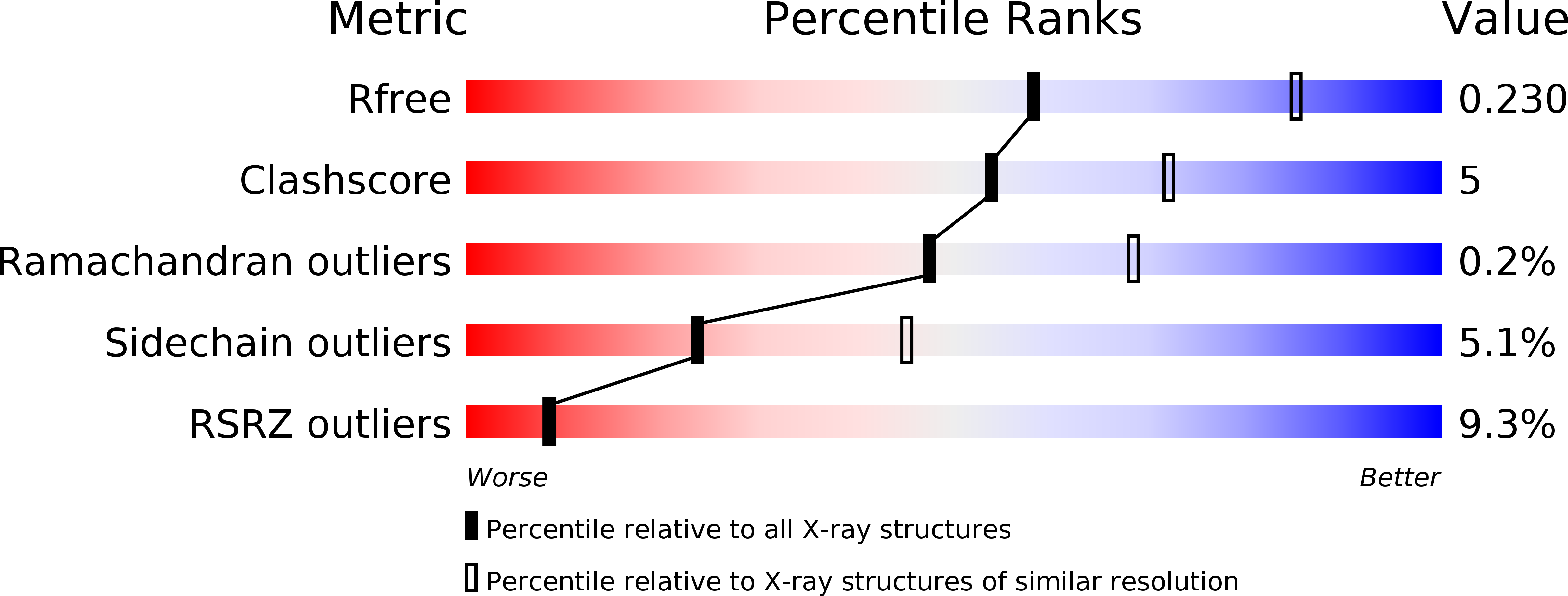
Experimental Method:
Resolution:
2.50 Å
R-Value Free:
0.23
R-Value Work:
0.15
R-Value Observed:
0.16
Space Group:
P 21 21 2
Macromolecular Entities
Structures with similar UniProt ID
Protein Blast
Polymer Type:polypeptide(L)
Molecule:Tryptophan 2,3-dioxygenase
Gene (Uniprot):TDO2
Chain IDs:A, B, C, D
Chain Length:380
Number of Molecules:4
Biological Source:Homo sapiens
Primary Citation
Molecular basis for catalysis and substrate-mediated cellular stabilization of human tryptophan 2,3-dioxygenase.
Sci Rep 6 35169 35169 (2016)
PMID: 27762317 DOI: 10.1038/srep35169

Abstact

Tryptophan 2,3-dioxygenase (TDO) and indoleamine 2,3-dioxygenase (IDO) play a central role in tryptophan metabolism and are involved in many cellular and disease processes. Here we report the crystal structure of human TDO (hTDO) in a ternary complex with the substrates L-Trp and O2 and in a binary complex with the product N-formylkynurenine (NFK), defining for the first time the binding modes of both substrates and the product of this enzyme. The structure indicates that the dioxygenation reaction is initiated by a direct attack of O2 on the C2 atom of the L-Trp indole ring. The structure also reveals an exo binding site for L-Trp, located ~42 Å from the active site and formed by residues conserved among tryptophan-auxotrophic TDOs. Biochemical and cellular studies indicate that Trp binding at this exo site does not affect enzyme catalysis but instead it retards the degradation of hTDO through the ubiquitin-dependent proteasomal pathway. This exo site may therefore provide a novel L-Trp-mediated regulation mechanism for cellular degradation of hTDO, which may have important implications in human diseases.

Legend

Protein

Chemical

Disease

Primary Citation of related structures
Feedback Form
Name
Email
Institute
Feedback