5SVY image
Deposition Date 2016-08-08
Release Date 2016-10-05
Last Version Date 2025-04-02
Entry Detail
PDB ID:
5SVY
Keywords:
Title:
MORC3 CW in complex with histone H3K4me1
Biological Source:
Source Organism:
Homo sapiens (Taxon ID: 9606)
Host Organism:
Method Details:
Experimental Method:
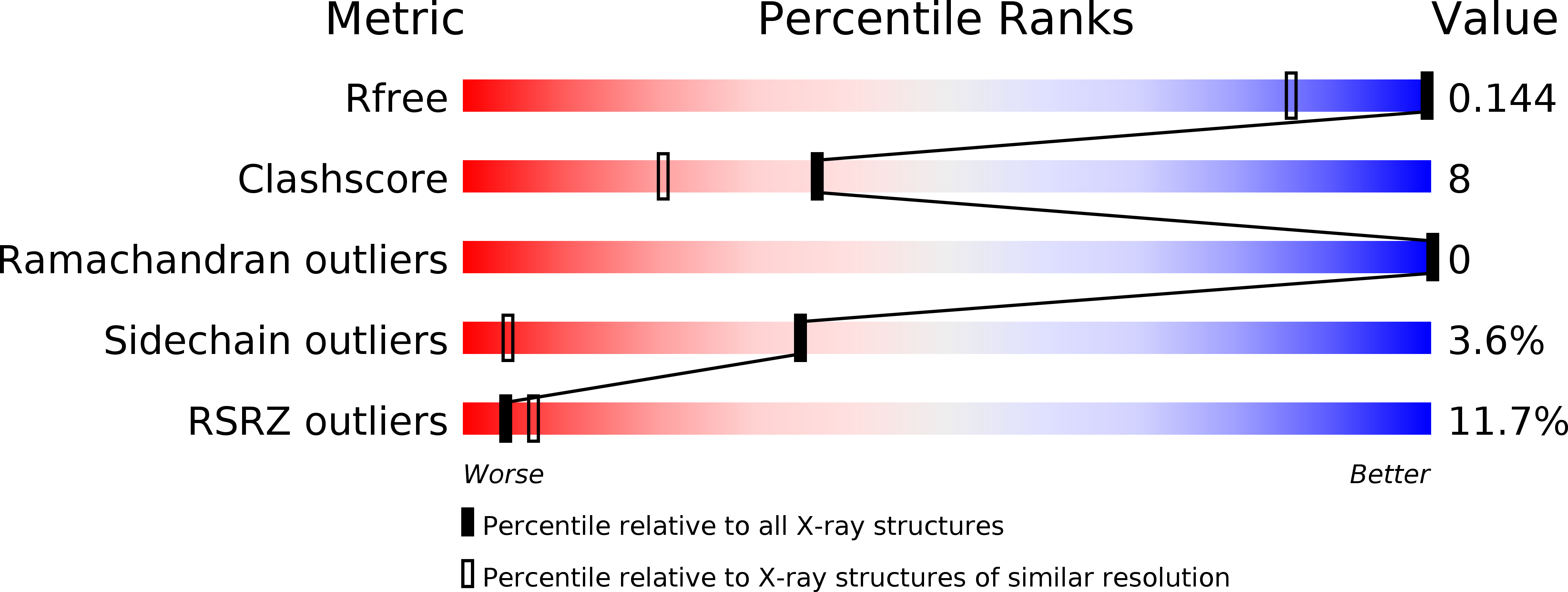
Resolution:
1.05 Å
R-Value Free:
0.14
R-Value Work:
0.12
R-Value Observed:
0.12
Space Group:
P 21 21 2
Macromolecular Entities
Structures with similar UniProt ID
Protein Blast
Polymer Type:polypeptide(L)
Molecule:MORC family CW-type zinc finger protein 3
Gene (Uniprot):MORC3
Chain IDs:A
Chain Length:50
Number of Molecules:1
Biological Source:Homo sapiens
Structures with similar UniProt ID
Protein Blast
Polymer Type:polypeptide(L)
Molecule:H3K4me1
Chain IDs:B
Chain Length:11
Number of Molecules:1
Biological Source:Homo sapiens
Primary Citation
Multivalent Chromatin Engagement and Inter-domain Crosstalk Regulate MORC3 ATPase.
Cell Rep 16 3195 3207 (2016)
PMID: 27653685 DOI: 10.1016/j.celrep.2016.08.050

Abstact

MORC3 is linked to inflammatory myopathies and cancer; however, the precise role of MORC3 in normal cell physiology and disease remains poorly understood. Here, we present detailed genetic, biochemical, and structural analyses of MORC3. We demonstrate that MORC3 is significantly upregulated in Down syndrome and that genetic abnormalities in MORC3 are associated with cancer. The CW domain of MORC3 binds to the methylated histone H3K4 tail, and this interaction is essential for recruitment of MORC3 to chromatin and accumulation in nuclear bodies. We show that MORC3 possesses intrinsic ATPase activity that requires DNA, but it is negatively regulated by the CW domain, which interacts with the ATPase domain. Natively linked CW impedes binding of the ATPase domain to DNA, resulting in a decrease in the DNA-stimulated enzymatic activity. Collectively, our studies provide a molecular framework detailing MORC3 functions and suggest that its modulation may contribute to human disease.

Legend

Protein

Chemical

Disease

Primary Citation of related structures
Feedback Form
Name
Email
Institute
Feedback