5OQP image
Deposition Date 2017-08-14
Release Date 2017-10-18
Last Version Date 2024-01-17
Entry Detail
PDB ID:
5OQP
Keywords:
Title:
Crystal structure of the S. cerevisiae condensin Ycg1-Brn1 subcomplex bound to DNA (crystal form I)
Biological Source:
Method Details:
Experimental Method:
Resolution:
2.98 Å
R-Value Free:
0.26
R-Value Work:
0.21
R-Value Observed:
0.22
Space Group:
P 21 21 21
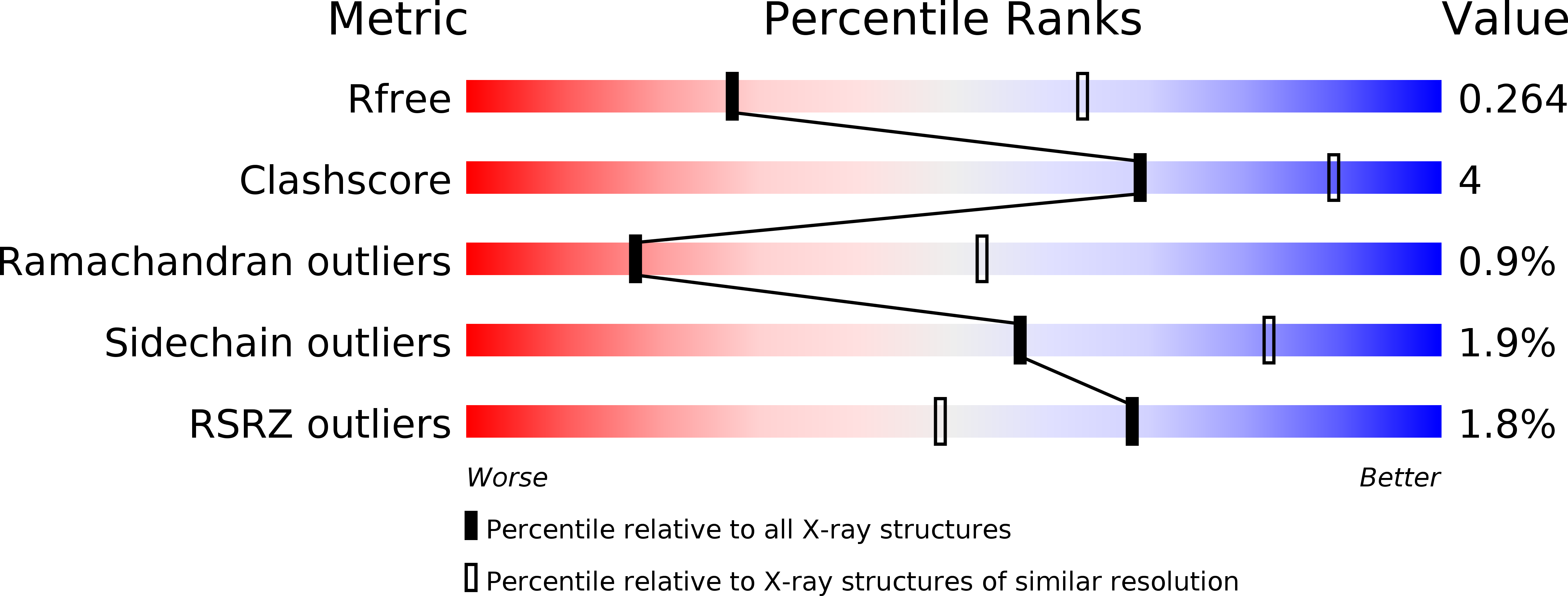
Macromolecular Entities
Structures with similar UniProt ID
Protein Blast
Polymer Type:polypeptide(L)
Molecule:Condensin complex subunit 3
Gene (Uniprot):YCG1
Chain IDs:A
Chain Length:869
Number of Molecules:1
Biological Source:Saccharomyces cerevisiae (strain ATCC 204508 / S288c)
Structures with similar UniProt ID
Protein Blast
Polymer Type:polypeptide(L)
Molecule:Condensin complex subunit 2
Gene (Uniprot):BRN1
Chain IDs:B
Chain Length:152
Number of Molecules:1
Biological Source:Saccharomyces cerevisiae (strain ATCC 204508 / S288c)
Polymer Type:polydeoxyribonucleotide
Molecule:DNA (5'-D(*GP*AP*TP*GP*TP*GP*TP*AP*GP*CP*TP*AP*CP*AP*CP*AP*TP*C)-3')
Chain IDs:C, D
Chain Length:18
Number of Molecules:2
Biological Source:synthetic construct
Primary Citation
Structural Basis for a Safety-Belt Mechanism That Anchors Condensin to Chromosomes.
Cell 171 588 600.e24 (2017)
PMID: 28988770 DOI: 10.1016/j.cell.2017.09.008

Abstact

Condensin protein complexes coordinate the formation of mitotic chromosomes and thereby ensure the successful segregation of replicated genomes. Insights into how condensin complexes bind to chromosomes and alter their topology are essential for understanding the molecular principles behind the large-scale chromatin rearrangements that take place during cell divisions. Here, we identify a direct DNA-binding site in the eukaryotic condensin complex, which is formed by its Ycg1Cnd3 HEAT-repeat and Brn1Cnd2 kleisin subunits. DNA co-crystal structures reveal a conserved, positively charged groove that accommodates the DNA double helix. A peptide loop of the kleisin subunit encircles the bound DNA and, like a safety belt, prevents its dissociation. Firm closure of the kleisin loop around DNA is essential for the association of condensin complexes with chromosomes and their DNA-stimulated ATPase activity. Our data suggest a sophisticated molecular basis for anchoring condensin complexes to chromosomes that enables the formation of large-sized chromatin loops.

Legend

Protein

Chemical

Disease

Primary Citation of related structures
Feedback Form
Name
Email
Institute
Feedback