5OQD image
Deposition Date 2017-08-11
Release Date 2017-11-01
Last Version Date 2024-05-08
Entry Detail
PDB ID:
5OQD
Keywords:
Title:
PHD2 and winged-helix domain of Polycomblike
Biological Source:
Source Organism:
Host Organism:
Method Details:
Experimental Method:
Resolution:
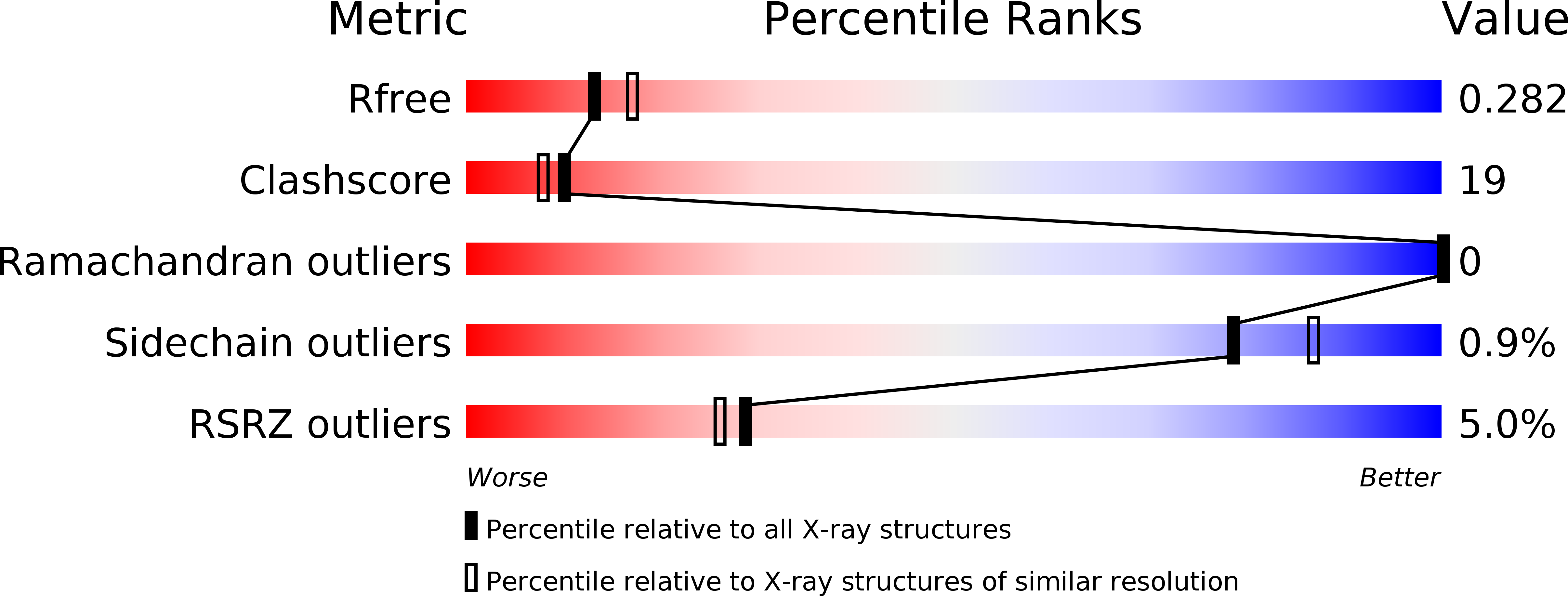
2.45 Å
R-Value Free:
0.27
R-Value Work:
0.23
R-Value Observed:
0.23
Space Group:
C 1 2 1
Macromolecular Entities
Structures with similar UniProt ID
Protein Blast
Polymer Type:polypeptide(L)
Molecule:Polycomb protein Pcl
Gene (Uniprot):Pcl
Chain IDs:A (auth: B), B (auth: A), C, D, E, F
Chain Length:209
Number of Molecules:6
Biological Source:Drosophila melanogaster
Primary Citation
DNA binding by PHF1 prolongs PRC2 residence time on chromatin and thereby promotes H3K27 methylation.
Nat. Struct. Mol. Biol. 24 1039 1047 (2017)
PMID: 29058710 DOI: 10.1038/nsmb.3488

Abstact

Polycomb repressive complex 2 (PRC2) trimethylates histone H3 at lysine 27 to mark genes for repression. We measured the dynamics of PRC2 binding on recombinant chromatin and free DNA at the single-molecule level using total internal reflection fluorescence (TIRF) microscopy. PRC2 preferentially binds free DNA with multisecond residence time and midnanomolar affinity. PHF1, a PRC2 accessory protein of the Polycomblike family, extends PRC2 residence time on DNA and chromatin. Crystallographic and functional studies reveal that Polycomblike proteins contain a winged-helix domain that binds DNA in a sequence-nonspecific fashion. DNA binding by this winged-helix domain accounts for the prolonged residence time of PHF1-PRC2 on chromatin and makes it a more efficient H3K27 methyltranferase than PRC2 alone. Together, these studies establish that interactions with DNA provide the predominant binding affinity of PRC2 for chromatin. Moreover, they reveal the molecular basis for how Polycomblike proteins stabilize PRC2 on chromatin and stimulate its activity.

Legend

Protein

Chemical

Disease

Primary Citation of related structures
Feedback Form
Name
Email
Institute
Feedback