5OQ2 image
Deposition Date 2017-08-10
Release Date 2017-11-01
Last Version Date 2024-11-20
Entry Detail
PDB ID:
5OQ2
Keywords:
Title:
Se-SAD structure of the functional region of Cwp19 from Clostridium difficile
Biological Source:
Source Organism(s):
Expression System(s):
Method Details:
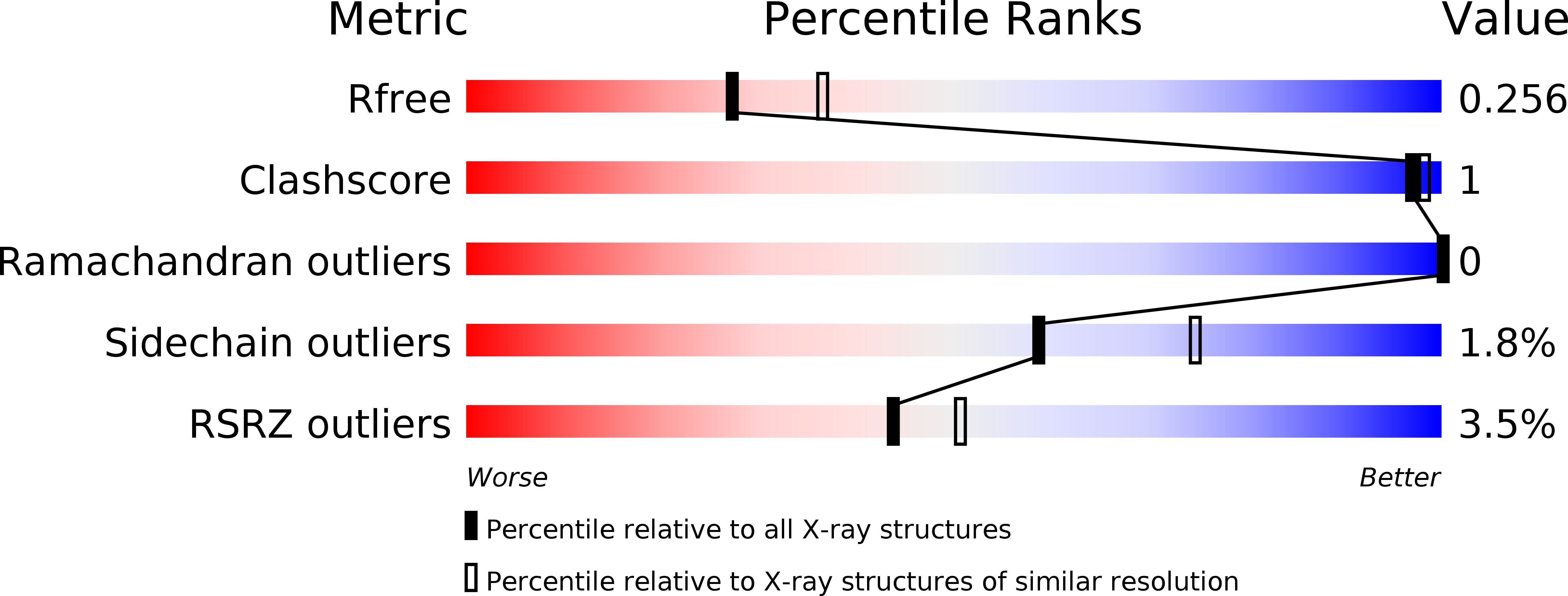
Experimental Method:
Resolution:
2.30 Å
R-Value Free:
0.25
R-Value Work:
0.19
R-Value Observed:
0.19
Space Group:
P 1 21 1
Macromolecular Entities
Structures with similar UniProt ID
Protein Blast
Polymer Type:polypeptide(L)
Molecule:Cwp19
Gene (Uniprot):cwp19
Chain IDs:A, B
Chain Length:396
Number of Molecules:2
Biological Source:Clostridioides difficile
Modified Residue
Compound ID Chain ID Parent Comp ID Details 2D Image
MSE A MET modified residue
Primary Citation
The molecular structure of the glycoside hydrolase domain of Cwp19 from Clostridium difficile.
FEBS J. 284 4343 4357 (2017)
PMID: 29083543 DOI: 10.1111/febs.14310

Abstact

UNLABELLED Clostridium difficile is a burden to healthcare systems around the world, causing tens of thousands of deaths annually. The S-layer of the bacterium, a layer of protein found of the surface of cells, has received a significant amount of attention over the past two decades as a potential target to combat the growing threat presented by C. difficile infections. The S-layer contains a wide range of proteins, each of which possesses three cell wall-binding domains, while many also possess a "functional" region. Here, we present the high resolution structure of the functional region of one such protein, Cwp19 along with preliminary functional characterisation of the predicted glycoside hydrolase. Cwp19 has a TIM barrel fold and appears to possess a high degree of substrate selectivity. The protein also exhibits peptidoglycan hydrolase activity, an order of magnitude slower than that of lysozyme and is the first member of glycoside hydrolase-like family 10 to be characterised. This research goes some way to understanding the role of Cwp19 in the S-layer of C. difficile. DATABASE Structural data are available in the PDB under the accession numbers 5OQ2 and 5OQ3.

Legend

Protein

Chemical

Disease

Primary Citation of related structures
Feedback Form
Name
Email
Institute
Feedback