5OLD image
Deposition Date 2017-07-27
Release Date 2018-08-29
Last Version Date 2024-11-20
Entry Detail
PDB ID:
5OLD
Keywords:
Title:
X-ray structure of the adduct formed upon reaction of ribonuclease A with a tetranuclear Pt-thiosemicarbazone compound
Biological Source:
Source Organism:
Bos taurus (Taxon ID: 9913)
Method Details:
Experimental Method:
Resolution:
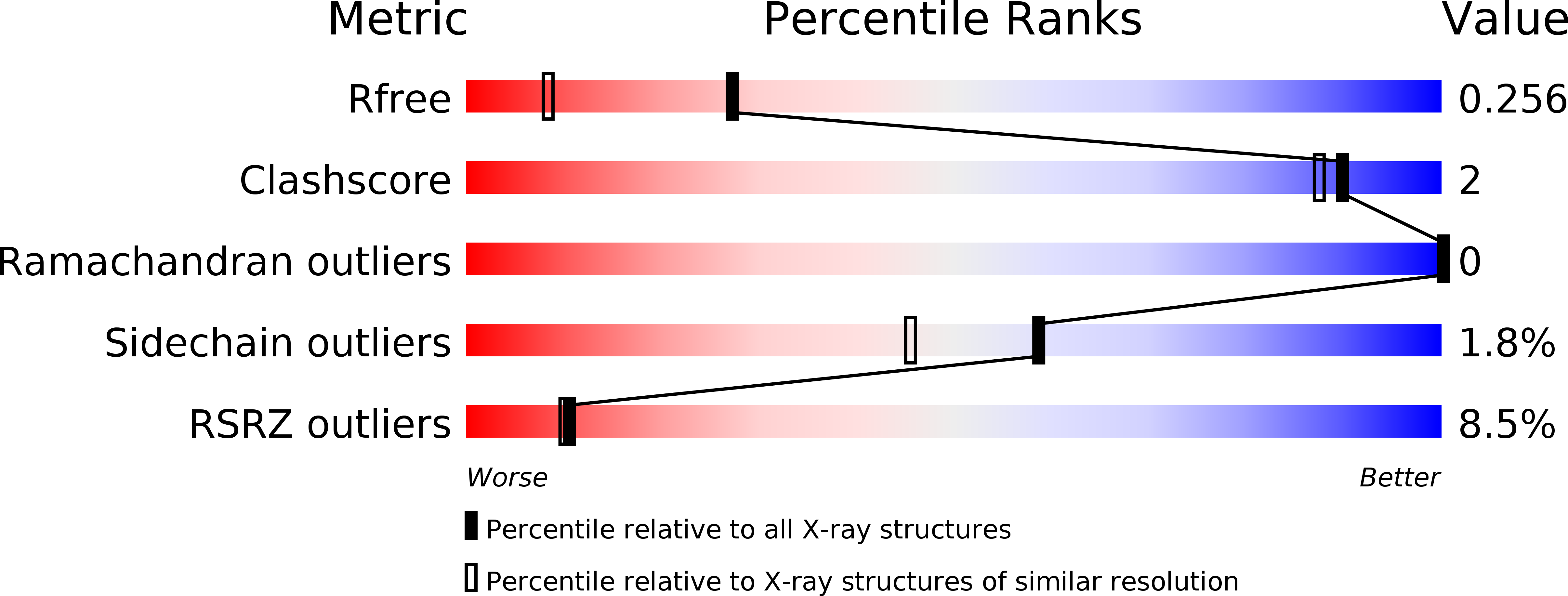
1.78 Å
R-Value Free:
0.25
R-Value Work:
0.19
R-Value Observed:
0.19
Space Group:
C 1 2 1
Macromolecular Entities
Structures with similar UniProt ID
Protein Blast
Polymer Type:polypeptide(L)
Molecule:Ribonuclease pancreatic
Gene (Uniprot):RNASE1
Chain IDs:A, B
Chain Length:124
Number of Molecules:2
Biological Source:Bos taurus
Primary Citation
Reactions of a tetranuclear Pt-thiosemicarbazone complex with model proteins.
J. Inorg. Biochem. 181 11 17 (2018)
PMID: 29353085 DOI: 10.1016/j.jinorgbio.2018.01.002

Abstact

The tetranuclear Pt complex (PtL)4 (where L2- is the anion derived from para-isopropyl thiosemicarbazone) was first described in A.G. Quiroga et al., J. Med. Chem. 41, 1998, 1399-1408. (PtL)4 manifests antiproliferative properties toward various cancer cell lines being a promising anticancer drug candidate. Yet, details of its reactivity with biomolecules have not been elucidated. To this end, we investigated the reactions of (PtL)4 with a few model proteins, i.e. bovine pancreatic ribonuclease (RNase A), cytochrome c (Cyt c) and hen egg white lysozyme (Lysozyme), through electrospray ionization mass spectrometry and other biophysical methods. A rich reactivity of (PtL)4 with the above-mentioned model proteins is observed, leading to the formation of numerous metallodrug-protein adducts. The tetranuclear complex breaks down and various fragments bind proteins up to high metal/protein ratios; this typically results into very complicated mass spectral patterns. However, some of the main mass peaks could be assigned in the case of the Lysozyme adduct. In addition, crystallographic data were obtained for the (PtL)4/Lysozyme and (PtL)4/RNase A adducts pointing at His side chains as the primary binding sites for monometallic Pt fragments. Notably, a few selected features of the interactions observed in the (PtL)4/protein adducts were reproduced by reacting (PtL)4 with a small molecule, i.e. N-methylimidazole. In conclusion, the present study confirms the prodrug nature of the tetraplatinum complex, clarifies one possible pathway for its activation through cluster disassembly and allows initial identification of adducts formed with a representative protein.

Legend

Protein

Chemical

Disease

Primary Citation of related structures
Feedback Form
Name
Email
Institute
Feedback