5O9T image
Deposition Date 2017-06-20
Release Date 2018-06-27
Last Version Date 2024-01-31
Entry Detail
PDB ID:
5O9T
Keywords:
Title:
HsNMT1 in complex with CoA and acetylated-NCFSKPK peptide
Biological Source:
Source Organism(s):
Expression System(s):
Method Details:
Experimental Method:
Resolution:
2.15 Å
R-Value Free:
0.21
R-Value Work:
0.16
R-Value Observed:
0.16
Space Group:
P 2 21 21
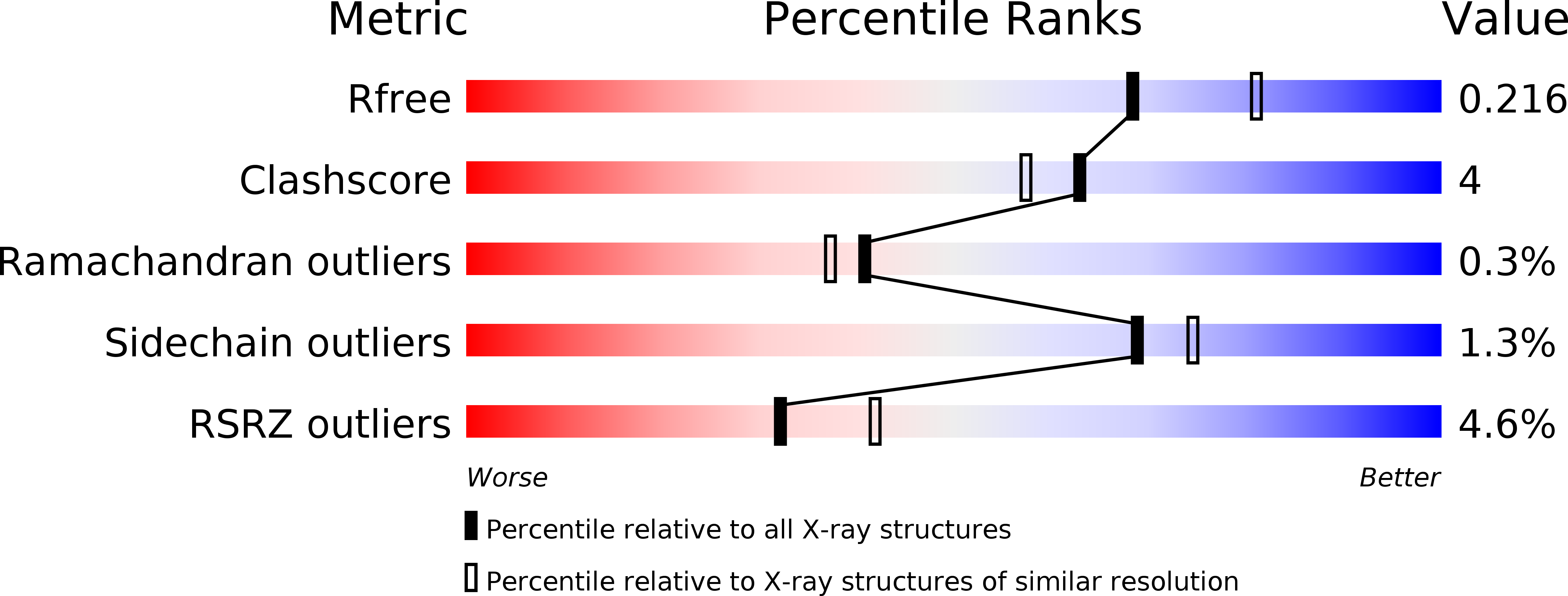
Macromolecular Entities
Structures with similar UniProt ID
Protein Blast
Polymer Type:polypeptide(L)
Molecule:Glycylpeptide N-tetradecanoyltransferase 1
Gene (Uniprot):NMT1
Chain IDs:A, B
Chain Length:402
Number of Molecules:2
Biological Source:Homo sapiens
Polymer Type:polypeptide(L)
Molecule:1IP-CYS-PHE-SER-LYS-PRO-ARG
Chain IDs:C, D
Chain Length:7
Number of Molecules:2
Biological Source:synthetic construct
Primary Citation
Structural and genomic decoding of human and plant myristoylomes reveals a definitive recognition pattern.
Nat. Chem. Biol. 14 671 679 (2018)
PMID: 29892081 DOI: 10.1038/s41589-018-0077-5

Abstact

An organism's entire protein modification repertoire has yet to be comprehensively mapped. N-myristoylation (MYR) is a crucial eukaryotic N-terminal protein modification. Here we mapped complete Homo sapiens and Arabidopsis thaliana myristoylomes. The crystal structures of human modifier NMT1 complexed with reactive and nonreactive target-mimicking peptide ligands revealed unexpected binding clefts and a modifier recognition pattern. This information allowed integrated mapping of myristoylomes using peptide macroarrays, dedicated prediction algorithms, and in vivo mass spectrometry. Global MYR profiling at the genomic scale identified over a thousand novel, heterogeneous targets in both organisms. Surprisingly, MYR involved a non-negligible set of overlapping targets with N-acetylation, and the sequence signature marks for a third proximal acylation-S-palmitoylation-were genomically imprinted, allowing recognition of sequences exhibiting both acylations. Together, the data extend the N-end rule concept for Gly-starting proteins to subcellular compartmentalization and reveal the main neighbors influencing protein modification profiles and consequent cell fate.

Legend

Protein

Chemical

Disease

Primary Citation of related structures
Feedback Form
Name
Email
Institute
Feedback