5O7X image
Deposition Date 2017-06-09
Release Date 2017-08-02
Last Version Date 2024-05-08
Entry Detail
PDB ID:
5O7X
Keywords:
Title:
CRYSTAL STRUCTURE OF S. CEREVISIAE CORE FACTOR AT 3.2A RESOLUTION
Biological Source:
Method Details:
Experimental Method:
Resolution:
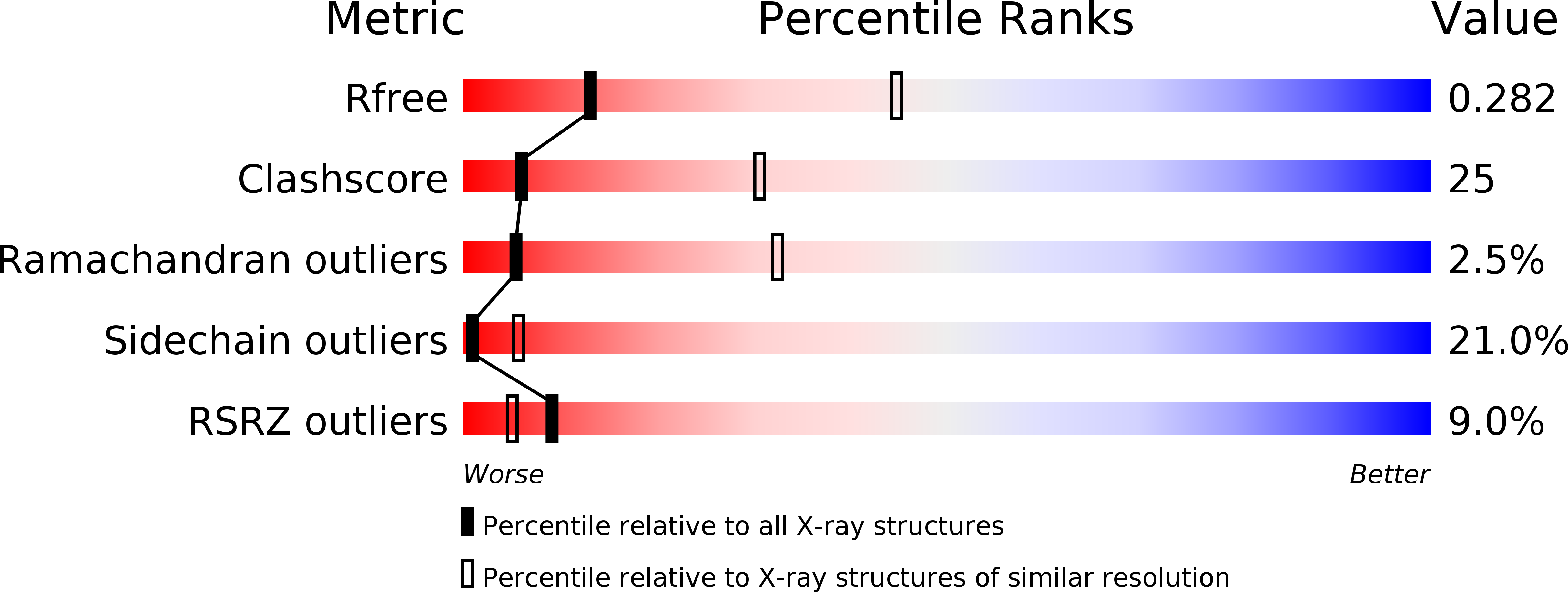
3.20 Å
R-Value Free:
0.28
R-Value Work:
0.25
R-Value Observed:
0.25
Space Group:
P 1
Macromolecular Entities
Structures with similar UniProt ID
Protein Blast
Polymer Type:polypeptide(L)
Molecule:RNA polymerase I-specific transcription initiation factor RRN6
Gene (Uniprot):RRN6
Chain IDs:A, D, G, J, M, P
Chain Length:894
Number of Molecules:6
Biological Source:Saccharomyces cerevisiae (strain ATCC 204508 / S288c)
Structures with similar UniProt ID
Protein Blast
Polymer Type:polypeptide(L)
Molecule:RNA polymerase I-specific transcription initiation factor RRN7
Gene (Uniprot):RRN7
Chain IDs:B, E, H, K, N, Q
Chain Length:514
Number of Molecules:6
Biological Source:Saccharomyces cerevisiae (strain ATCC 204508 / S288c)
Structures with similar UniProt ID
Protein Blast
Polymer Type:polypeptide(L)
Molecule:RNA polymerase I-specific transcription initiation factor RRN11
Gene (Uniprot):RRN11
Chain IDs:C, F, I, L, O, R
Chain Length:507
Number of Molecules:6
Biological Source:Saccharomyces cerevisiae (strain ATCC 204508 / S288c)
Primary Citation
Structural Basis of RNA Polymerase I Transcription Initiation.
Cell 169 120 131.e22 (2017)
PMID: 28340337 DOI: 10.1016/j.cell.2017.03.003

Abstact

Transcription initiation at the ribosomal RNA promoter requires RNA polymerase (Pol) I and the initiation factors Rrn3 and core factor (CF). Here, we combine X-ray crystallography and cryo-electron microscopy (cryo-EM) to obtain a molecular model for basal Pol I initiation. The three-subunit CF binds upstream promoter DNA, docks to the Pol I-Rrn3 complex, and loads DNA into the expanded active center cleft of the polymerase. DNA unwinding between the Pol I protrusion and clamp domains enables cleft contraction, resulting in an active Pol I conformation and RNA synthesis. Comparison with the Pol II system suggests that promoter specificity relies on a distinct "bendability" and "meltability" of the promoter sequence that enables contacts between initiation factors, DNA, and polymerase.

Legend

Protein

Chemical

Disease

Primary Citation of related structures
Feedback Form
Name
Email
Institute
Feedback