5NVG image
Deposition Date 2017-05-04
Release Date 2017-05-31
Last Version Date 2024-10-23
Entry Detail
PDB ID:
5NVG
Title:
Thr12 Phosphorylated Ubiquitin
Biological Source:
Source Organism:
Homo sapiens (Taxon ID: 9606)
Host Organism:
Method Details:
Experimental Method:
Resolution:
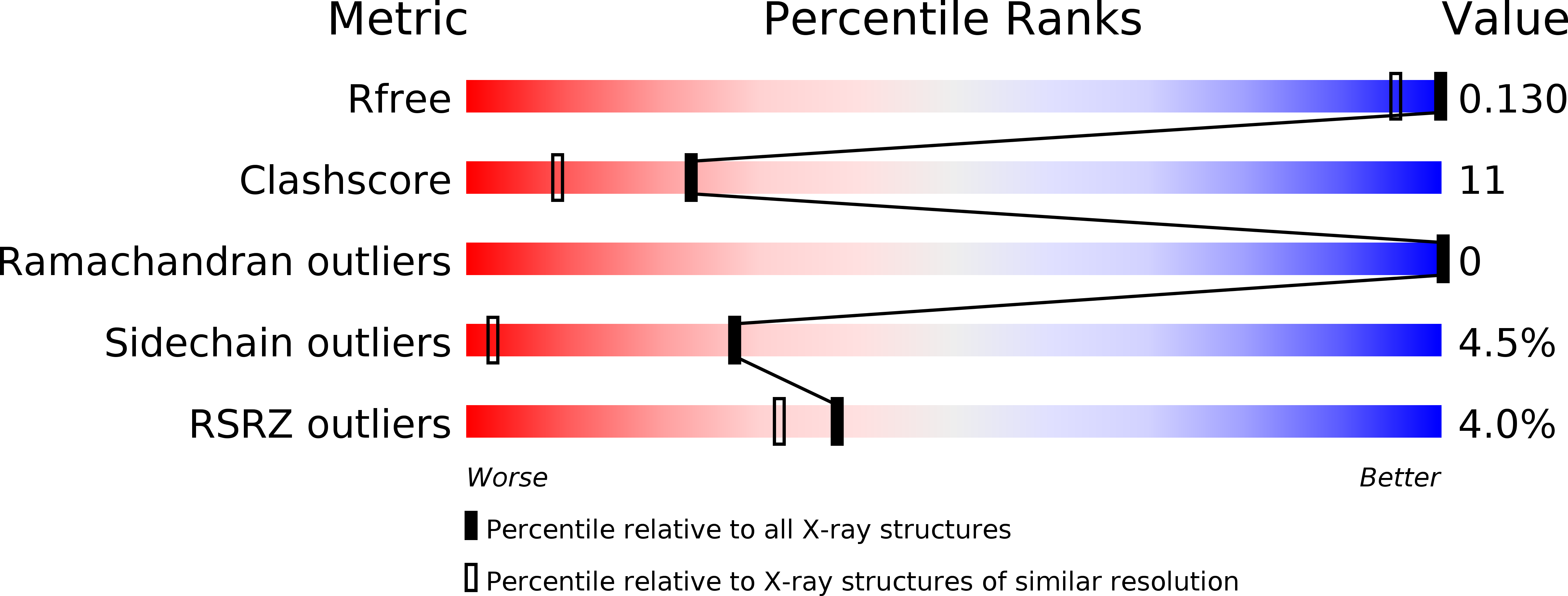
1.07 Å
R-Value Free:
0.16
R-Value Work:
0.12
R-Value Observed:
0.13
Space Group:
C 1 2 1
Macromolecular Entities
Structures with similar UniProt ID
Protein Blast
Polymer Type:polypeptide(L)
Molecule:Polyubiquitin-B
Gene (Uniprot):UBB
Chain IDs:A
Chain Length:76
Number of Molecules:1
Biological Source:Homo sapiens
Modified Residue
Compound ID Chain ID Parent Comp ID Details 2D Image
TPO A THR modified residue
Primary Citation
Biosynthesis and genetic encoding of phosphothreonine through parallel selection and deep sequencing.
Nat. Methods 14 729 736 (2017)
PMID: 28553966 DOI: 10.1038/nmeth.4302

Abstact

The phosphorylation of threonine residues in proteins regulates diverse processes in eukaryotic cells, and thousands of threonine phosphorylations have been identified. An understanding of how threonine phosphorylation regulates biological function will be accelerated by general methods to biosynthesize defined phosphoproteins. Here we describe a rapid approach for directly discovering aminoacyl-tRNA synthetase-tRNA pairs that selectively incorporate non-natural amino acids into proteins; our method uses parallel positive selections combined with deep sequencing and statistical analysis and enables the direct, scalable discovery of aminoacyl-tRNA synthetase-tRNA pairs with mutually orthogonal substrate specificity. By combining a method to biosynthesize phosphothreonine in cells with this selection approach, we discover a phosphothreonyl-tRNA synthetase-tRNACUA pair and create an entirely biosynthetic route to incorporating phosphothreonine in proteins. We biosynthesize several phosphoproteins and demonstrate phosphoprotein structure determination and synthetic protein kinase activation.

Legend

Protein

Chemical

Disease

Primary Citation of related structures
Feedback Form
Name
Email
Institute
Feedback