5NV6 image
Deposition Date 2017-05-03
Release Date 2017-08-09
Last Version Date 2024-11-13
Entry Detail
PDB ID:
5NV6
Title:
Structure of human transforming growth factor beta-induced protein (TGFBIp).
Biological Source:
Source Organism:
Homo sapiens (Taxon ID: 9606)
Host Organism:
Method Details:
Experimental Method:
Resolution:
2.93 Å
R-Value Free:
0.26
R-Value Work:
0.21
R-Value Observed:
0.22
Space Group:
P 61
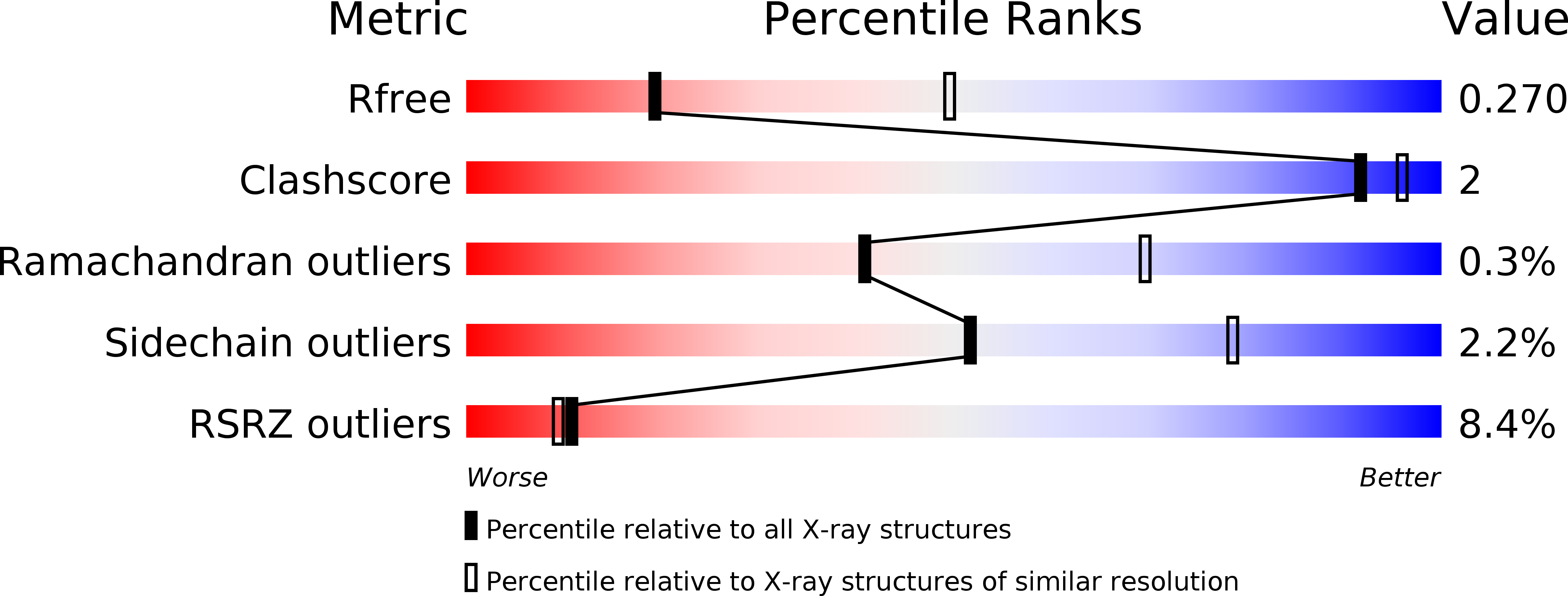
Macromolecular Entities
Structures with similar UniProt ID
Protein Blast
Polymer Type:polypeptide(L)
Molecule:Transforming growth factor-beta-induced protein ig-h3
Gene (Uniprot):TGFBI
Chain IDs:A, B
Chain Length:683
Number of Molecules:2
Biological Source:Homo sapiens
Ligand Molecules
Primary Citation
Structural and Functional Implications of Human Transforming Growth Factor beta-Induced Protein, TGFBIp, in Corneal Dystrophies.
Structure 25 1740 1750.e2 (2017)
PMID: 28988748 DOI: 10.1016/j.str.2017.09.001

Abstact

A major cause of visual impairment, corneal dystrophies result from accumulation of protein deposits in the cornea. One of the proteins involved is transforming growth factor β-induced protein (TGFBIp), an extracellular matrix component that interacts with integrins but also produces corneal deposits when mutated. Human TGFBIp is a multi-domain 683-residue protein, which contains one CROPT domain and four FAS1 domains. Its structure spans ∼120 Å and reveals that vicinal domains FAS1-1/FAS1-2 and FAS1-3/FAS1-4 tightly interact in an equivalent manner. The FAS1 domains are sandwiches of two orthogonal four-stranded β sheets decorated with two three-helix insertions. The N-terminal FAS1 dimer forms a compact moiety with the structurally novel CROPT domain, which is a five-stranded all-β cysteine-knot solely found in TGFBIp and periostin. The overall TGFBIp architecture discloses regions for integrin binding and that most dystrophic mutations cluster at both molecule ends, within domains FAS1-1 and FAS1-4.

Legend

Protein

Chemical

Disease

Primary Citation of related structures
Feedback Form
Name
Email
Institute
Feedback