5N6Y image
Deposition Date 2017-02-16
Release Date 2017-07-26
Last Version Date 2024-05-08
Entry Detail
PDB ID:
5N6Y
Keywords:
Title:
Azotobacter vinelandii vanadium nitrogenase
Biological Source:
Source Organism:
Method Details:
Experimental Method:
Resolution:
1.35 Å
R-Value Free:
0.14
R-Value Work:
0.10
R-Value Observed:
0.11
Space Group:
P 1
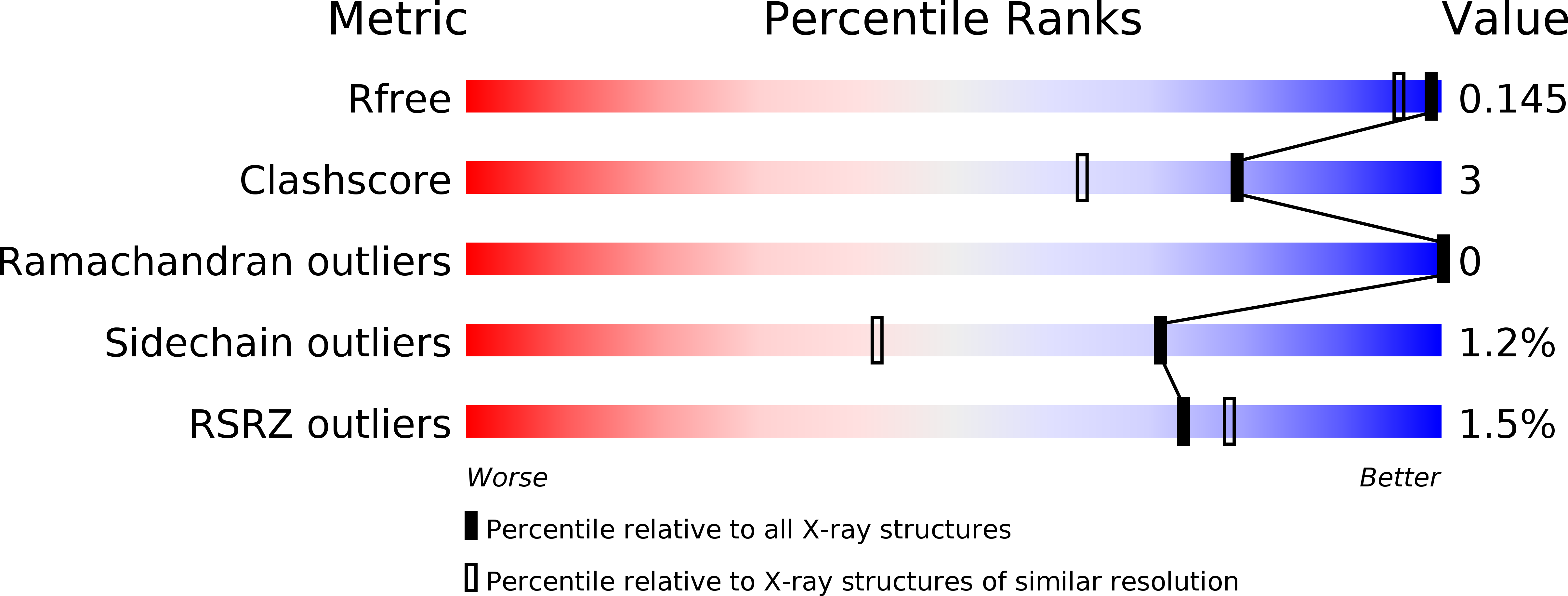
Macromolecular Entities
Structures with similar UniProt ID
Protein Blast
Polymer Type:polypeptide(L)
Molecule:Nitrogenase vanadium-iron protein alpha chain
Gene (Uniprot):vnfD
Chain IDs:A, D
Chain Length:474
Number of Molecules:2
Biological Source:Azotobacter vinelandii
Structures with similar UniProt ID
Protein Blast
Polymer Type:polypeptide(L)
Molecule:Nitrogenase vanadium-iron protein delta chain
Gene (Uniprot):vnfG
Chain IDs:C, F
Chain Length:113
Number of Molecules:2
Biological Source:Azotobacter vinelandii
Structures with similar UniProt ID
Protein Blast
Polymer Type:polypeptide(L)
Molecule:Nitrogenase vanadium-iron protein beta chain
Gene (Uniprot):vnfK
Chain IDs:B (auth: E), E (auth: B)
Chain Length:475
Number of Molecules:2
Biological Source:Azotobacter vinelandii
Primary Citation
The structure of vanadium nitrogenase reveals an unusual bridging ligand.
Nat. Chem. Biol. 13 956 960 (2017)
PMID: 28692069 DOI: 10.1038/nchembio.2428

Abstact

Nitrogenases catalyze the reduction of dinitrogen (N2) gas to ammonium at a complex heterometallic cofactor. This most commonly occurs at the FeMo cofactor (FeMoco), a [Mo-7Fe-9S-C] cluster whose exact reactivity and substrate-binding mode remain unknown. Alternative nitrogenases replace molybdenum with either vanadium or iron and differ in reactivity, most prominently in the ability of vanadium nitrogenase to reduce CO to hydrocarbons. Here we report the 1.35-Å structure of vanadium nitrogenase from Azotobacter vinelandii. The 240-kDa protein contains an additional α-helical subunit that is not present in molybdenum nitrogenase. The FeV cofactor (FeVco) is a [V-7Fe-8S-C] cluster with a homocitrate ligand to vanadium. Unexpectedly, it lacks one sulfide ion compared to FeMoco, which is replaced by a bridging ligand, likely a μ-1,3-carbonate. The anion fits into a pocket within the protein that is obstructed in molybdenum nitrogenase, and its different chemical character helps to rationalize the altered chemical properties of this unique N2- and CO-fixing enzyme.

Legend

Protein

Chemical

Disease

Primary Citation of related structures
Feedback Form
Name
Email
Institute
Feedback