5MZM image
Deposition Date 2017-02-01
Release Date 2018-03-21
Last Version Date 2024-11-06
Entry Detail
PDB ID:
5MZM
Keywords:
Title:
Structure of H-2Db in complex with TEIPP APL Trh4 p3P
Biological Source:
Source Organism:
Mus musculus (Taxon ID: 10090)
Host Organism:
Method Details:
Experimental Method:
Resolution:
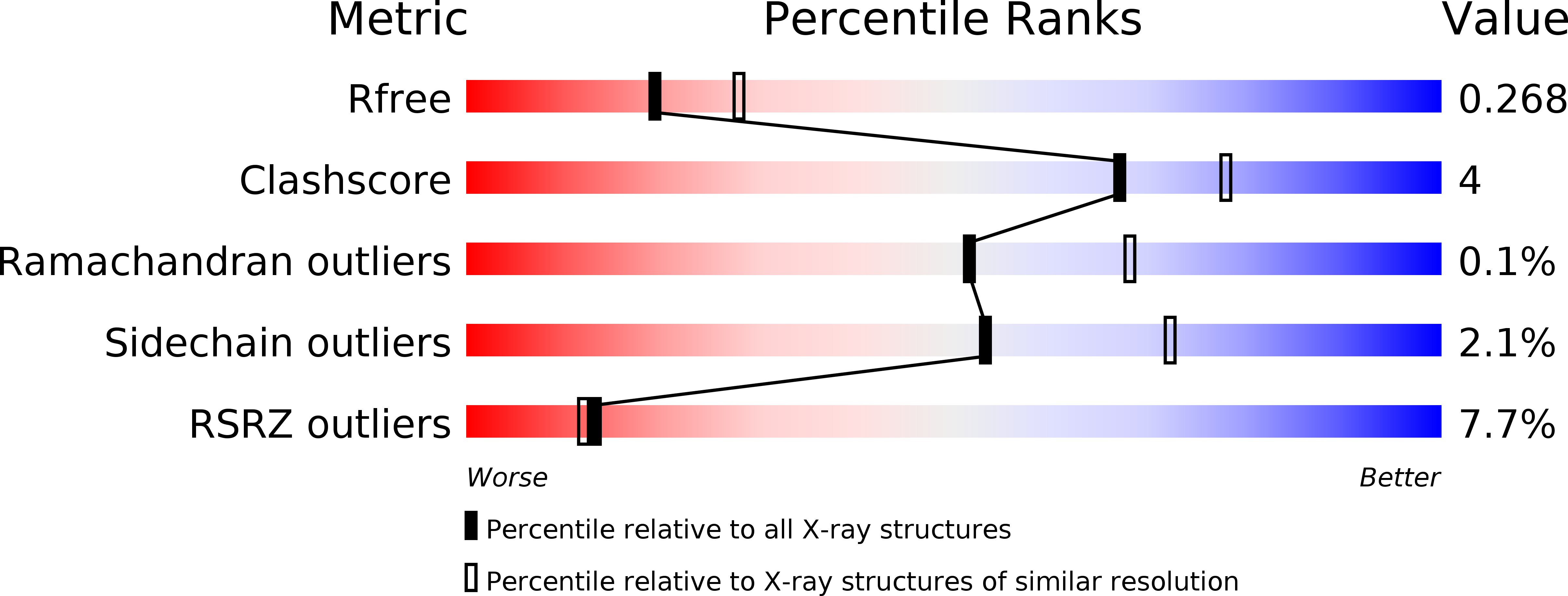
2.40 Å
R-Value Free:
0.26
R-Value Work:
0.22
R-Value Observed:
0.22
Space Group:
I 1 2 1
Macromolecular Entities
Structures with similar UniProt ID
Protein Blast
Polymer Type:polypeptide(L)
Molecule:H-2 class I histocompatibility antigen, D-B alpha chain
Gene (Uniprot):H2-D1
Chain IDs:A, D
Chain Length:276
Number of Molecules:2
Biological Source:Mus musculus
Structures with similar UniProt ID
Protein Blast
Polymer Type:polypeptide(L)
Molecule:Beta-2-microglobulin
Gene (Uniprot):B2m
Chain IDs:B, E
Chain Length:99
Number of Molecules:2
Biological Source:Mus musculus
Polymer Type:polypeptide(L)
Molecule:Ceramide synthase 5 derived peptide Trh4 p3P
Chain IDs:C, F
Chain Length:9
Number of Molecules:2
Biological Source:Mus musculus
Primary Citation
The Immunogenicity of a Proline-Substituted Altered Peptide Ligand toward the Cancer-Associated TEIPP Neoepitope Trh4 Is Unrelated to Complex Stability.
J. Immunol. 200 2860 2868 (2018)
PMID: 29507106 DOI: 10.4049/jimmunol.1700228

Abstact

Human cancers frequently display defects in Ag processing and presentation allowing for immune evasion, and they therefore constitute a significant challenge for T cell-based immunotherapy. We have previously demonstrated that the antigenicity of tumor-associated Ags can be significantly enhanced through unconventional residue modifications as a novel tool for MHC class I (MHC-I)-based immunotherapy approaches. We have also previously identified a novel category of cancer neo-epitopes, that is, T cell epitopes associated with impaired peptide processing (TEIPP), that are selectively presented by MHC-I on cells lacking the peptide transporter TAP. In this study, we demonstrate that substitution of the nonanchoring position 3 into a proline residue of the first identified TEIPP peptide, the murine Trh4, results in significantly enhanced recognition by antitumor CTLs toward the wild-type epitope. Although higher immunogenicity has in most cases been associated with increased MHC/peptide complex stability, our results demonstrate that the overall stability of H-2Db in complex with the highly immunogenic altered peptide ligand Trh4-p3P is significantly reduced compared with wild-type H-2Db/Trh4. Comparison of the crystal structures of the H-2Db/Trh4-p3P and H-2Db/Trh4 complexes revealed that the conformation of the nonconventional methionine anchor residue p5M is altered, deleting its capacity to form adequate sulfur-π interactions with H-2Db residues, thus reducing the overall longevity of the complex. Collectively, our results indicate that vaccination with Thr4-p3P significantly enhances T cell recognition of targets presenting the wild-type TEIPP epitope and that higher immunogenicity is not necessarily directly related to MHC/peptide complex stability, opening for the possibility to design novel peptide vaccines with reduced MHC/peptide complex stability.

Legend

Protein

Chemical

Disease

Primary Citation of related structures
Feedback Form
Name
Email
Institute
Feedback