5MVV image
Deposition Date 2017-01-17
Release Date 2017-07-12
Last Version Date 2024-05-08
Entry Detail
PDB ID:
5MVV
Title:
Crystal structure of Plasmodium falciparum actin I- gelsolin segment 1 -CdATP complex
Biological Source:
Source Organism:
Host Organism:
Method Details:
Experimental Method:
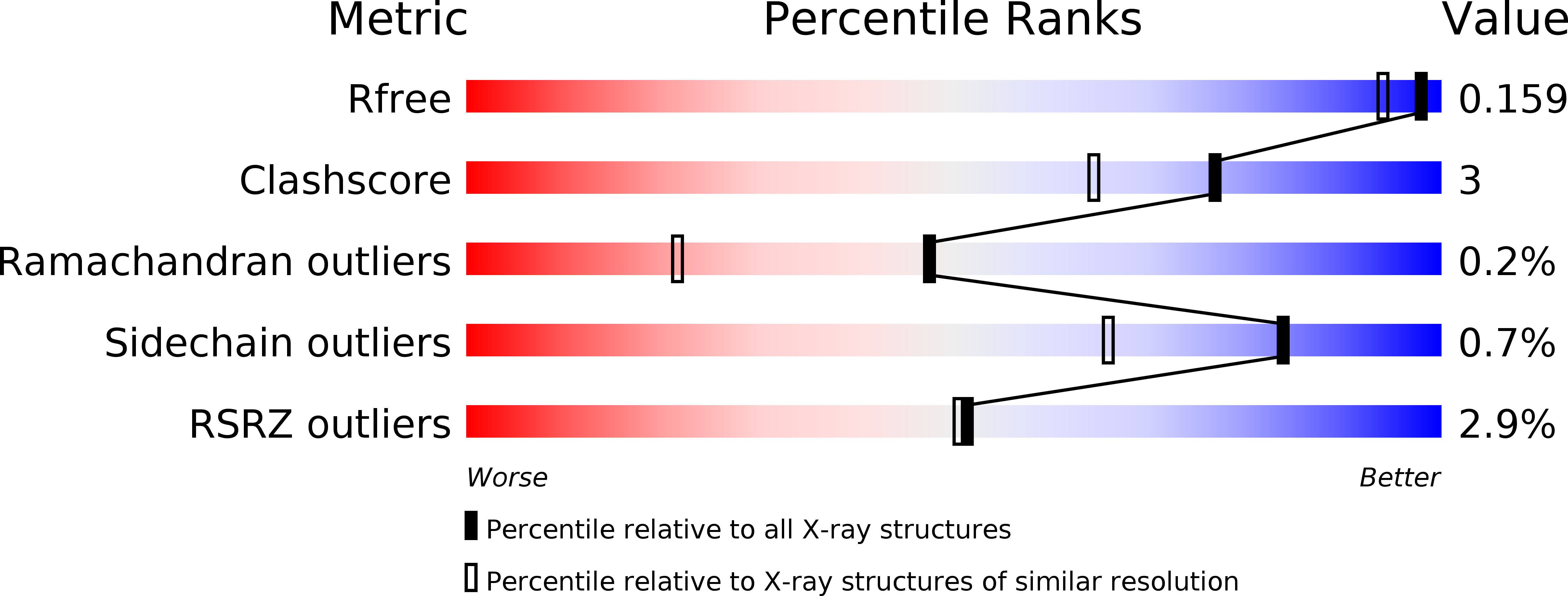
Resolution:
1.40 Å
R-Value Free:
0.15
R-Value Work:
0.12
R-Value Observed:
0.12
Space Group:
P 21 21 2
Macromolecular Entities
Structures with similar UniProt ID
Protein Blast
Polymer Type:polypeptide(L)
Molecule:Actin-1
Gene (Uniprot):ACT1
Chain IDs:A
Chain Length:378
Number of Molecules:1
Biological Source:Plasmodium falciparum (isolate 3D7)
Structures with similar UniProt ID
Protein Blast
Polymer Type:polypeptide(L)
Molecule:Gelsolin
Gene (Uniprot):Gsn
Chain IDs:B (auth: G)
Chain Length:127
Number of Molecules:1
Biological Source:Mus musculus
Primary Citation
Rapid cadmium SAD phasing at the standard wavelength (1 angstrom ).
Acta Crystallogr D Struct Biol 73 581 590 (2017)
PMID: 28695858 DOI: 10.1107/S2059798317006970

Abstact

Cadmium ions can be effectively used to promote crystal growth and for experimental phasing. Here, the use of cadmium ions as a suitable anomalous scatterer at the standard wavelength of 1 Å is demonstrated. The structures of three different proteins were determined using cadmium single-wavelength anomalous dispersion (SAD) phasing. Owing to the strong anomalous signal, the structure of lysozyme could be automatically phased and built using a very low anomalous multiplicity (1.1) and low-completeness (77%) data set. Additionally, it is shown that cadmium ions can easily substitute divalent ions in ATP-divalent cation complexes. This property could be generally applied for phasing experiments of a wide range of nucleotide-binding proteins. Improvements in crystal growth and quality, good anomalous signal at standard wavelengths (i.e. no need to change photon energy) and rapid phasing and refinement using a single data set are benefits that should allow cadmium ions to be widely used for experimental phasing.

Legend

Protein

Chemical

Disease

Primary Citation of related structures
Feedback Form
Name
Email
Institute
Feedback