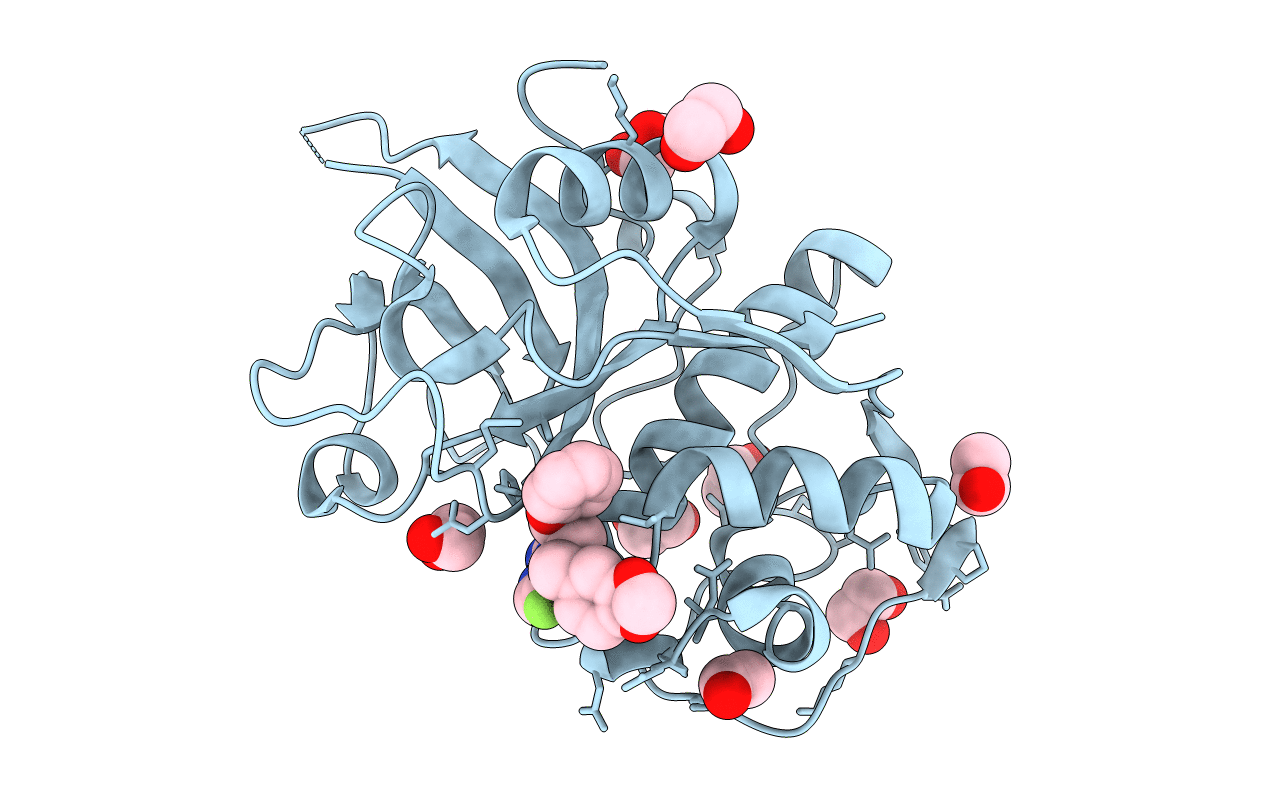
5MQY image
Deposition Date 2016-12-21
Release Date 2017-03-22
Last Version Date 2024-10-16
Entry Detail
PDB ID:
5MQY
Keywords:
Title:
CATHEPSIN L IN COMPLEX WITH 4-[1,3-benzodioxol-5-ylmethyl(2-phenoxyethyl)amino]-5-fluoropyrimidine-2-carbonitrile
Biological Source:
Source Organism:
Homo sapiens (Taxon ID: 9606)
Host Organism:
Method Details:
Experimental Method:
Resolution:
1.13 Å
R-Value Free:
0.19
R-Value Work:
0.14
R-Value Observed:
0.15
Space Group:
P 21 21 21

Macromolecular Entities
Structures with similar UniProt ID
Protein Blast
Polymer Type:polypeptide(L)
Molecule:Cathepsin L1
Gene (Uniprot):CTSL
Chain IDs:A
Chain Length:220
Number of Molecules:1
Biological Source:Homo sapiens
Primary Citation
Prospective Evaluation of Free Energy Calculations for the Prioritization of Cathepsin L Inhibitors.
J. Med. Chem. 60 2485 2497 (2017)
PMID: 28287264 DOI: 10.1021/acs.jmedchem.6b01881

Abstact

Improving the binding affinity of a chemical series by systematically probing one of its exit vectors is a medicinal chemistry activity that can benefit from molecular modeling input. Herein, we compare the effectiveness of four approaches in prioritizing building blocks with better potency: selection by a medicinal chemist, manual modeling, docking followed by manual filtering, and free energy calculations (FEP). Our study focused on identifying novel substituents for the apolar S2 pocket of cathepsin L and was conducted entirely in a prospective manner with synthesis and activity determination of 36 novel compounds. We found that FEP selected compounds with improved affinity for 8 out of 10 picks compared to 1 out of 10 for the other approaches. From this result and other additional analyses, we conclude that FEP can be a useful approach to guide this type of medicinal chemistry optimization once it has been validated for the system under consideration.

Legend

Protein

Chemical

Disease

Primary Citation of related structures
Feedback Form
Name
Email
Institute
Feedback