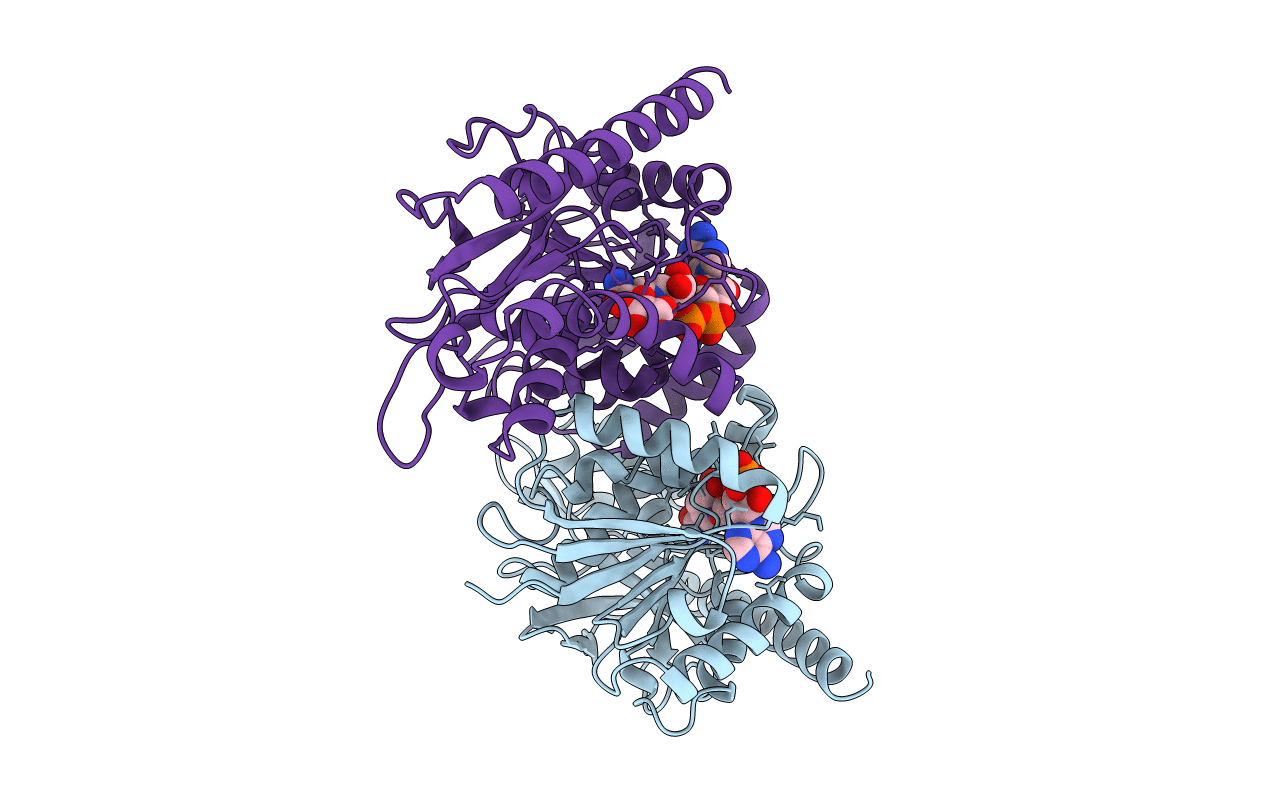
5MDH image
Deposition Date 1998-10-08
Release Date 1999-05-18
Last Version Date 2024-12-25
Entry Detail
PDB ID:
5MDH
Keywords:
Title:
CRYSTAL STRUCTURE OF TERNARY COMPLEX OF PORCINE CYTOPLASMIC MALATE DEHYDROGENASE ALPHA-KETOMALONATE AND TNAD AT 2.4 ANGSTROMS RESOLUTION
Biological Source:
Source Organism:
Sus scrofa (Taxon ID: 9823)
Host Organism:
Method Details:
Experimental Method:
Resolution:
2.40 Å
R-Value Free:
0.25
R-Value Work:
0.19
Space Group:
P 21 21 2

Macromolecular Entities
Structures with similar UniProt ID
Protein Blast
Polymer Type:polypeptide(L)
Molecule:MALATE DEHYDROGENASE
Gene (Uniprot):MDH1
Chain IDs:A, B
Chain Length:333
Number of Molecules:2
Biological Source:Sus scrofa
Primary Citation

Abstact

The structural basis for the extreme discrimination achieved by malate dehydrogenases between a variety of closely related substrates encountered within the cell has been difficult to assess because of the lack of an appropriate catalytically competent structure of the enzyme. Here, we have determined the crystal structure of a ternary complex of porcine cytoplasmic malate dehydrogenase with the alternative substrate alpha-ketomalonate and the coenzyme analogue 1,4,5,6-tetrahydronicotinamide. Both subunits of the dimeric porcine heart, and from the prokaryotes Escherichia coli and Thermus flavus. However, large changes are noted around the active site, where a mobile loop now closes to bring key residues into contact with the substrate. This observation substantiates a postulated mechanism in which the enzyme achieves high levels of substrate discrimination through charge balancing in the active site. As the activated cofactor/substrate complex has a net negative charge, a positive counter-charge is provided by a conserved arginine in the active site loop. The enzyme must, however, also discriminate against smaller substrates, such as pyruvate. The structure shows in the closed (loop down) catalytically competent complex two arginine residues (91 and 97) are driven into close proximity. Without the complimentary, negative charge of the substrate side-chain of oxaloacetate or alpha-ketomalonate, charge repulsion would resist formation production of this catalytically productive conformation, hence minimising the effectiveness of pyruvate as a substrate. By this mechanism, malate dehydrogenase uses charge balancing to achieve fivefold orders of magnitude in discrimination between potential substrates.

Legend

Protein

Chemical

Disease

Primary Citation of related structures
Feedback Form
Name
Email
Institute
Feedback