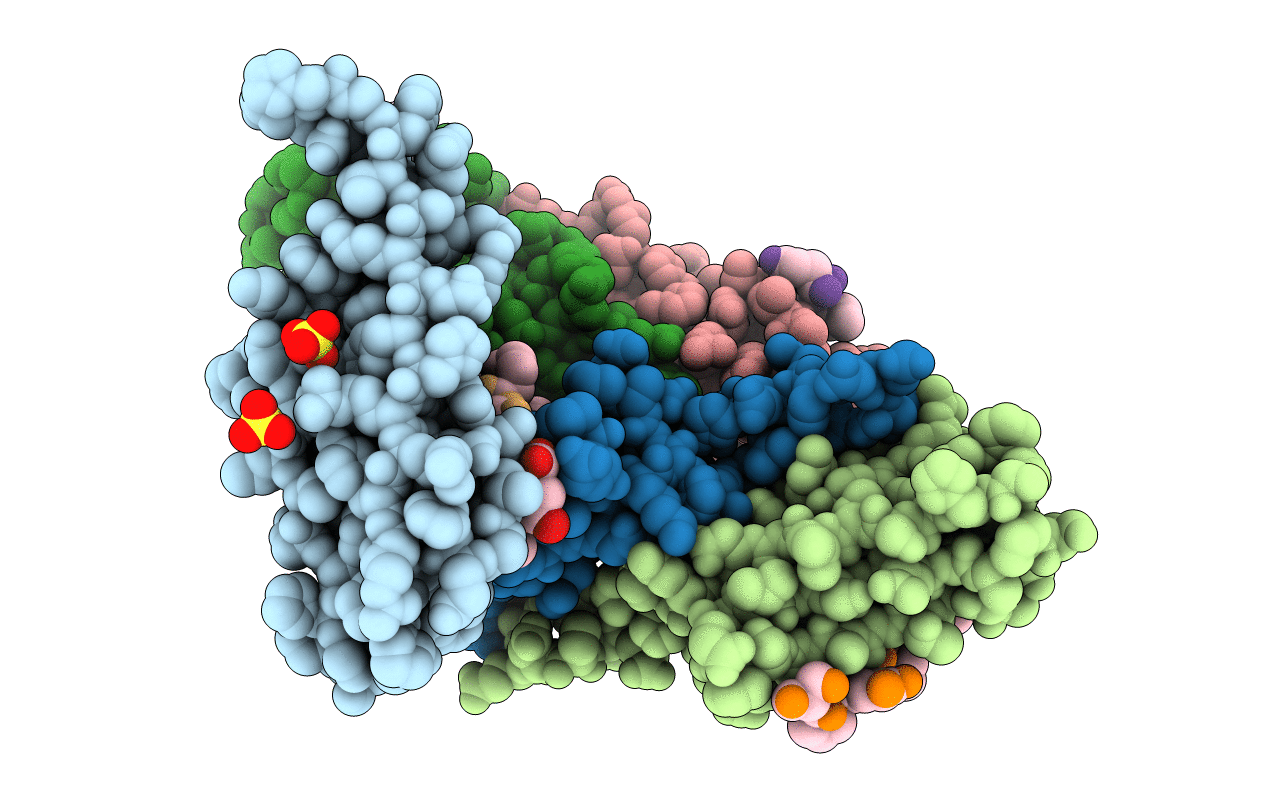
5LUM image
Deposition Date 2016-09-09
Release Date 2017-02-01
Last Version Date 2024-01-17
Entry Detail
PDB ID:
5LUM
Keywords:
Title:
Alpha-crystallin domain of human HSPB6 patched with its N-terminal peptide
Biological Source:
Source Organism:
Homo sapiens (Taxon ID: 9606)
Host Organism:
Method Details:
Experimental Method:
Resolution:
2.60 Å
R-Value Free:
0.22
R-Value Work:
0.20
R-Value Observed:
0.20
Space Group:
P 31 2 1

Macromolecular Entities
Structures with similar UniProt ID
Protein Blast
Polymer Type:polypeptide(L)
Molecule:Heat shock protein beta-6
Gene (Uniprot):HSPB6
Chain IDs:B (auth: A), D (auth: B), F (auth: C), H (auth: D), J (auth: E)
Chain Length:78
Number of Molecules:5
Biological Source:Homo sapiens
Structures with similar UniProt ID
Protein Blast
Polymer Type:polypeptide(L)
Molecule:Heat shock protein beta-6
Gene (Uniprot):HSPB6
Chain IDs:A (auth: F), C (auth: G), E (auth: H), G (auth: I), I (auth: J)
Chain Length:9
Number of Molecules:5
Biological Source:Homo sapiens
Ligand Molecules
Primary Citation
Structural Basis for the Interaction of a Human Small Heat Shock Protein with the 14-3-3 Universal Signaling Regulator.
Structure 25 305 316 (2017)
PMID: 28089448 DOI: 10.1016/j.str.2016.12.005

Abstact

By interacting with hundreds of protein partners, 14-3-3 proteins coordinate vital cellular processes. Phosphorylation of the small heat shock protein, HSPB6, within its intrinsically disordered N-terminal domain activates its interaction with 14-3-3, ultimately triggering smooth muscle relaxation. After analyzing the binding of an HSPB6-derived phosphopeptide to 14-3-3 using isothermal calorimetry and X-ray crystallography, we have determined the crystal structure of the complete assembly consisting of the 14-3-3 dimer and full-length HSPB6 dimer and further characterized this complex in solution using fluorescence spectroscopy, small-angle X-ray scattering, and limited proteolysis. We show that selected intrinsically disordered regions of HSPB6 are transformed into well-defined conformations upon the interaction, whereby an unexpectedly asymmetric structure is formed. This structure provides the first atomic resolution snapshot of a human small HSP in functional state, explains how 14-3-3 proteins sequester their regulatory partners, and can inform the design of small-molecule interaction modifiers to be used as myorelaxants.

Legend

Protein

Chemical

Disease

Primary Citation of related structures
Feedback Form
Name
Email
Institute
Feedback