5LOY image
Deposition Date 2016-08-10
Release Date 2017-06-07
Last Version Date 2024-01-10
Entry Detail
PDB ID:
5LOY
Keywords:
Title:
Helical Assembly of a Designed Anbu Protein
Biological Source:
Source Organism:
Host Organism:
Method Details:
Experimental Method:
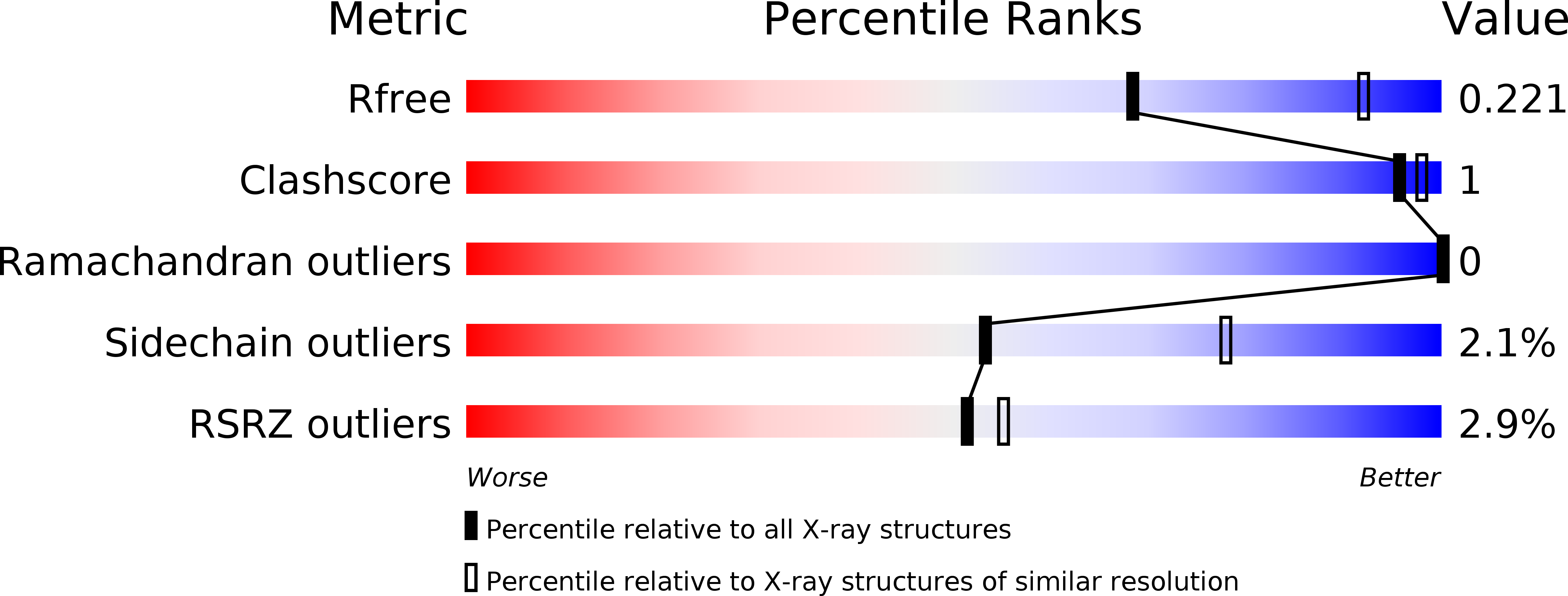
Resolution:
2.50 Å
R-Value Free:
0.22
R-Value Work:
0.18
R-Value Observed:
0.18
Space Group:
P 43 21 2
Macromolecular Entities
Polymer Type:polypeptide(L)
Molecule:Designed Anbu Protein
Chain IDs:A, B, C, D
Chain Length:240
Number of Molecules:4
Biological Source:synthetic construct
Primary Citation
The Architecture of the Anbu Complex Reflects an Evolutionary Intermediate at the Origin of the Proteasome System.
Structure 25 834 845.e5 (2017)
PMID: 28479063 DOI: 10.1016/j.str.2017.04.005

Abstact

Proteasomes are self-compartmentalizing proteases that function at the core of the cellular protein degradation machinery in eukaryotes, archaea, and some bacteria. Although their evolutionary history is under debate, it is thought to be linked to that of the bacterial protease HslV and the hypothetical bacterial protease Anbu (ancestral beta subunit). Here, together with an extensive bioinformatic analysis, we present the first biophysical characterization of Anbu. Anbu forms a dodecameric complex with a unique architecture that was only accessible through the combination of X-ray crystallography and small-angle X-ray scattering. While forming continuous helices in crystals and electron microscopy preparations, refinement of sections from the crystal structure against the scattering data revealed a helical open-ring structure in solution, contrasting the ring-shaped structures of proteasome and HslV. Based on this primordial architecture and exhaustive sequence comparisons, we propose that Anbu represents an ancestral precursor at the origin of self-compartmentalization.

Legend

Protein

Chemical

Disease

Primary Citation of related structures
Feedback Form
Name
Email
Institute
Feedback