5LHB image
Deposition Date 2016-07-10
Release Date 2016-10-12
Last Version Date 2025-08-06
Entry Detail
PDB ID:
5LHB
Keywords:
Title:
POLYADPRIBOSYL GLYCOSIDASE IN COMPLEX WITH PDD00017262
Biological Source:
Source Organism(s):
Homo sapiens (Taxon ID: 9606)
Expression System(s):
Method Details:
Experimental Method:
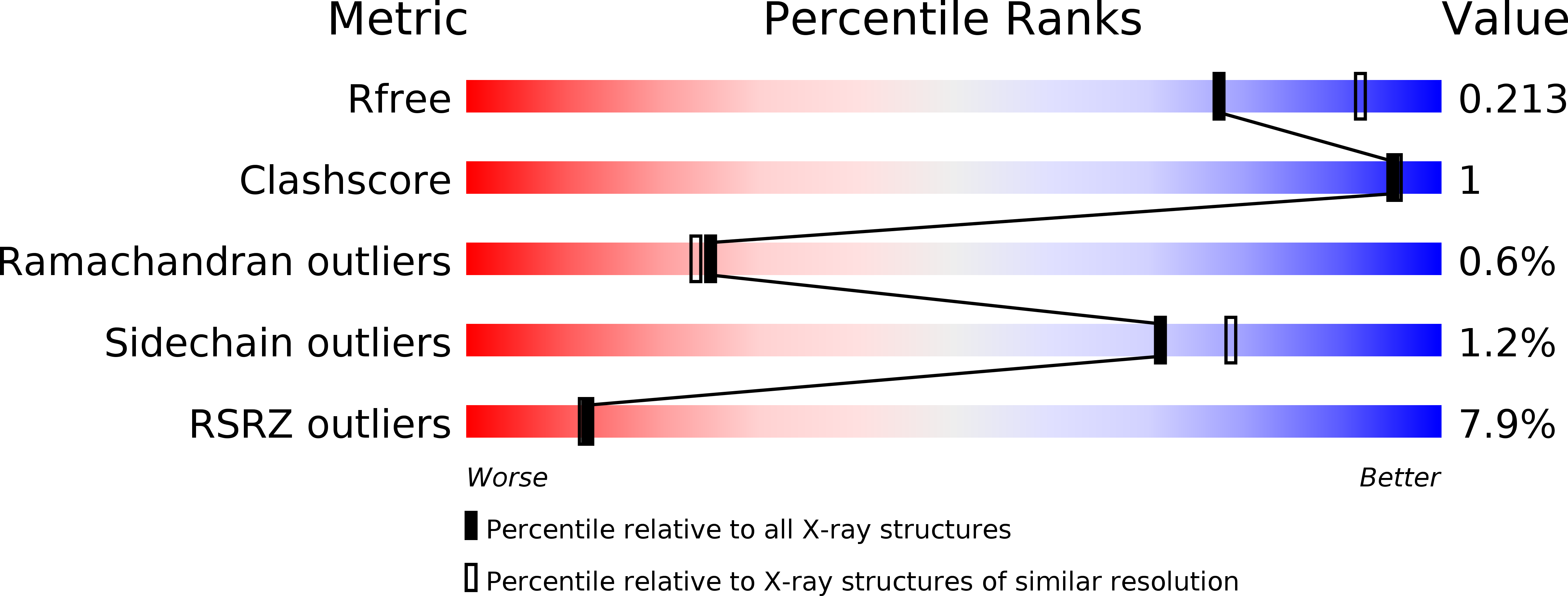
Resolution:
2.23 Å
R-Value Free:
0.21
R-Value Work:
0.16
R-Value Observed:
0.16
Space Group:
P 21 21 21
Macromolecular Entities
Structures with similar UniProt ID
Protein Blast
Polymer Type:polypeptide(L)
Molecule:Poly(ADP-ribose) glycohydrolase
Gene (Uniprot):PARG
Mutagens:K616A, Q617A, K618A, E688A, K689A, K690A
Chain IDs:A
Chain Length:531
Number of Molecules:1
Biological Source:Homo sapiens
Primary Citation
First-in-Class Chemical Probes against Poly(ADP-ribose) Glycohydrolase (PARG) Inhibit DNA Repair with Differential Pharmacology to Olaparib.
ACS Chem. Biol. 11 3179 3190 (2016)
PMID: 27689388 DOI: 10.1021/acschembio.6b00609

Abstact

The enzyme poly(ADP-ribose) glycohydrolase (PARG) performs a critical role in the repair of DNA single strand breaks (SSBs). However, a detailed understanding of its mechanism of action has been hampered by a lack of credible, cell-active chemical probes. Herein, we demonstrate inhibition of PARG with a small molecule, leading to poly(ADP-ribose) (PAR) chain persistence in intact cells. Moreover, we describe two advanced, and chemically distinct, cell-active tool compounds with convincing on-target pharmacology and selectivity. Using one of these tool compounds, we demonstrate pharmacology consistent with PARG inhibition. Further, while the roles of PARG and poly(ADP-ribose) polymerase (PARP) are closely intertwined, we demonstrate that the pharmacology of a PARG inhibitor differs from that observed with the more thoroughly studied PARP inhibitor olaparib. We believe that these tools will facilitate a wider understanding of this important component of DNA repair and may enable the development of novel therapeutic agents exploiting the critical dependence of tumors on the DNA damage response (DDR).

Legend

Protein

Chemical

Disease

Primary Citation of related structures
Feedback Form
Name
Email
Institute
Feedback