5LD2 image
Deposition Date 2016-06-23
Release Date 2016-10-05
Last Version Date 2024-05-15
Entry Detail
PDB ID:
5LD2
Keywords:
Title:
Cryo-EM structure of RecBCD+DNA complex revealing activated nuclease domain
Biological Source:
Source Organism:
Host Organism:
Method Details:
Experimental Method:
Resolution:
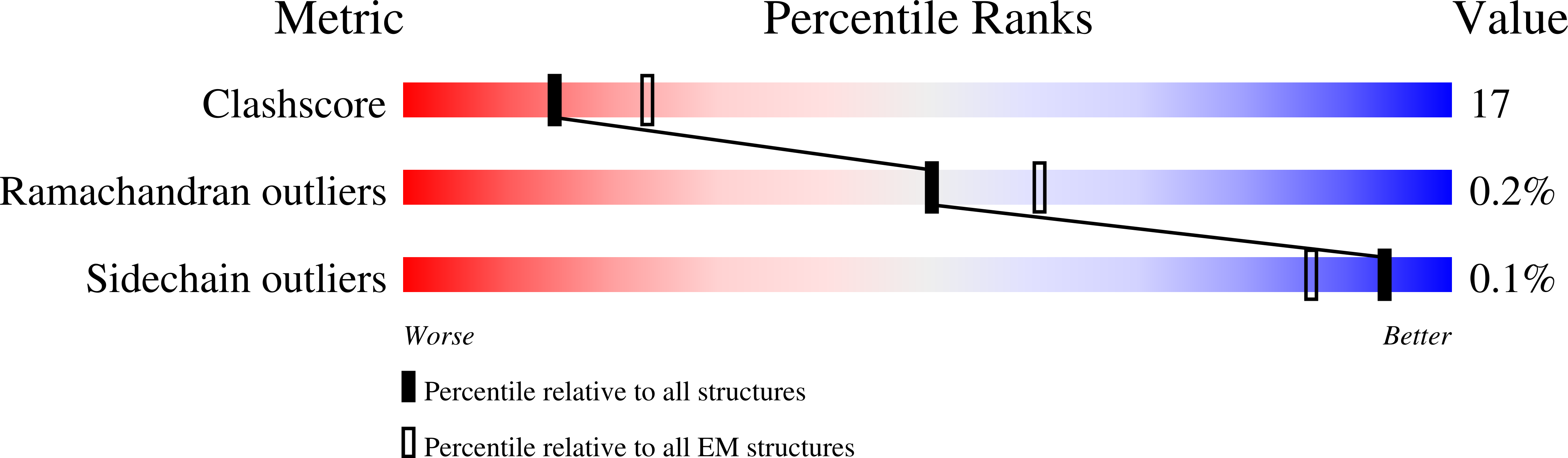
3.83 Å
Aggregation State:
PARTICLE
Reconstruction Method:
SINGLE PARTICLE
Macromolecular Entities
Structures with similar UniProt ID
Protein Blast
Polymer Type:polypeptide(L)
Molecule:RecBCD enzyme subunit RecB,RecBCD enzyme subunit RecB,RecBCD enzyme subunit RecB
Gene (Uniprot):recB
Mutagens:D1080A,D1080A,D1080A
Chain IDs:A (auth: B)
Chain Length:1181
Number of Molecules:1
Biological Source:Escherichia coli (strain K12)
Structures with similar UniProt ID
Protein Blast
Polymer Type:polypeptide(L)
Molecule:RecBCD enzyme subunit RecC
Gene (Uniprot):recC
Chain IDs:B (auth: C)
Chain Length:1122
Number of Molecules:1
Biological Source:Escherichia coli (strain K12)
Structures with similar UniProt ID
Protein Blast
Polymer Type:polypeptide(L)
Molecule:RecBCD enzyme subunit RecD
Gene (Uniprot):recD
Chain IDs:C (auth: D)
Chain Length:609
Number of Molecules:1
Biological Source:Escherichia coli (strain K12)
Polymer Type:polydeoxyribonucleotide
Molecule:Fork-Hairpin DNA (70-MER)
Chain IDs:D (auth: X)
Chain Length:70
Number of Molecules:1
Biological Source:Endothia gyrosa
Primary Citation
Mechanism for nuclease regulation in RecBCD.
Elife 5 ? ? (2016)
PMID: 27644322 DOI: 10.7554/eLife.18227

Abstact

In bacterial cells, processing of double-stranded DNA breaks for repair by homologous recombination is catalysed by AddAB, AdnAB or RecBCD-type helicase-nucleases. These enzyme complexes are highly processive, duplex unwinding and degrading machines that require tight regulation. Here, we report the structure of E.coli RecBCD, determined by cryoEM at 3.8 Å resolution, with a DNA substrate that reveals how the nuclease activity of the complex is activated once unwinding progresses. Extension of the 5'-tail of the unwound duplex induces a large conformational change in the RecD subunit, that is transferred through the RecC subunit to activate the nuclease domain of the RecB subunit. The process involves a SH3 domain that binds to a region of the RecB subunit in a binding mode that is distinct from others observed previously in SH3 domains and, to our knowledge, this is the first example of peptide-binding of an SH3 domain in a bacterial system.

Legend

Protein

Chemical

Disease

Primary Citation of related structures
Feedback Form
Name
Email
Institute
Feedback