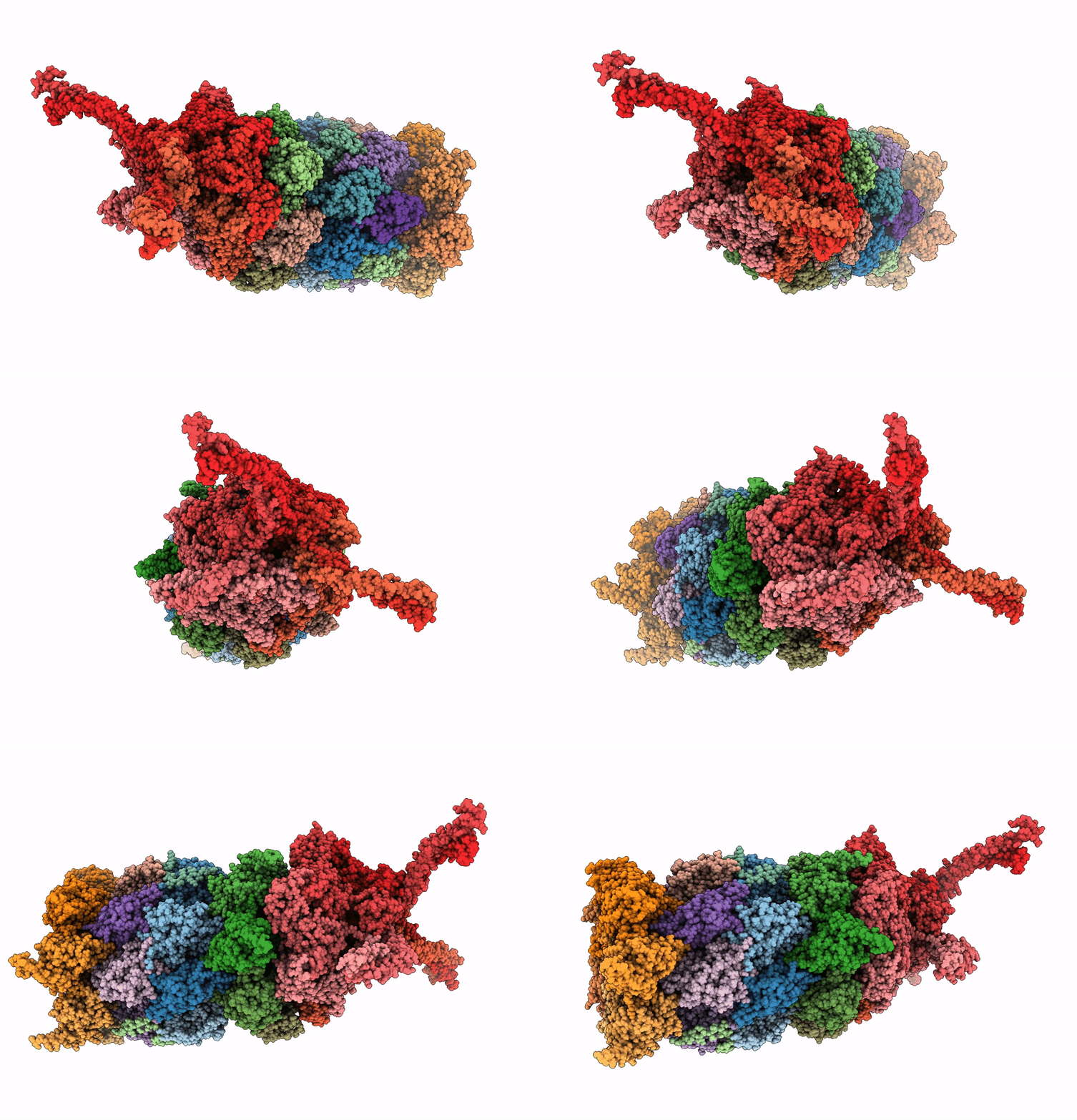
5L4G image
Deposition Date 2016-05-25
Release Date 2016-09-07
Last Version Date 2024-05-08
Entry Detail
PDB ID:
5L4G
Keywords:
Title:
The human 26S proteasome at 3.9 A
Biological Source:
Source Organism:
Homo sapiens (Taxon ID: 9606)
Host Organism:
Method Details:
Experimental Method:
Resolution:
3.90 Å
Aggregation State:
PARTICLE
Reconstruction Method:
SINGLE PARTICLE

Macromolecular Entities
Structures with similar UniProt ID
Protein Blast
Polymer Type:polypeptide(L)
Molecule:Proteasome subunit beta type-7
Gene (Uniprot):PSMB7
Chain IDs:N (auth: 8), BA (auth: 7)
Chain Length:277
Number of Molecules:2
Biological Source:Homo sapiens
Structures with similar UniProt ID
Protein Blast
Polymer Type:polypeptide(L)
Molecule:26S protease regulatory subunit 7
Gene (Uniprot):PSMC2
Chain IDs:CA (auth: H)
Chain Length:433
Number of Molecules:1
Biological Source:Homo sapiens
Structures with similar UniProt ID
Protein Blast
Polymer Type:polypeptide(L)
Molecule:26S protease regulatory subunit 4
Gene (Uniprot):PSMC1
Chain IDs:DA (auth: I)
Chain Length:440
Number of Molecules:1
Biological Source:Homo sapiens
Structures with similar UniProt ID
Protein Blast
Polymer Type:polypeptide(L)
Molecule:26S protease regulatory subunit 8
Gene (Uniprot):PSMC5
Chain IDs:HA (auth: J)
Chain Length:406
Number of Molecules:1
Biological Source:Homo sapiens
Structures with similar UniProt ID
Protein Blast
Polymer Type:polypeptide(L)
Molecule:26S protease regulatory subunit 6B
Gene (Uniprot):PSMC4
Chain IDs:EA (auth: K)
Chain Length:418
Number of Molecules:1
Biological Source:Homo sapiens
Structures with similar UniProt ID
Protein Blast
Polymer Type:polypeptide(L)
Molecule:26S protease regulatory subunit 10B
Gene (Uniprot):PSMC6
Chain IDs:FA (auth: L)
Chain Length:389
Number of Molecules:1
Biological Source:Homo sapiens
Structures with similar UniProt ID
Protein Blast
Polymer Type:polypeptide(L)
Molecule:26S protease regulatory subunit 6A
Gene (Uniprot):PSMC3
Chain IDs:GA (auth: M)
Chain Length:439
Number of Molecules:1
Biological Source:Homo sapiens
Structures with similar UniProt ID
Protein Blast
Polymer Type:polypeptide(L)
Molecule:Proteasome subunit alpha type-6
Gene (Uniprot):PSMA6
Chain IDs:A (auth: N), O (auth: A)
Chain Length:246
Number of Molecules:2
Biological Source:Homo sapiens
Structures with similar UniProt ID
Protein Blast
Polymer Type:polypeptide(L)
Molecule:Proteasome subunit alpha type-2
Gene (Uniprot):PSMA2
Chain IDs:B (auth: O), P (auth: B)
Chain Length:234
Number of Molecules:2
Biological Source:Homo sapiens
Structures with similar UniProt ID
Protein Blast
Polymer Type:polypeptide(L)
Molecule:Proteasome subunit alpha type-4
Gene (Uniprot):PSMA4
Chain IDs:C (auth: P), Q (auth: C)
Chain Length:261
Number of Molecules:2
Biological Source:Homo sapiens
Structures with similar UniProt ID
Protein Blast
Polymer Type:polypeptide(L)
Molecule:Proteasome subunit alpha type-7
Gene (Uniprot):PSMA7
Chain IDs:D (auth: Q), R (auth: D)
Chain Length:248
Number of Molecules:2
Biological Source:Homo sapiens
Structures with similar UniProt ID
Protein Blast
Polymer Type:polypeptide(L)
Molecule:Proteasome subunit alpha type-5
Gene (Uniprot):PSMA5
Chain IDs:E (auth: R), S (auth: E)
Chain Length:241
Number of Molecules:2
Biological Source:Homo sapiens
Structures with similar UniProt ID
Protein Blast
Polymer Type:polypeptide(L)
Molecule:Proteasome subunit alpha type-1
Gene (Uniprot):PSMA1
Chain IDs:F (auth: S), T (auth: F)
Chain Length:263
Number of Molecules:2
Biological Source:Homo sapiens
Structures with similar UniProt ID
Protein Blast
Polymer Type:polypeptide(L)
Molecule:Proteasome subunit alpha type-3
Gene (Uniprot):PSMA3
Chain IDs:G (auth: T), U (auth: G)
Chain Length:255
Number of Molecules:2
Biological Source:Homo sapiens
Structures with similar UniProt ID
Protein Blast
Polymer Type:polypeptide(L)
Molecule:Proteasome subunit beta type-1
Gene (Uniprot):PSMB1
Chain IDs:H (auth: U), V (auth: 1)
Chain Length:241
Number of Molecules:2
Biological Source:Homo sapiens
Structures with similar UniProt ID
Protein Blast
Polymer Type:polypeptide(L)
Molecule:Proteasome subunit beta type-2
Gene (Uniprot):PSMB2
Chain IDs:I (auth: V), W (auth: 2)
Chain Length:201
Number of Molecules:2
Biological Source:Homo sapiens
Structures with similar UniProt ID
Protein Blast
Polymer Type:polypeptide(L)
Molecule:Proteasome subunit beta type-3
Gene (Uniprot):PSMB3
Chain IDs:J (auth: W), X (auth: 3)
Chain Length:205
Number of Molecules:2
Biological Source:Homo sapiens
Structures with similar UniProt ID
Protein Blast
Polymer Type:polypeptide(L)
Molecule:Proteasome subunit beta type-4
Gene (Uniprot):PSMB4
Chain IDs:K (auth: X), Y (auth: 4)
Chain Length:264
Number of Molecules:2
Biological Source:Homo sapiens
Structures with similar UniProt ID
Protein Blast
Polymer Type:polypeptide(L)
Molecule:Proteasome subunit beta type-5
Gene (Uniprot):PSMB5
Chain IDs:L (auth: Y), Z (auth: 5)
Chain Length:263
Number of Molecules:2
Biological Source:Homo sapiens
Structures with similar UniProt ID
Protein Blast
Polymer Type:polypeptide(L)
Molecule:Proteasome subunit beta type-6
Gene (Uniprot):PSMB6
Chain IDs:M (auth: Z), AA (auth: 6)
Chain Length:239
Number of Molecules:2
Biological Source:Homo sapiens
Primary Citation
Structure of the human 26S proteasome at a resolution of 3.9 angstrom.
Proc.Natl.Acad.Sci.USA 113 7816 7821 (2016)
PMID: 27342858 DOI: 10.1073/pnas.1608050113

Abstact

Protein degradation in eukaryotic cells is performed by the Ubiquitin-Proteasome System (UPS). The 26S proteasome holocomplex consists of a core particle (CP) that proteolytically degrades polyubiquitylated proteins, and a regulatory particle (RP) containing the AAA-ATPase module. This module controls access to the proteolytic chamber inside the CP and is surrounded by non-ATPase subunits (Rpns) that recognize substrates and deubiquitylate them before unfolding and degradation. The architecture of the 26S holocomplex is highly conserved between yeast and humans. The structure of the human 26S holocomplex described here reveals previously unidentified features of the AAA-ATPase heterohexamer. One subunit, Rpt6, has ADP bound, whereas the other five have ATP in their binding pockets. Rpt6 is structurally distinct from the other five Rpt subunits, most notably in its pore loop region. For Rpns, the map reveals two main, previously undetected, features: the C terminus of Rpn3 protrudes into the mouth of the ATPase ring; and Rpn1 and Rpn2, the largest proteasome subunits, are linked by an extended connection. The structural features of the 26S proteasome observed in this study are likely to be important for coordinating the proteasomal subunits during substrate processing.

Legend

Protein

Chemical

Disease

Primary Citation of related structures
Feedback Form
Name
Email
Institute
Feedback