Planned Maintenance: Some services may turn out to be unavailable from 15th January, 2026 to 16th January, 2026. We apologize for the inconvenience!

5KIM image
Deposition Date 2016-06-16
Release Date 2017-04-12
Last Version Date 2023-09-27
Entry Detail
PDB ID:
5KIM
Keywords:
Title:
PSEUDO T4 LYSOZYME MUTANT - Y88PHE-I
Biological Source:
Source Organism(s):
Expression System(s):
Method Details:
Experimental Method:
Resolution:
1.50 Å
R-Value Free:
0.18
R-Value Work:
0.16
R-Value Observed:
0.16
Space Group:
P 32 2 1
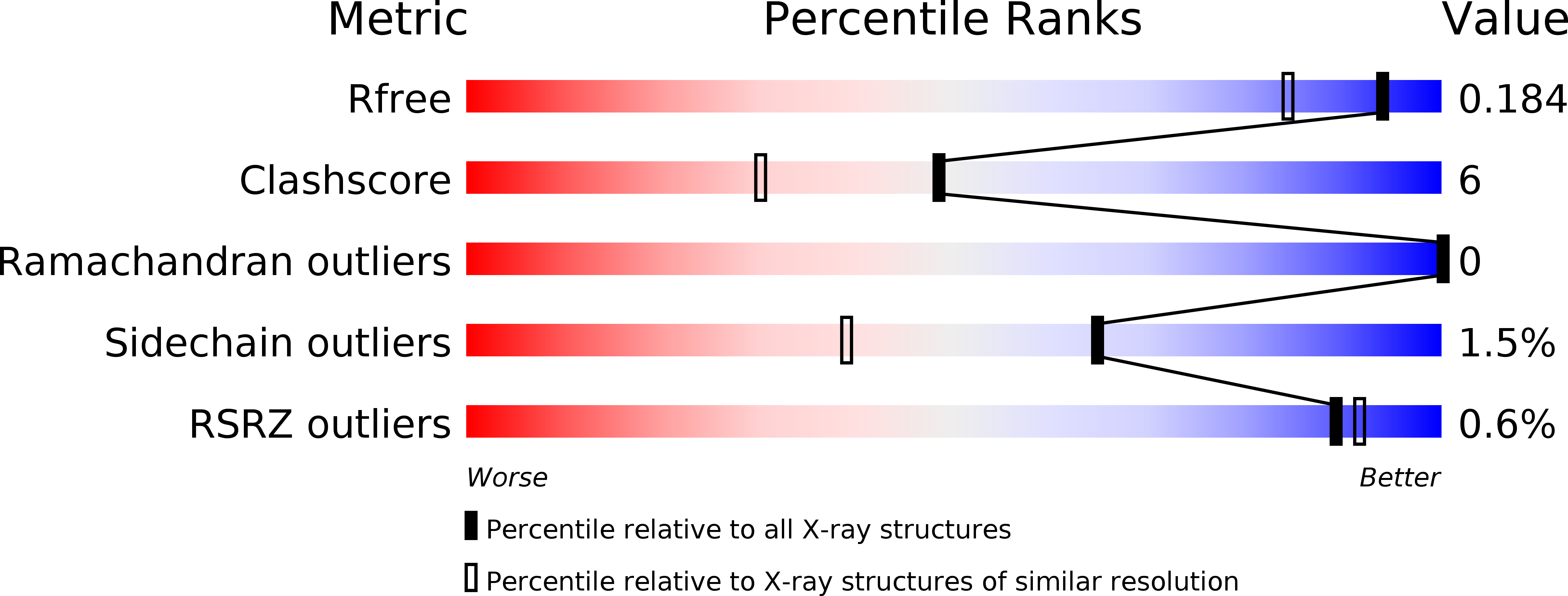
Macromolecular Entities
Structures with similar UniProt ID
Protein Blast
Polymer Type:polypeptide(L)
Molecule:Endolysin
Gene (Uniprot):E
Mutagens:YES
Chain IDs:A
Chain Length:170
Number of Molecules:1
Biological Source:Enterobacteria phage T4
Primary Citation
Structure-Energy Relationships of Halogen Bonds in Proteins.
Biochemistry 56 2794 2802 (2017)
PMID: 28345933 DOI: 10.1021/acs.biochem.7b00022

Abstact

The structures and stabilities of proteins are defined by a series of weak noncovalent electrostatic, van der Waals, and hydrogen bond (HB) interactions. In this study, we have designed and engineered halogen bonds (XBs) site-specifically to study their structure-energy relationship in a model protein, T4 lysozyme. The evidence for XBs is the displacement of the aromatic side chain toward an oxygen acceptor, at distances that are equal to or less than the sums of their respective van der Waals radii, when the hydroxyl substituent of the wild-type tyrosine is replaced by a halogen. In addition, thermal melting studies show that the iodine XB rescues the stabilization energy from an otherwise destabilizing substitution (at an equivalent noninteracting site), indicating that the interaction is also present in solution. Quantum chemical calculations show that the XB complements an HB at this site and that solvent structure must also be considered in trying to design molecular interactions such as XBs into biological systems. A bromine substitution also shows displacement of the side chain, but the distances and geometries do not indicate formation of an XB. Thus, we have dissected the contributions from various noncovalent interactions of halogens introduced into proteins, to drive the application of XBs, particularly in biomolecular design.

Legend

Protein

Chemical

Disease

Primary Citation of related structures
Feedback Form
Name
Email
Institute
Feedback