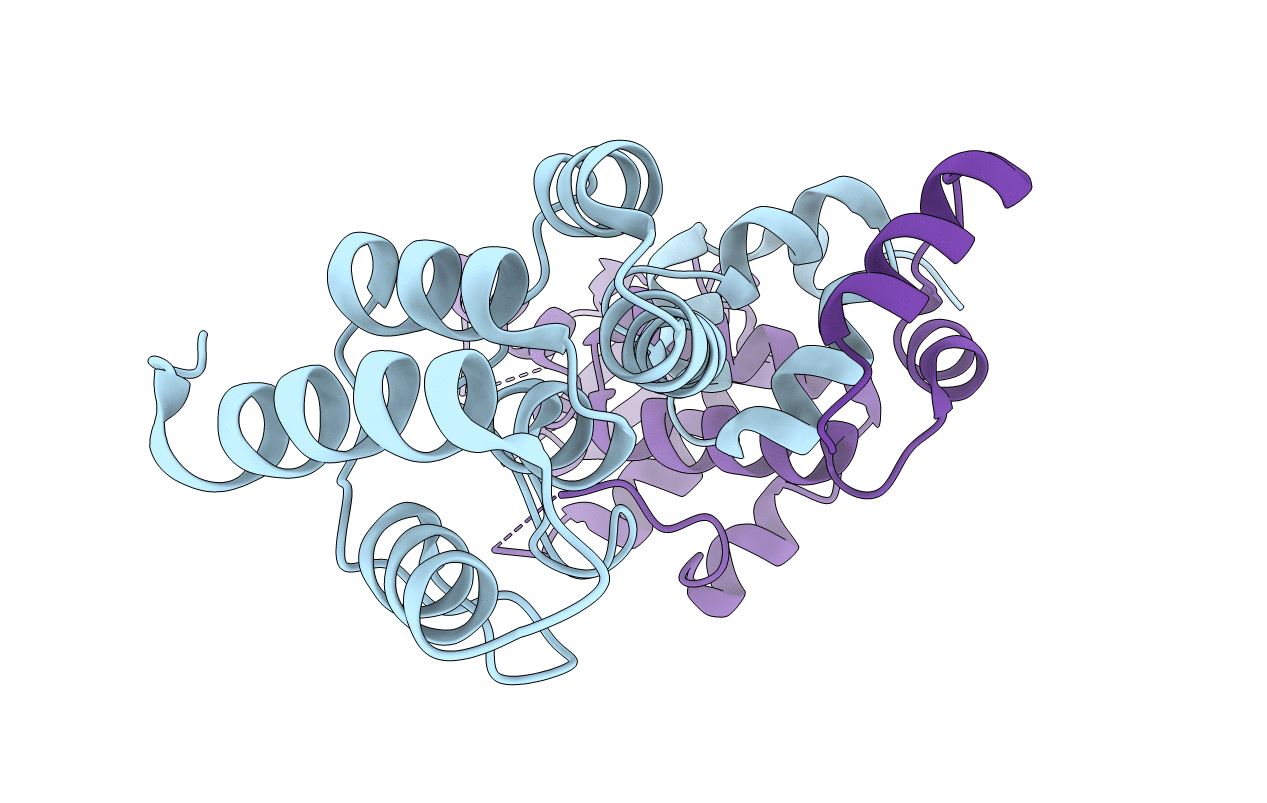
5K35 image
Deposition Date 2016-05-19
Release Date 2017-01-25
Last Version Date 2024-03-06
Entry Detail
PDB ID:
5K35
Keywords:
Title:
Structure of the Legionella effector, AnkB, in complex with human Skp1
Biological Source:
Source Organism(s):
Expression System(s):
Method Details:
Experimental Method:
Resolution:
2.85 Å
R-Value Free:
0.27
R-Value Work:
0.21
R-Value Observed:
0.22
Space Group:
P 21 21 21

Macromolecular Entities
Structures with similar UniProt ID
Protein Blast
Polymer Type:polypeptide(L)
Molecule:Ankyrin-repeat protein B
Chain IDs:A
Chain Length:182
Number of Molecules:1
Biological Source:Legionella pneumophila
Structures with similar UniProt ID
Protein Blast
Polymer Type:polypeptide(L)
Molecule:S-phase kinase-associated protein 1
Gene (Uniprot):SKP1
Chain IDs:B
Chain Length:163
Number of Molecules:1
Biological Source:Homo sapiens
Primary Citation
Structural Mimicry by a Bacterial F Box Effector Hijacks the Host Ubiquitin-Proteasome System.
Structure 25 376 383 (2017)
PMID: 28111017 DOI: 10.1016/j.str.2016.12.015

Abstact

Ankyrin B (AnkB/LegAU13) is a translocated F box effector essential for the intracellular replication of the pathogen Legionella pneumophila. AnkB co-opts a host ubiquitin ligase to decorate the pathogen-containing vacuole with K48-linked polyubiquitinated proteins and degrade host proteins as a source of energy. Here, we report that AnkB commandeers the host ubiquitin-proteasome system through mimicry of two eukaryotic protein domains. Using X-ray crystallography, we determined the 3D structure of AnkB in complex with Skp1, a component of the human SCF ubiquitination ligase. The structure confirms that AnkB contains an N-terminal F box similar to Skp2 and a C-terminal substrate-binding domain similar to eukaryotic ankyrin repeats. We identified crucial amino acids in the substrate-binding domain of AnkB and showed them to be essential for the function of AnkB in L. pneumophila intracellular proliferation. The study reveals how Legionella uses molecular mimicry to manipulate the host ubiquitination pathway and proliferate intracellularly.

Legend

Protein

Chemical

Disease

Primary Citation of related structures
Feedback Form
Name
Email
Institute
Feedback