5K1N image
Deposition Date 2016-05-18
Release Date 2016-07-20
Last Version Date 2024-01-10
Entry Detail
PDB ID:
5K1N
Title:
Human TTR altered by a rhenium tris-carbonyl Pyta-C12 derivative
Biological Source:
Source Organism:
Homo sapiens (Taxon ID: 9606)
Method Details:
Experimental Method:
Resolution:
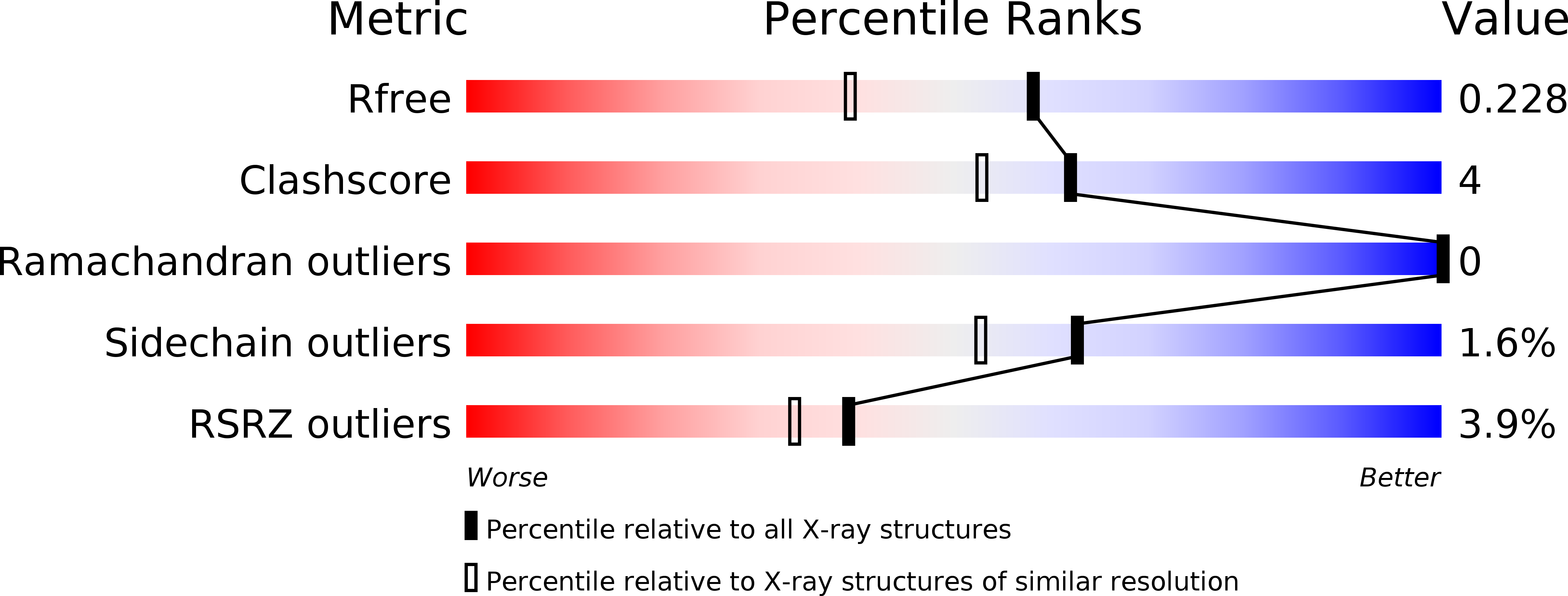
1.81 Å
R-Value Free:
0.22
R-Value Work:
0.18
R-Value Observed:
0.19
Space Group:
P 21 21 2
Macromolecular Entities
Structures with similar UniProt ID
Protein Blast
Polymer Type:polypeptide(L)
Molecule:Transthyretin
Gene (Uniprot):TTR
Chain IDs:A, B
Chain Length:118
Number of Molecules:2
Biological Source:Homo sapiens
Primary Citation
Human TTR conformation altered by rhenium tris-carbonyl derivatives.
J.Struct.Biol. 195 353 364 (2016)
PMID: 27402536 DOI: 10.1016/j.jsb.2016.07.002

Abstact

Transthyretin (TTR) is a 54 kDa homotetrameric serum protein that transports thyroxine (T4) and retinol. TTR is potentially amyloidogenic due to homotetramer dissociation into monomeric intermediates that self-assemble as amyloid deposits and insoluble fibrils. Most crystallographic structures, including those of amyloidogenic variants show the same tetramer without major variations in the monomer-monomer interface nor in the volume of the interdimeric cavity. Soaking TTR crystals in a solution containing rhenium tris-carbonyl derivatives yields a TTR conformer never observed before. Only one of the two monomers of the crystallographic dimer is significantly altered, and the inner part of the T4 binding cavity is expanded at one end and shrunk at the other. The result redefines the mechanism of allosteric communication between the two sites, suggesting that negative cooperativity is a function of dimer asymmetry, which can be induced through internal or external binding. An aspect that remains unexplained is why the conformational changes are ubiquitous throughout the crystal although the heavy metal content of the derivatized crystals is relatively low. The conformational changes observed, which include Leu(82), may represent a form of TTR better at scavenging β-Amyloid. At a resolution of 1.69Å, with excellent refinement statistics and well defined electron density for all parts of the structure, it is possible to envisage answering important questions that range from protein cooperative behavior to heavy atom induced protein conformational modifications that can result in crystallographic non-isomorphism.

Legend

Protein

Chemical

Disease

Primary Citation of related structures
Feedback Form
Name
Email
Institute
Feedback