5JWP image
Deposition Date 2016-05-12
Release Date 2016-11-23
Last Version Date 2023-09-27
Entry Detail
PDB ID:
5JWP
Keywords:
Title:
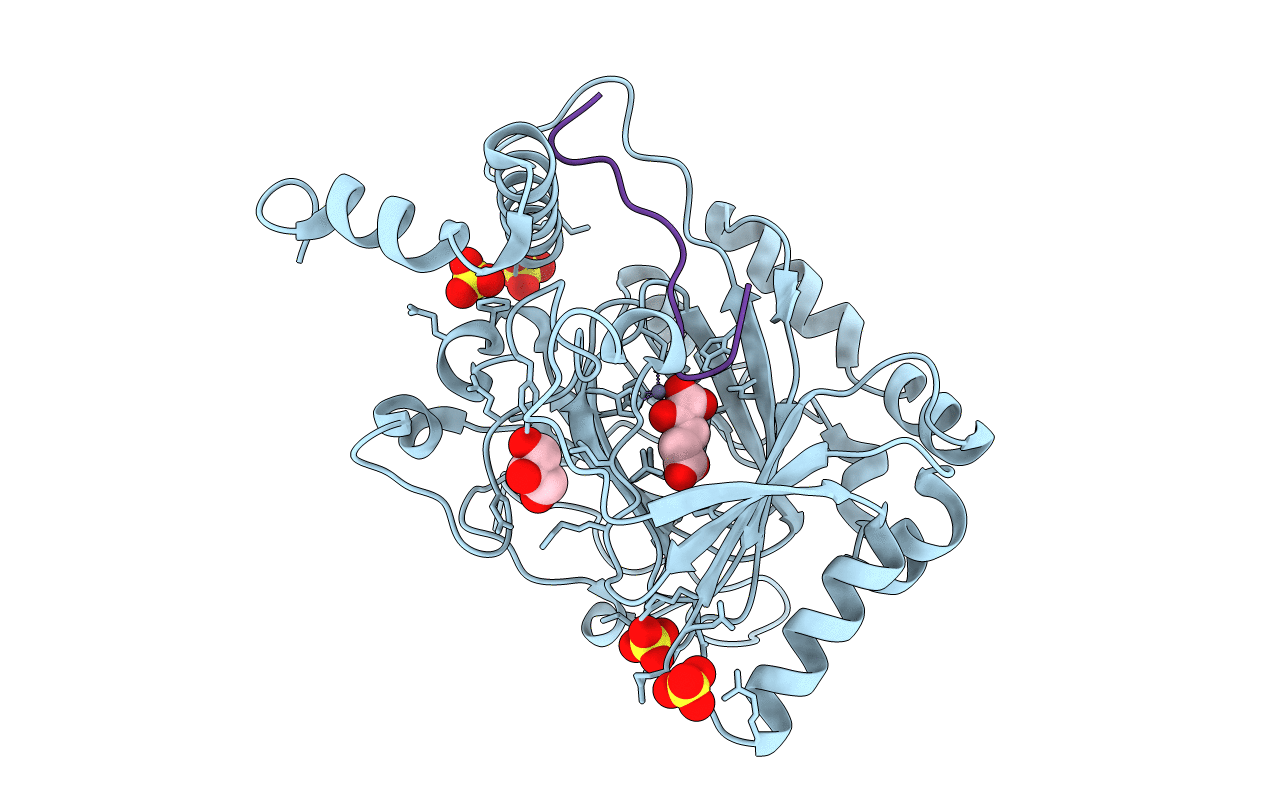
Crystal structure of human FIH D201E variant in complex with Zn, alpha-ketoglutarate, and HIF1 alpha peptide.
Biological Source:
Source Organism:
Homo sapiens (Taxon ID: 9606)
Host Organism:
Method Details:
Experimental Method:
Resolution:
2.10 Å
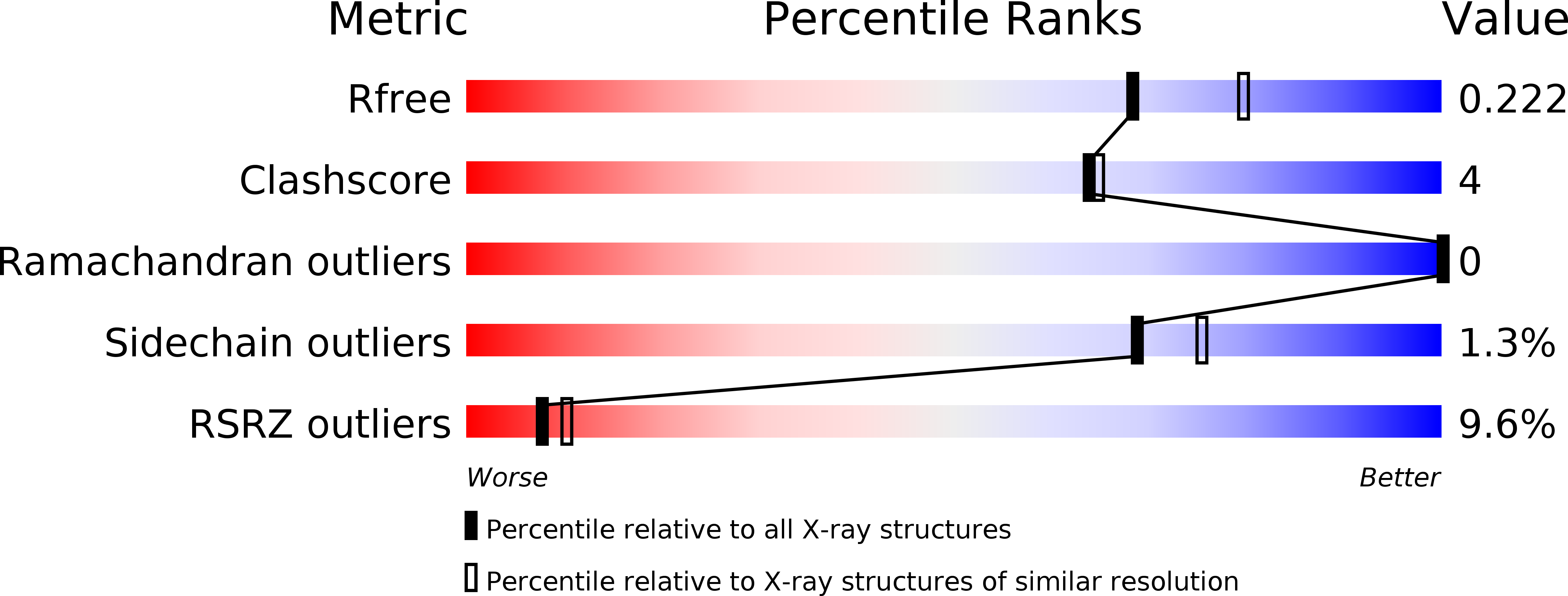
R-Value Free:
0.20
R-Value Work:
0.17
R-Value Observed:
0.17
Space Group:
P 41 21 2
Macromolecular Entities
Structures with similar UniProt ID
Protein Blast
Polymer Type:polypeptide(L)
Molecule:Hypoxia-inducible factor 1-alpha inhibitor
Gene (Uniprot):HIF1AN
Mutagens:D201E
Chain IDs:A
Chain Length:352
Number of Molecules:1
Biological Source:Homo sapiens
Structures with similar UniProt ID
Protein Blast
Polymer Type:polypeptide(L)
Molecule:Hypoxia-inducible factor 1-alpha
Gene (Uniprot):HIF1A
Chain IDs:B
Chain Length:19
Number of Molecules:1
Biological Source:Homo sapiens
Primary Citation
The facial triad in the alpha-ketoglutarate dependent oxygenase FIH: A role for sterics in linking substrate binding to O2 activation.
J.Inorg.Biochem. 166 26 33 (2016)
PMID: 27815979 DOI: 10.1016/j.jinorgbio.2016.10.007

Abstact

The factor inhibiting hypoxia inducible factor-1α (FIH) is a nonheme Fe(II)/αKG oxygenase using a 2-His-1-Asp facial triad. FIH activates O2 via oxidative decarboxylation of α-ketoglutarate (αKG) to generate an enzyme-based oxidant which hydroxylates the Asn803 residue within the C-terminal transactivation domain (CTAD) of HIF-1α. Tight coupling of these two sequential reactions requires a structural linkage between the Fe(II) and the substrate binding site to ensure that O2 activation occurs after substrate binds. We tested the hypothesis that the facial triad carboxylate (Asp201) of FIH linked substrate binding and O2 binding sites. Asp201 variants of FIH were constructed and thoroughly characterized in vitro using steady-state kinetics, crystallography, autohydroxylation, and coupling measurements. Our studies revealed each variant activated O2 with a catalytic efficiency similar to that of wild-type (WT) FIH (kcataKM(O2)=0.17μM-1min-1), but led to defects in the coupling of O2 activation to substrate hydroxylation. Steady-state kinetics showed similar catalytic efficiencies for hydroxylation by WT-FIH (kcat/KM(CTAD)=0.42μM-1min-1) and D201G (kcat/KM(CTAD)=0.34μM-1min-1); hydroxylation by D201E was greatly impaired, while hydroxylation by D201A was undetectable. Analysis of the crystal structure of the D201E variant revealed steric crowding near the diffusible ligand site supporting a role for sterics from the facial triad carboxylate in the O2 binding order. Our data support a model in which the facial triad carboxylate Asp201 provides both steric and polar contacts to favor O2 access to the Fe(II) only after substrate binds, leading to coupled turnover in FIH and other αKG oxygenases.

Legend

Protein

Chemical

Disease

Primary Citation of related structures
Feedback Form
Name
Email
Institute
Feedback