5JLV image
Deposition Date 2016-04-27
Release Date 2016-06-15
Last Version Date 2024-10-23
Entry Detail
PDB ID:
5JLV
Keywords:
Title:
Receptor binding domain of Botulinum neurotoxin A in complex with human glycosylated SV2C
Biological Source:
Source Organism:
Host Organism:
Method Details:
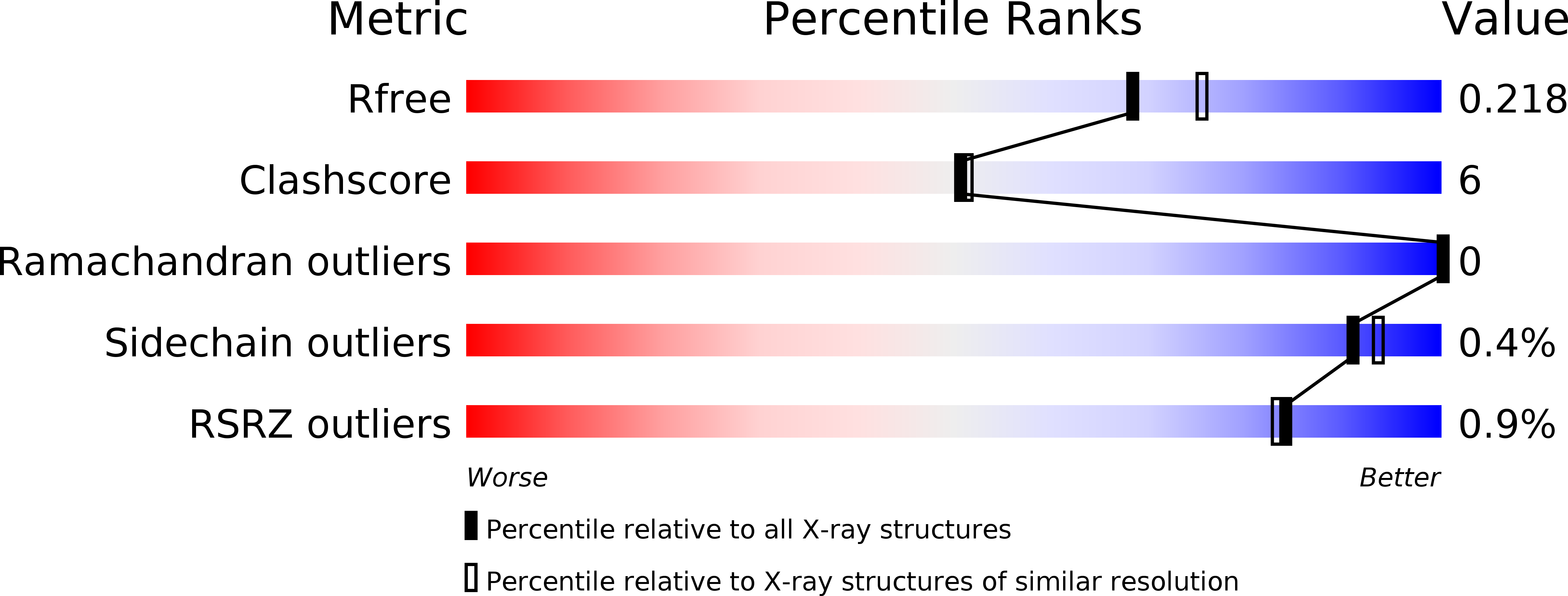
Experimental Method:
Resolution:
2.00 Å
R-Value Free:
0.21
R-Value Work:
0.17
R-Value Observed:
0.17
Space Group:
C 1 2 1
Macromolecular Entities
Structures with similar UniProt ID
Protein Blast
Polymer Type:polypeptide(L)
Molecule:Botulinum neurotoxin type A
Mutagens:T1158A
Chain IDs:A, B
Chain Length:428
Number of Molecules:2
Biological Source:Clostridium botulinum
Structures with similar UniProt ID
Protein Blast
Polymer Type:polypeptide(L)
Molecule:Synaptic vesicle glycoprotein 2C
Gene (Uniprot):SV2C
Chain IDs:C, D
Chain Length:117
Number of Molecules:2
Biological Source:Homo sapiens
Primary Citation
N-linked glycosylation of SV2 is required for binding and uptake of botulinum neurotoxin A.
Nat.Struct.Mol.Biol. 23 656 662 (2016)
PMID: 27294781 DOI: 10.1038/nsmb.3245

Abstact

Botulinum neurotoxin serotype A1 (BoNT/A1), a licensed drug widely used for medical and cosmetic applications, exerts its action by invading motoneurons. Here we report a 2.0-Å-resolution crystal structure of the BoNT/A1 receptor-binding domain in complex with its neuronal receptor, glycosylated human SV2C. We found that the neuronal tropism of BoNT/A1 requires recognition of both the peptide moiety and an N-linked glycan on SV2. This N-glycan-which is conserved in all SV2 isoforms across vertebrates-is essential for BoNT/A1 binding to neurons and for its potent neurotoxicity. The glycan-binding interface on SV2 is targeted by a human BoNT/A1-neutralizing antibody currently licensed as an antibotulism drug. Our studies reveal a new paradigm of host-pathogen interactions, in which pathogens exploit conserved host post-translational modifications, thereby achieving highly specific receptor binding while also tolerating genetic changes across multiple isoforms of receptors.

Legend

Protein

Chemical

Disease

Primary Citation of related structures
Feedback Form
Name
Email
Institute
Feedback