Planned Maintenance: Some services may turn out to be unavailable from 15th January, 2026 to 16th January, 2026. We apologize for the inconvenience!

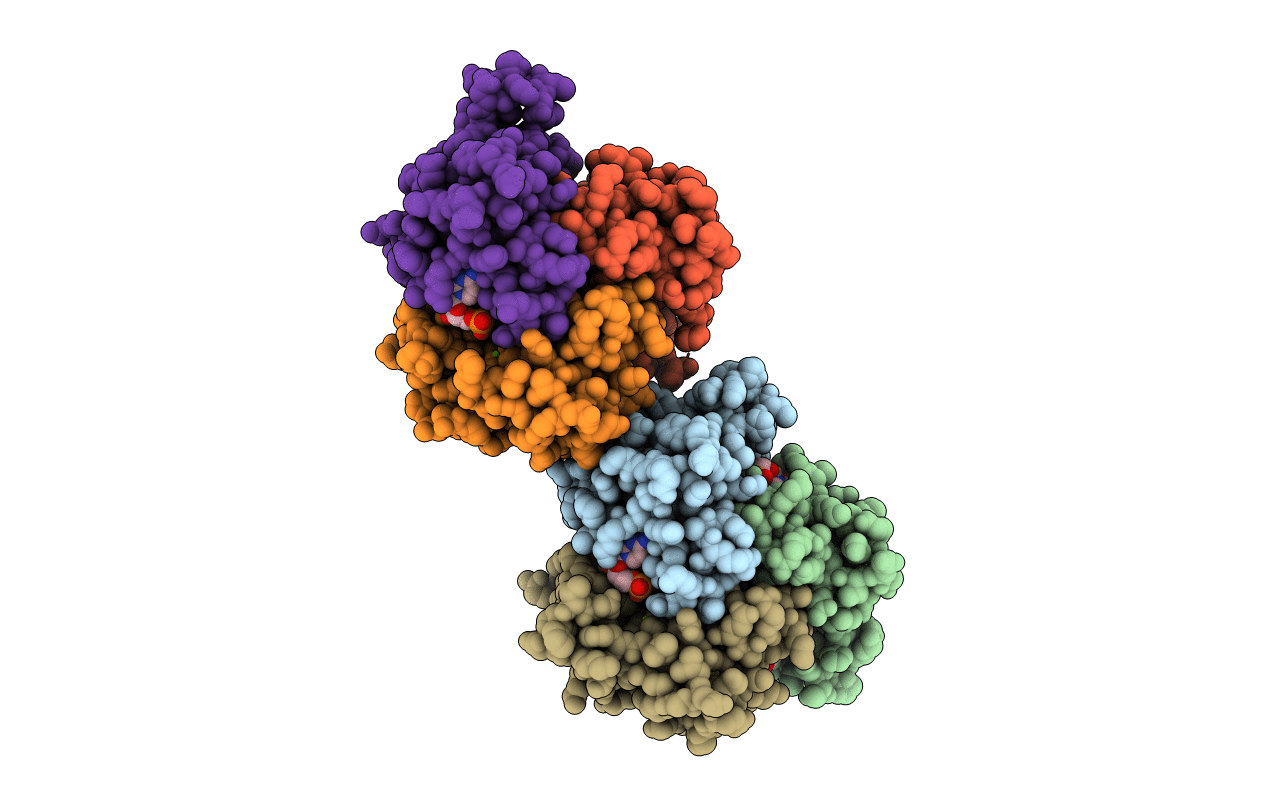
5IWY image
Deposition Date 2016-03-23
Release Date 2017-03-29
Last Version Date 2023-11-08
Entry Detail
PDB ID:
5IWY
Keywords:
Title:
Crystal structure of 2-C-methyl-D-erythritol 2,4-cyclodiphosphate synthase from Bacillus subtitis complexed with CMP and Mg2+
Method Details:
Experimental Method:
Resolution:
1.99 Å
R-Value Free:
0.21
R-Value Work:
0.17
R-Value Observed:
0.17
Space Group:
P 1 21 1
Macromolecular Entities
Structures with similar UniProt ID
Protein Blast
Polymer Type:polypeptide(L)
Molecule:2-C-methyl-D-erythritol 2,4-cyclodiphosphate synthase
Gene (Uniprot):ispF
Chain IDs:A, B, C, D, E, F
Chain Length:158
Number of Molecules:6
Biological Source:Bacillus subtilis (strain 168)
Primary Citation
Crystal structure of IspF from Bacillus subtilis and absence of protein complex assembly among IspD/IspE/IspF enzymes in the MEP pathway.
Biosci. Rep. ? ? ? (2018)
PMID: 29335298 DOI: 10.1042/BSR20171370

Abstact

2-C-Methyl-d-erythritol 2,4-cyclodiphosphate synthase (IspF) is a key enzyme in the 2-C-Methyl-d-erythritol-4-phosphate (MEP) pathway of isoprenoid biosynthesis. This enzyme catalyzes the 4-diphosphocytidyl-2-C-methyl-d-erythritol 2-phosphate (CDPME2P) to 2-C-methyl-d-erythritol 2,4-cyclodiphosphate (MEcDP) with concomitant release of cytidine 5'-diphospate (CMP). Bacillus subtilis is a potential host cell for the production of isoprenoids, but few studies are performed on the key enzymes of MEP pathway in B. subtilis In this work, the high-resolution crystal structures of IspF in native and complex with CMP from B. subtilis have been determined. Structural comparisons indicate that there is a looser packing of the subunits of IspF in B. subtilis, whereas the solvent accessible surface of its active pockets is smaller than that in Escherichia coli. Meanwhile, the protein-protein associations of 2-C-Methyl-d-erythritol-4-phosphatecytidyltransferase (IspD), CDPME kinase (IspE) and IspF from B. subtilis and E. coli, which catalyze three consecutive steps in the MEP pathway, are analyzed by native gel shift and size exclusion chromatography methods. The data here show that protein complex assembly is not detectable. These results will be useful for isoprenoid biosynthesis by metabolic engineering.

Legend

Protein

Chemical

Disease

Primary Citation of related structures
Feedback Form
Name
Email
Institute
Feedback