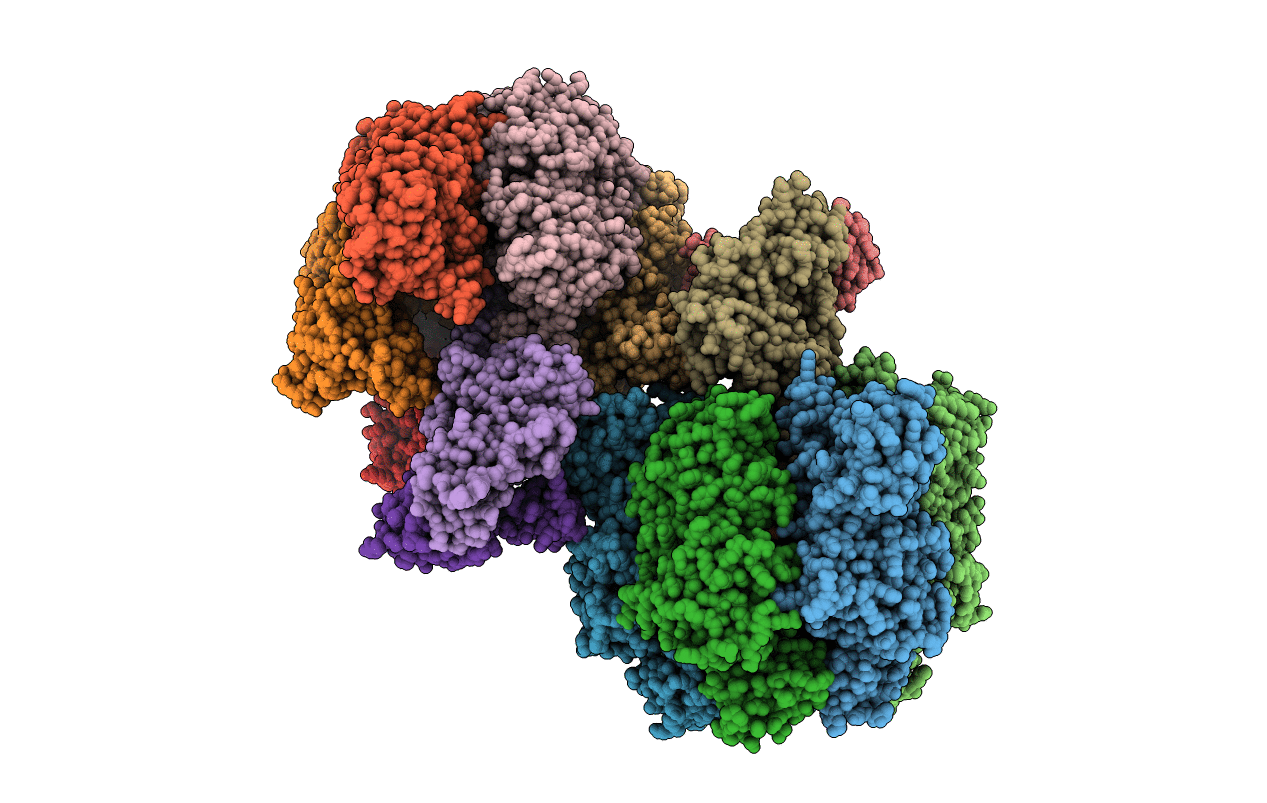
5IK2 image
Deposition Date 2016-03-03
Release Date 2016-09-21
Last Version Date 2024-01-10
Entry Detail
PDB ID:
5IK2
Keywords:
Title:
Caldalaklibacillus thermarum F1-ATPase (epsilon mutant)
Biological Source:
Source Organism:
Method Details:
Experimental Method:
Resolution:
2.60 Å
R-Value Free:
0.23
R-Value Work:
0.21
R-Value Observed:
0.21
Space Group:
P 1 21 1

Macromolecular Entities
Structures with similar UniProt ID
Protein Blast
Polymer Type:polypeptide(L)
Molecule:ATP synthase subunit alpha
Gene (Uniprot):atpA
Chain IDs:A, B, C, I, J, K
Chain Length:479
Number of Molecules:6
Biological Source:Caldalkalibacillus thermarum TA2.A1
Structures with similar UniProt ID
Protein Blast
Polymer Type:polypeptide(L)
Molecule:ATP synthase subunit beta
Gene (Uniprot):atpD
Chain IDs:D, E, F, L, M, N
Chain Length:462
Number of Molecules:6
Biological Source:Caldalkalibacillus thermarum TA2.A1
Structures with similar UniProt ID
Protein Blast
Polymer Type:polypeptide(L)
Molecule:ATP synthase gamma chain
Gene (Uniprot):atpG
Chain IDs:G, O
Chain Length:285
Number of Molecules:2
Biological Source:Caldalkalibacillus thermarum TA2.A1
Structures with similar UniProt ID
Protein Blast
Polymer Type:polypeptide(L)
Molecule:ATP synthase epsilon chain
Gene (Uniprot):atpC
Mutagens:D89A, R92A
Chain IDs:H, P
Chain Length:134
Number of Molecules:2
Biological Source:Caldalkalibacillus thermarum TA2.A1
Primary Citation
Regulation of the thermoalkaliphilic F1-ATPase from Caldalkalibacillus thermarum.
Proc.Natl.Acad.Sci.USA 113 10860 10865 (2016)
PMID: 27621435 DOI: 10.1073/pnas.1612035113

Abstact

The crystal structure has been determined of the F1-catalytic domain of the F-ATPase from Caldalkalibacillus thermarum, which hydrolyzes adenosine triphosphate (ATP) poorly. It is very similar to those of active mitochondrial and bacterial F1-ATPases. In the F-ATPase from Geobacillus stearothermophilus, conformational changes in the ε-subunit are influenced by intracellular ATP concentration and membrane potential. When ATP is plentiful, the ε-subunit assumes a "down" state, with an ATP molecule bound to its two C-terminal α-helices; when ATP is scarce, the α-helices are proposed to inhibit ATP hydrolysis by assuming an "up" state, where the α-helices, devoid of ATP, enter the α3β3-catalytic region. However, in the Escherichia coli enzyme, there is no evidence that such ATP binding to the ε-subunit is mechanistically important for modulating the enzyme's hydrolytic activity. In the structure of the F1-ATPase from C. thermarum, ATP and a magnesium ion are bound to the α-helices in the down state. In a form with a mutated ε-subunit unable to bind ATP, the enzyme remains inactive and the ε-subunit is down. Therefore, neither the γ-subunit nor the regulatory ATP bound to the ε-subunit is involved in the inhibitory mechanism of this particular enzyme. The structure of the α3β3-catalytic domain is likewise closely similar to those of active F1-ATPases. However, although the βE-catalytic site is in the usual "open" conformation, it is occupied by the unique combination of an ADP molecule with no magnesium ion and a phosphate ion. These bound hydrolytic products are likely to be the basis of inhibition of ATP hydrolysis.

Legend

Protein

Chemical

Disease

Primary Citation of related structures
Feedback Form
Name
Email
Institute
Feedback