5I6G image
Deposition Date 2016-02-16
Release Date 2016-04-20
Last Version Date 2024-11-06
Entry Detail
PDB ID:
5I6G
Keywords:
Title:
Crystal structure of C-terminal variant 2 of Chaetomium thermophilum acetyl-CoA carboxylase
Biological Source:
Method Details:
Experimental Method:
Resolution:
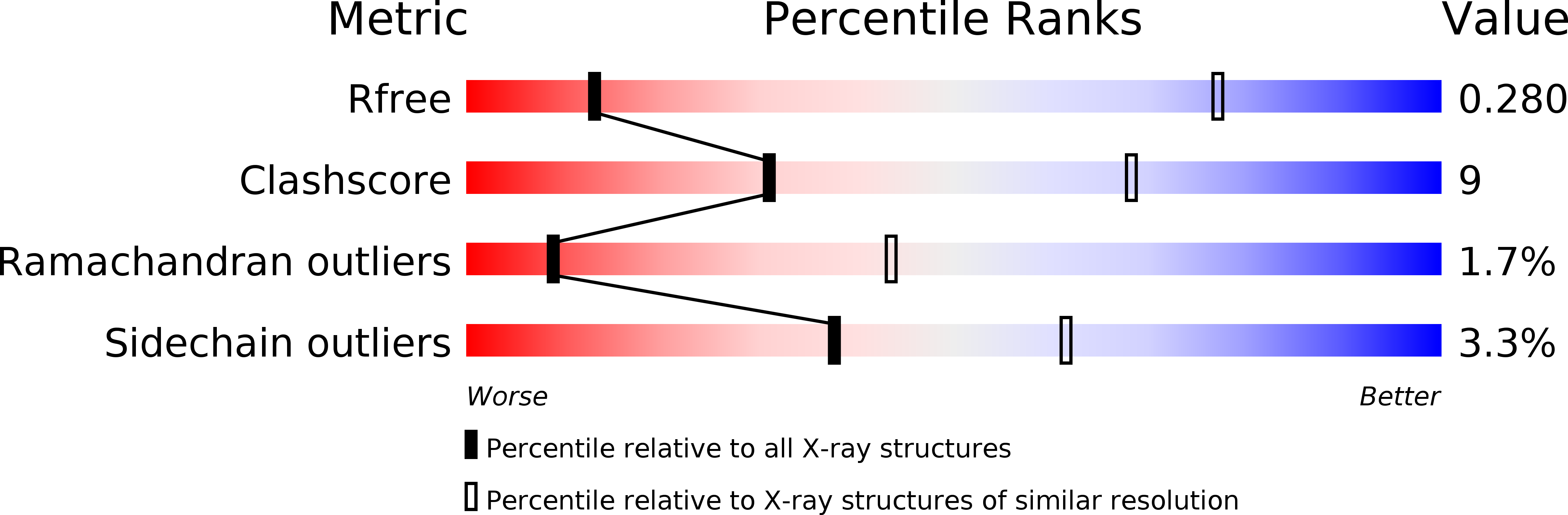
4.50 Å
R-Value Free:
0.23
R-Value Work:
0.23
R-Value Observed:
0.23
Space Group:
P 21 21 21
Macromolecular Entities
Structures with similar UniProt ID
Protein Blast
Polymer Type:polypeptide(L)
Molecule:Acetyl-CoA carboxylase-like protein,Acetyl-CoA carboxylase-like protein
Gene (Uniprot):CTHT_0021690
Chain IDs:A, B
Chain Length:1161
Number of Molecules:2
Biological Source:Chaetomium thermophilum (strain DSM 1495 / CBS 144.50 / IMI 039719), Chaetomium thermophilum var. thermophilum DSM 1495
Ligand Molecules
Primary Citation
The dynamic organization of fungal acetyl-CoA carboxylase.
Nat Commun 7 11196 11196 (2016)
PMID: 27073141 DOI: 10.1038/ncomms11196

Abstact

Acetyl-CoA carboxylases (ACCs) catalyse the committed step in fatty-acid biosynthesis: the ATP-dependent carboxylation of acetyl-CoA to malonyl-CoA. They are important regulatory hubs for metabolic control and relevant drug targets for the treatment of the metabolic syndrome and cancer. Eukaryotic ACCs are single-chain multienzymes characterized by a large, non-catalytic central domain (CD), whose role in ACC regulation remains poorly characterized. Here we report the crystal structure of the yeast ACC CD, revealing a unique four-domain organization. A regulatory loop, which is phosphorylated at the key functional phosphorylation site of fungal ACC, wedges into a crevice between two domains of CD. Combining the yeast CD structure with intermediate and low-resolution data of larger fragments up to intact ACCs provides a comprehensive characterization of the dynamic fungal ACC architecture. In contrast to related carboxylases, large-scale conformational changes are required for substrate turnover, and are mediated by the CD under phosphorylation control.

Legend

Protein

Chemical

Disease

Primary Citation of related structures
Feedback Form
Name
Email
Institute
Feedback