5HNK image
Deposition Date 2016-01-18
Release Date 2016-06-01
Last Version Date 2024-01-10
Entry Detail
PDB ID:
5HNK
Keywords:
Title:
Crystal structure of T5Fen in complex intact substrate and metal ions.
Biological Source:
Source Organism:
Host Organism:
Method Details:
Experimental Method:
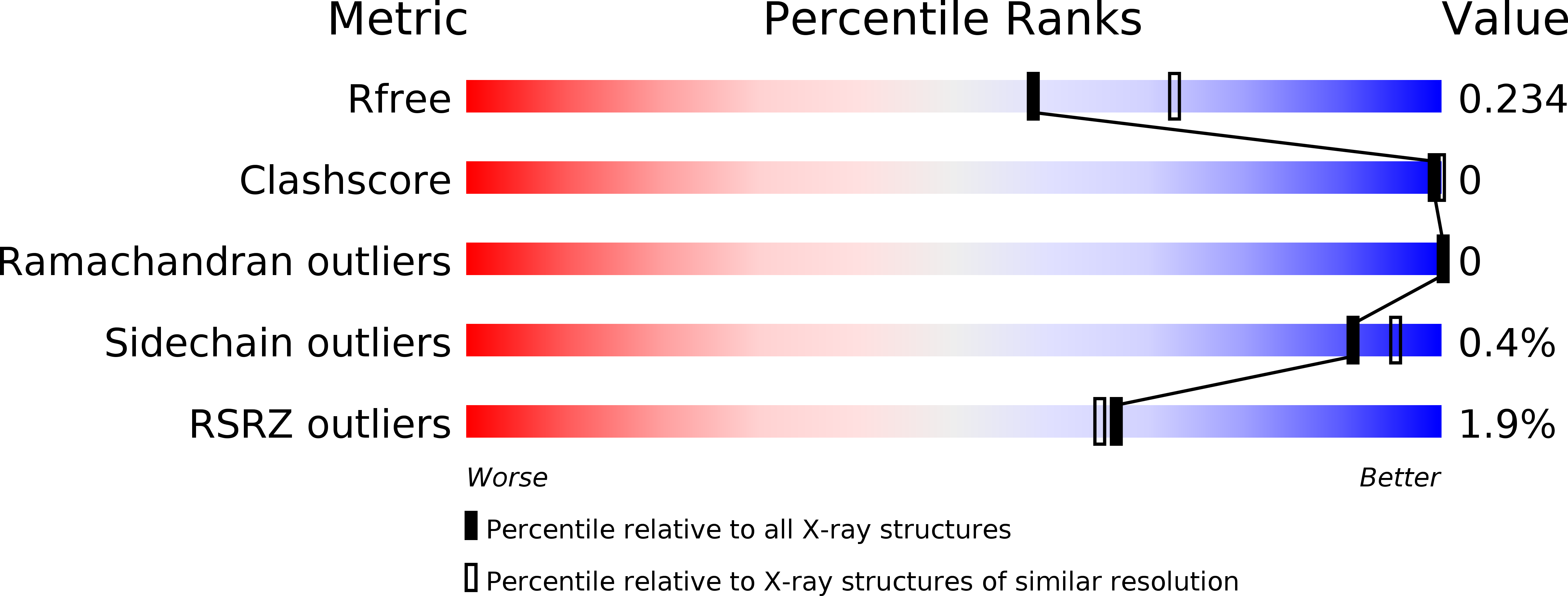
Resolution:
2.22 Å
R-Value Free:
0.23
R-Value Work:
0.18
R-Value Observed:
0.18
Space Group:
P 21 21 21
Macromolecular Entities
Structures with similar UniProt ID
Protein Blast
Polymer Type:polypeptide(L)
Molecule:Exodeoxyribonuclease
Gene (Uniprot):D15
Chain IDs:C (auth: A), D (auth: B)
Chain Length:272
Number of Molecules:2
Biological Source:Escherichia phage T5
Polymer Type:polydeoxyribonucleotide
Molecule:DNA (5'-D(*AP*AP*AP*AP*GP*CP*GP*TP*AP*CP*GP*C)-3')
Chain IDs:A (auth: X), B (auth: Y)
Chain Length:12
Number of Molecules:2
Biological Source:synthetic construct
Primary Citation
Direct observation of DNA threading in flap endonuclease complexes.
Nat.Struct.Mol.Biol. 23 640 646 (2016)
PMID: 27273516 DOI: 10.1038/nsmb.3241

Abstact

Maintenance of genome integrity requires that branched nucleic acid molecules be accurately processed to produce double-helical DNA. Flap endonucleases are essential enzymes that trim such branched molecules generated by Okazaki-fragment synthesis during replication. Here, we report crystal structures of bacteriophage T5 flap endonuclease in complexes with intact DNA substrates and products, at resolutions of 1.9-2.2 Å. They reveal single-stranded DNA threading through a hole in the enzyme, which is enclosed by an inverted V-shaped helical arch straddling the active site. Residues lining the hole induce an unusual barb-like conformation in the DNA substrate, thereby juxtaposing the scissile phosphate and essential catalytic metal ions. A series of complexes and biochemical analyses show how the substrate's single-stranded branch approaches, threads through and finally emerges on the far side of the enzyme. Our studies suggest that substrate recognition involves an unusual 'fly-casting, thread, bend and barb' mechanism.

Legend

Protein

Chemical

Disease

Primary Citation of related structures
Feedback Form
Name
Email
Institute
Feedback