5HBI image
Deposition Date 1998-06-24
Release Date 1998-11-11
Last Version Date 2024-05-22
Entry Detail
PDB ID:
5HBI
Title:
SCAPHARCA DIMERIC HEMOGLOBIN, MUTANT T72I, CO-LIGANDED FORM
Biological Source:
Source Organism:
Host Organism:
Method Details:
Experimental Method:
Resolution:
1.60 Å
R-Value Free:
0.24
R-Value Work:
0.19
R-Value Observed:
0.19
Space Group:
C 1 2 1
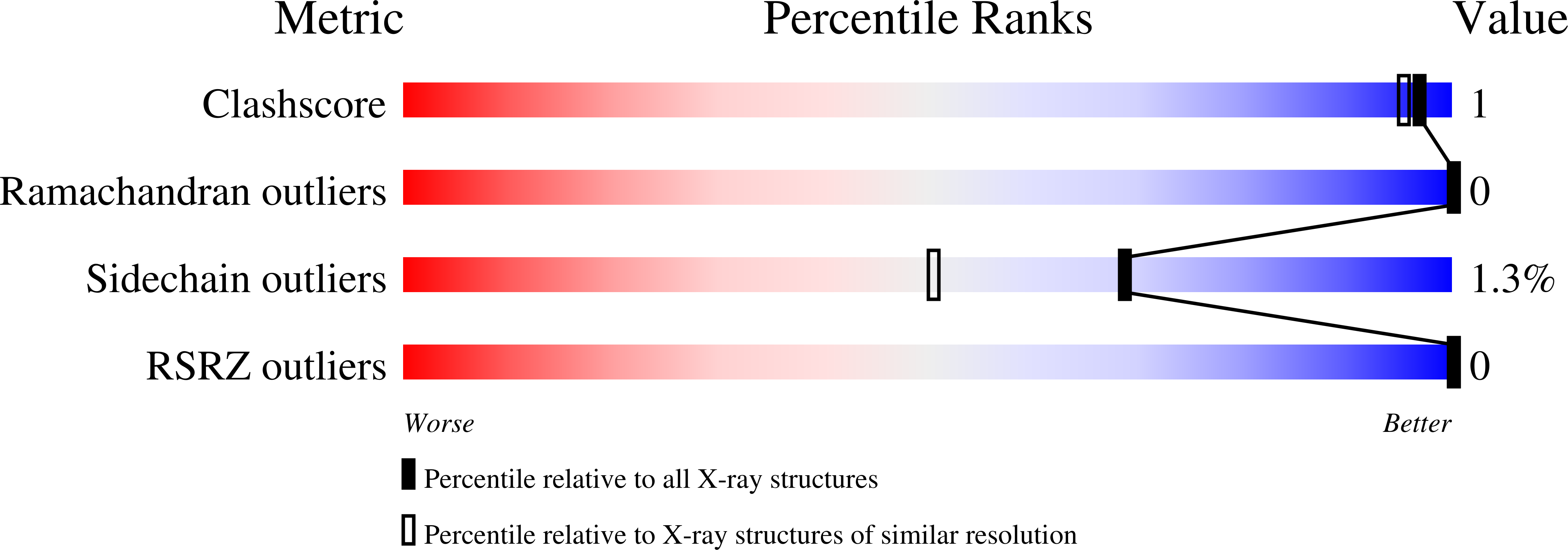
Macromolecular Entities
Structures with similar UniProt ID
Protein Blast
Polymer Type:polypeptide(L)
Molecule:HEMOGLOBIN
Mutagens:T72I
Chain IDs:A, B
Chain Length:146
Number of Molecules:2
Biological Source:Scapharca inaequivalvis
Primary Citation
Mutational destabilization of the critical interface water cluster in Scapharca dimeric hemoglobin: structural basis for altered allosteric activity.
J.Mol.Biol. 284 729 739 (1998)
PMID: 9826511 DOI: 10.1006/jmbi.1998.2195

Abstact

A cluster of interface ordered water molecules has been proposed to act as a key mediator of intersubunit communication in the homodimeric hemoglobin of Scapharca inaequivalvis. Mutations of Thr72 to Val and Ile, which lack the hydroxyl group to hydrogen bond the deoxy interface water molecules, result in sharply altered functional properties. We have determined the high resolution (1.6-1. 8 A) crystal structures of these two mutants in both the deoxygenated and CO-liganded states. These structures show minimal protein structural changes relative to the same native derivatives, despite greater than 40-fold increases in oxygen affinity. In the deoxy state of both mutants two water molecules at the periphery of the water cluster are lost, and the remaining cluster water molecules are destabilized. The CO-liganded structures show key differences between the two mutants including a more optimal interface packing involving Ile72 that acts to stabilize its high affinity (R) state. This additional stabilization allows rationalization of its lowered cooperativity within the context of a two-state model. These studies support a key role of ordered water in cooperative functioning and illustrate how subtle structural alterations can result in significantly altered functional properties in an allosteric molecule.

Legend

Protein

Chemical

Disease

Primary Citation of related structures
Feedback Form
Name
Email
Institute
Feedback