5HAW image
Deposition Date 2015-12-31
Release Date 2016-04-13
Last Version Date 2024-05-22
Entry Detail
PDB ID:
5HAW
Keywords:
Title:
structures of the NO factor SlmA bound to DNA and the cytoskeletal cell division protein FtsZ
Biological Source:
Method Details:
Experimental Method:
Resolution:
1.89 Å
R-Value Free:
0.21
R-Value Work:
0.19
R-Value Observed:
0.19
Space Group:
P 31 2 1
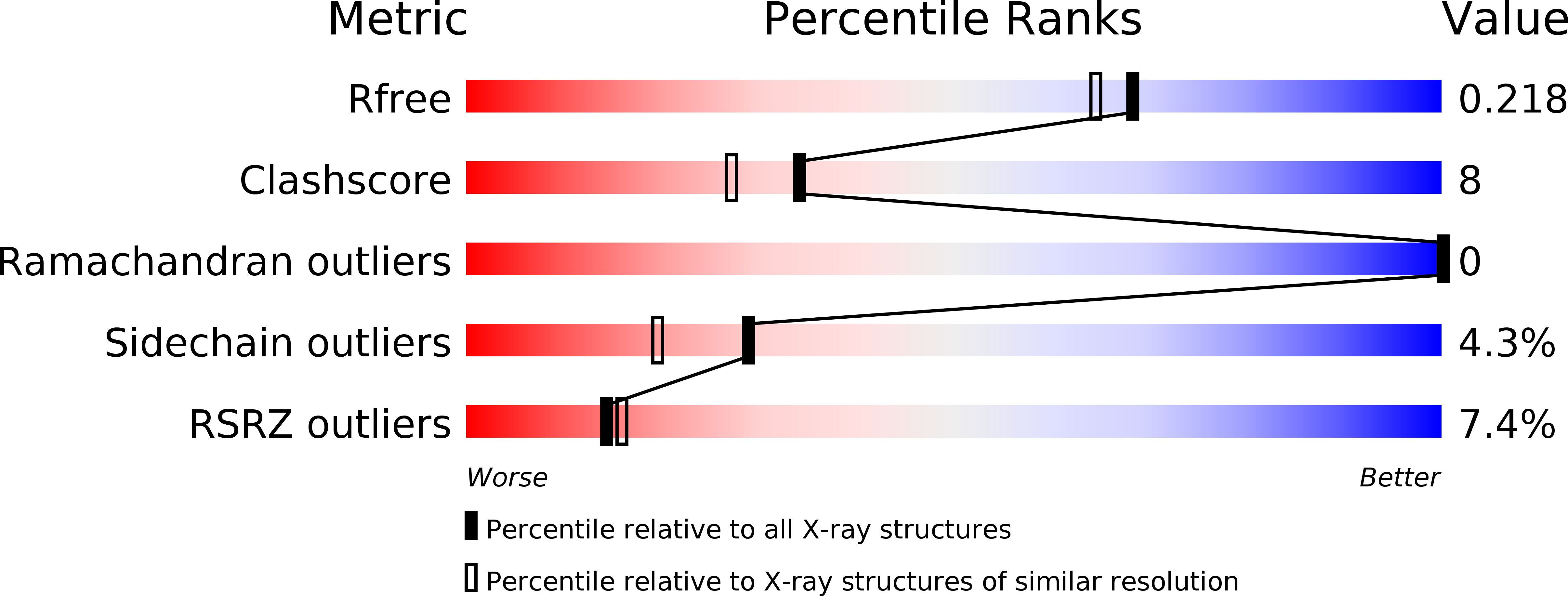
Macromolecular Entities
Structures with similar UniProt ID
Protein Blast
Polymer Type:polypeptide(L)
Molecule:Nucleoid occlusion factor SlmA
Gene (Uniprot):slmA
Chain IDs:A, B
Chain Length:196
Number of Molecules:2
Biological Source:Vibrio cholerae serotype O1 (strain ATCC 39315 / El Tor Inaba N16961)
Structures with similar UniProt ID
Protein Blast
Polymer Type:polypeptide(L)
Molecule:FtsZ CTT
Chain IDs:D (auth: L), E (auth: K)
Chain Length:10
Number of Molecules:2
Biological Source:synthetic construct
Polymer Type:polydeoxyribonucleotide
Molecule:DNA (5'-D(*GP*TP*GP*AP*GP*TP*AP*CP*TP*CP*AP*C)-3')
Chain IDs:C (auth: Z)
Chain Length:12
Number of Molecules:1
Biological Source:synthetic construct
Primary Citation
Structures of the nucleoid occlusion protein SlmA bound to DNA and the C-terminal domain of the cytoskeletal protein FtsZ.
Proc.Natl.Acad.Sci.USA 113 4988 4993 (2016)
PMID: 27091999 DOI: 10.1073/pnas.1602327113

Abstact

Cell division in most prokaryotes is mediated by FtsZ, which polymerizes to create the cytokinetic Z ring. Multiple FtsZ-binding proteins regulate FtsZ polymerization to ensure the proper spatiotemporal formation of the Z ring at the division site. The DNA-binding protein SlmA binds to FtsZ and prevents Z-ring formation through the nucleoid in a process called "nucleoid occlusion" (NO). As do most FtsZ-accessory proteins, SlmA interacts with the conserved C-terminal domain (CTD) that is connected to the FtsZ core by a long, flexible linker. However, SlmA is distinct from other regulatory factors in that it must be DNA-bound to interact with the FtsZ CTD. Few structures of FtsZ regulator-CTD complexes are available, but all reveal the CTD bound as a helix. To deduce the molecular basis for the unique SlmA-DNA-FtsZ CTD regulatory interaction and provide insight into FtsZ-regulator protein complex formation, we determined structures of Escherichia coli, Vibrio cholera, and Klebsiella pneumonia SlmA-DNA-FtsZ CTD ternary complexes. Strikingly, the FtsZ CTD does not interact with SlmA as a helix but binds as an extended conformation in a narrow, surface-exposed pocket formed only in the DNA-bound state of SlmA and located at the junction between the DNA-binding and C-terminal dimer domains. Binding studies are consistent with the structure and underscore key interactions in complex formation. Combined, these data reveal the molecular basis for the SlmA-DNA-FtsZ interaction with implications for SlmA's NO function and underscore the ability of the FtsZ CTD to adopt a wide range of conformations, explaining its ability to bind diverse regulatory proteins.

Legend

Protein

Chemical

Disease

Primary Citation of related structures
Feedback Form
Name
Email
Institute
Feedback