5H0P image
Deposition Date 2016-10-06
Release Date 2017-09-13
Last Version Date 2023-11-08
Entry Detail
PDB ID:
5H0P
Title:
Crystal structure of EF-hand protein mutant
Biological Source:
Source Organism:
Homo sapiens (Taxon ID: 9606)
Host Organism:
Method Details:
Experimental Method:
Resolution:
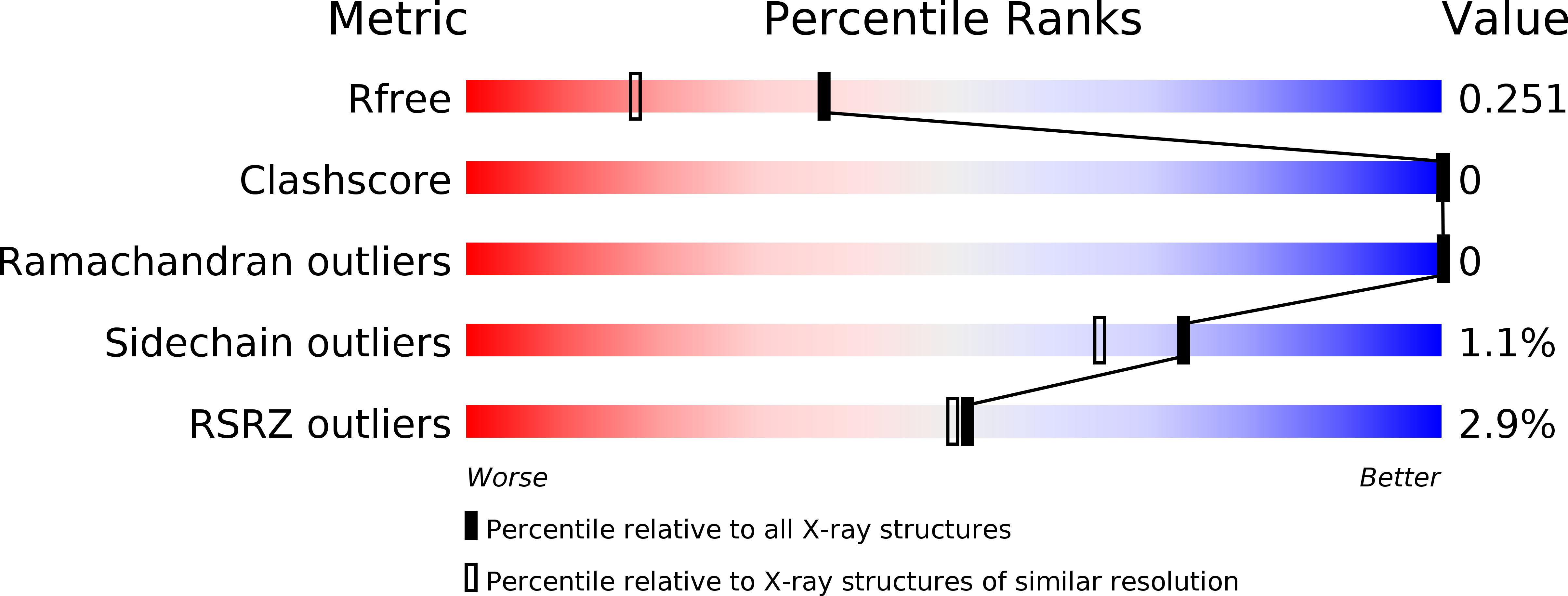
1.86 Å
R-Value Free:
0.24
R-Value Work:
0.19
R-Value Observed:
0.20
Space Group:
P 21 21 21
Macromolecular Entities
Structures with similar UniProt ID
Protein Blast
Polymer Type:polypeptide(L)
Molecule:EF-hand domain-containing protein D2
Gene (Uniprot):EFHD2
Mutagens:S183E
Chain IDs:A
Chain Length:120
Number of Molecules:1
Biological Source:Homo sapiens
Ligand Molecules
Primary Citation
Structural mechanism underlying regulation of human EFhd2/Swiprosin-1 actin-bundling activity by Ser183 phosphorylation.
Biochem. Biophys. Res. Commun. 483 442 448 (2017)
PMID: 28011271 DOI: 10.1016/j.bbrc.2016.12.124

Abstact

EF-hand domain-containing protein D2/Swiprosin-1 (EFhd2) is an actin-binding protein mainly expressed in the central nervous and the immune systems of mammals. Intracellular events linked to EFhd2, such as membrane protrusion formation, cell adhesion, and BCR signaling, are triggered by the association of EFhd2 and F-actin. We previously reported that Ca2+ enhances the F-actin-bundling ability of EFhd2 through maintaining a rigid parallel EFhd2-homodimer structure. It was also reported that the F-actin-bundling ability of EFhd2 is regulated by a phosphorylation-dependent mechanism. EGF-induced phosphorylation at Ser183 of EFhd2 has been shown to inhibit F-actin-bundling, leading to irregular actin dynamics at the leading edges of cells. However, the underlying mechanism of this inhibition has remained elusive. Here, we report the crystal structure of a phospho-mimicking mutant (S183E) of the EFhd2 core domain, where the actin-binding sites are located. Although the overall structure of the phospho-mimicking mutant is similar to the one of the unphosphorylated form, we observed a conformational transition from ordered to disordered structure in the linker region at the C-terminus of the mutant. Based on our structural and biochemical analyses, we suggest that phosphorylation at Ser183 of EFhd2 causes changes in the local conformational dynamics and the surface charge distribution of the actin-binding site, resulting in a re-coordination of the actin-binding sites in the dimer structure and a reduction of F-actin-bundling activity without affecting the F-actin-binding capacity.

Legend

Protein

Chemical

Disease

Primary Citation of related structures
Feedback Form
Name
Email
Institute
Feedback