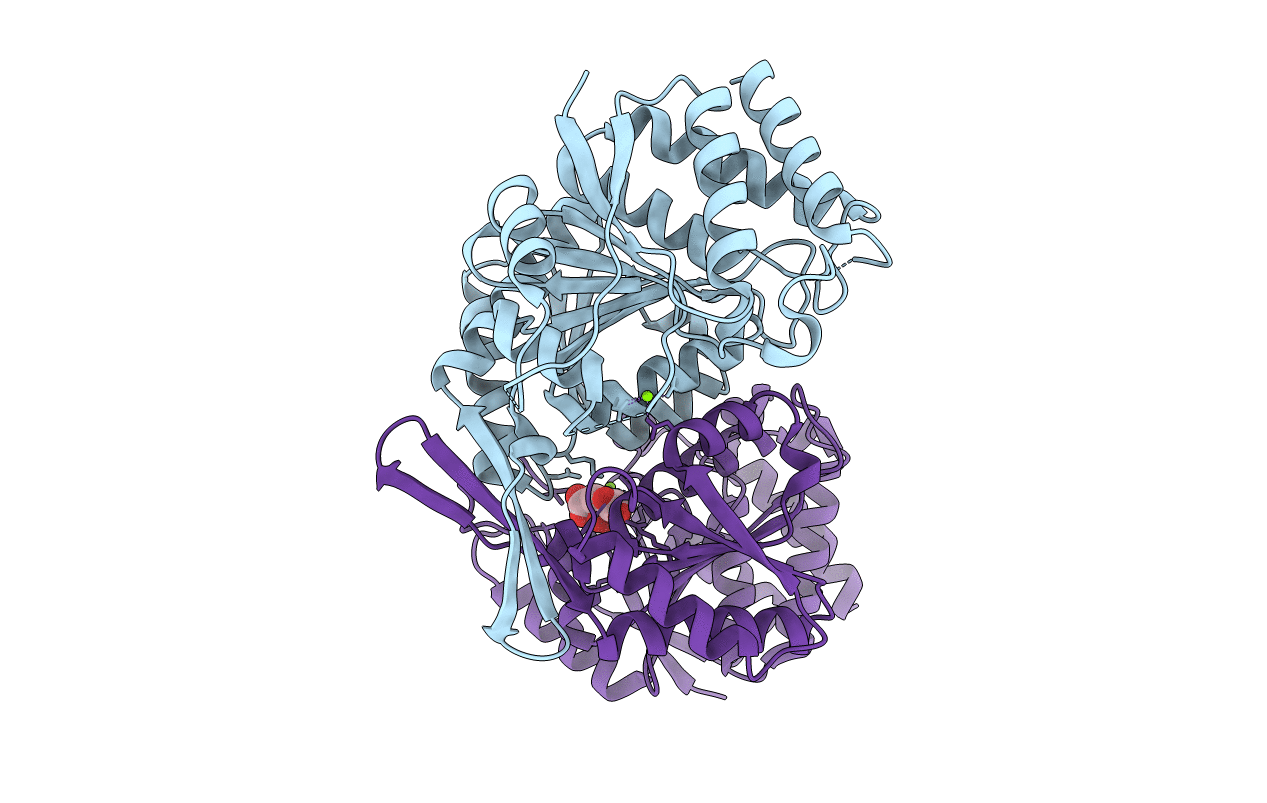
5GRI image
Deposition Date 2016-08-11
Release Date 2017-02-15
Last Version Date 2023-11-08
Entry Detail
PDB ID:
5GRI
Keywords:
Title:
Crystal structure of the alpha gamma heterodimer of human IDH3 in complex with Mg(2+) and citrate
Biological Source:
Source Organism:
Homo sapiens (Taxon ID: 9606)
Method Details:
Experimental Method:
Resolution:
2.31 Å
R-Value Free:
0.27
R-Value Work:
0.24
R-Value Observed:
0.24
Space Group:
P 31 2 1
Macromolecular Entities
Structures with similar UniProt ID
Protein Blast
Polymer Type:polypeptide(L)
Molecule:Isocitrate dehydrogenase [NAD] subunit alpha, mitochondrial
Gene (Uniprot):IDH3A
Chain IDs:A
Chain Length:339
Number of Molecules:1
Biological Source:Homo sapiens
Structures with similar UniProt ID
Protein Blast
Polymer Type:polypeptide(L)
Molecule:Isocitrate dehydrogenase [NAD] subunit gamma, mitochondrial
Gene (Uniprot):IDH3G
Chain IDs:B
Chain Length:354
Number of Molecules:1
Biological Source:Homo sapiens
Primary Citation
Molecular mechanism of the allosteric regulation of the alpha gamma heterodimer of human NAD-dependent isocitrate dehydrogenase.
Sci Rep 7 40921 40921 (2017)
PMID: 28098230 DOI: 10.1038/srep40921

Abstact

Human NAD-dependent isocitrate dehydrogenase catalyzes the decarboxylation of isocitrate (ICT) into α-ketoglutarate in the Krebs cycle. It exists as the α2βγ heterotetramer composed of the αβ and αγ heterodimers. Previously, we have demonstrated biochemically that the α2βγ heterotetramer and αγ heterodimer can be allosterically activated by citrate (CIT) and ADP. In this work, we report the crystal structures of the αγ heterodimer with the γ subunit bound without or with different activators. Structural analyses show that CIT, ADP and Mg2+ bind adjacent to each other at the allosteric site. The CIT binding induces conformational changes at the allosteric site, which are transmitted to the active site through the heterodimer interface, leading to stabilization of the ICT binding at the active site and thus activation of the enzyme. The ADP binding induces no further conformational changes but enhances the CIT binding through Mg2+-mediated interactions, yielding a synergistic activation effect. ICT can also bind to the CIT-binding subsite, which induces similar conformational changes but exhibits a weaker activation effect. The functional roles of the key residues are verified by mutagenesis, kinetic and structural studies. Our structural and functional data together reveal the molecular mechanism of the allosteric regulation of the αγ heterodimer.

Legend

Protein

Chemical

Disease

Primary Citation of related structures
Feedback Form
Name
Email
Institute
Feedback