5FSW image
Deposition Date 2016-01-08
Release Date 2016-03-02
Last Version Date 2024-01-10
Entry Detail
PDB ID:
5FSW
Keywords:
Title:
RNA dependent RNA polymerase QDE-1 from Thielavia terrestris
Biological Source:
Source Organism:
Host Organism:
Method Details:
Experimental Method:
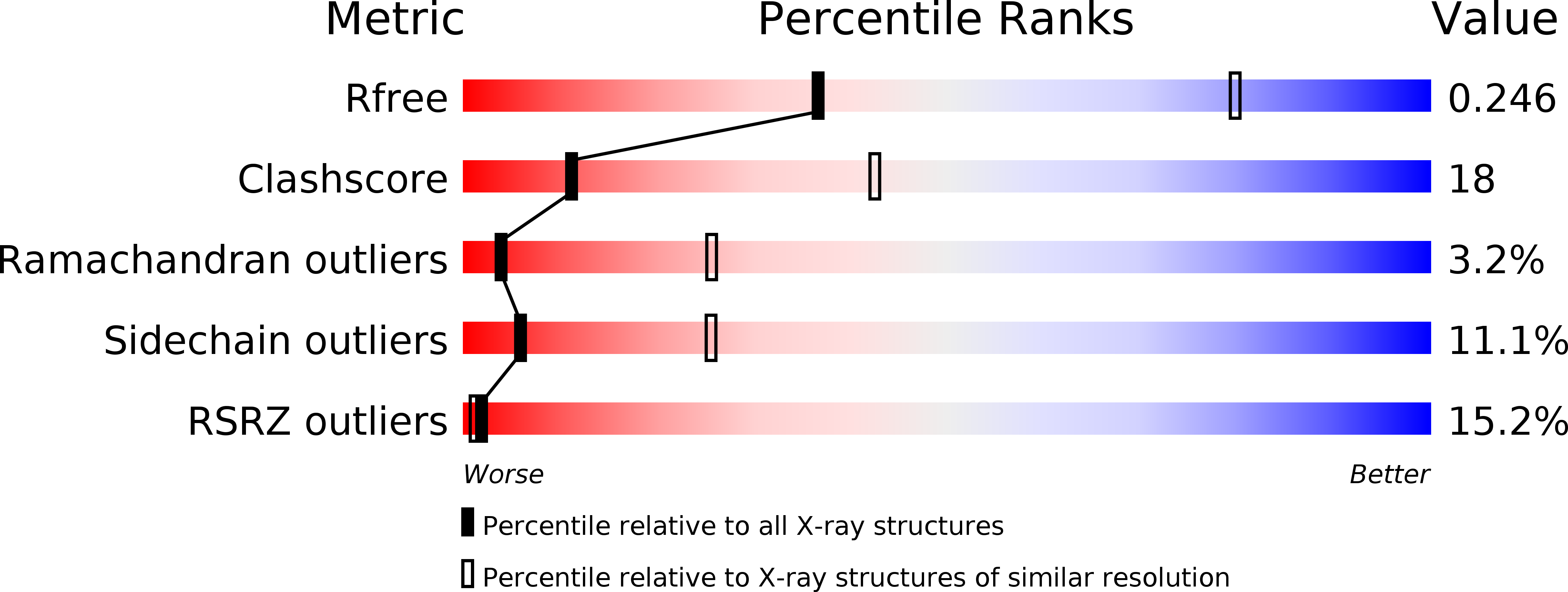
Resolution:
3.19 Å
R-Value Free:
0.25
R-Value Work:
0.21
R-Value Observed:
0.21
Space Group:
P 1 21 1
Macromolecular Entities
Structures with similar UniProt ID
Protein Blast
Polymer Type:polypeptide(L)
Molecule:RNA DEPENDENT RNA POLYMERASE QDE-1
Gene (Uniprot):THITE_2079458
Chain IDs:A, B, C, D
Chain Length:1034
Number of Molecules:4
Biological Source:THIELAVIA TERRESTRIS
Ligand Molecules
Primary Citation
Functional Evolution in Orthologous Cell-Encoded RNA-Dependent RNA Polymerases
J.Biol.Chem. 291 9295 ? (2016)
PMID: 26907693 DOI: 10.1074/JBC.M115.685933

Abstact

Many eukaryotic organisms encode more than one RNA-dependent RNA polymerase (RdRP) that probably emerged as a result of gene duplication. Such RdRP paralogs often participate in distinct RNA silencing pathways and show characteristic repertoires of enzymatic activities in vitro However, to what extent members of individual paralogous groups can undergo functional changes during speciation remains an open question. We show that orthologs of QDE-1, an RdRP component of the quelling pathway in Neurospora crassa, have rapidly diverged in evolution at the amino acid sequence level. Analyses of purified QDE-1 polymerases from N. crassa (QDE-1(Ncr)) and related fungi, Thielavia terrestris (QDE-1(Tte)) and Myceliophthora thermophila (QDE-1(Mth)), show that all three enzymes can synthesize RNA, but the precise modes of their action differ considerably. Unlike their QDE-1(Ncr) counterpart favoring processive RNA synthesis, QDE-1(Tte) and QDE-1(Mth) produce predominantly short RNA copies via primer-independent initiation. Surprisingly, a 3.19 Å resolution crystal structure of QDE-1(Tte) reveals a quasisymmetric dimer similar to QDE-1(Ncr) Further electron microscopy analyses confirm that QDE-1(Tte) occurs as a dimer in solution and retains this status upon interaction with a template. We conclude that divergence of orthologous RdRPs can result in functional innovation while retaining overall protein fold and quaternary structure.

Legend

Protein

Chemical

Disease

Primary Citation of related structures
Feedback Form
Name
Email
Institute
Feedback