5FN4 image
Deposition Date 2015-11-10
Release Date 2015-12-16
Last Version Date 2024-10-23
Entry Detail
PDB ID:
5FN4
Keywords:
Title:
Cryo-EM structure of gamma secretase in class 2 of the apo- state ensemble
Biological Source:
Source Organism:
Homo sapiens (Taxon ID: 9606)
Host Organism:
Method Details:
Experimental Method:
Resolution:
4.00 Å
Aggregation State:
PARTICLE
Reconstruction Method:
SINGLE PARTICLE
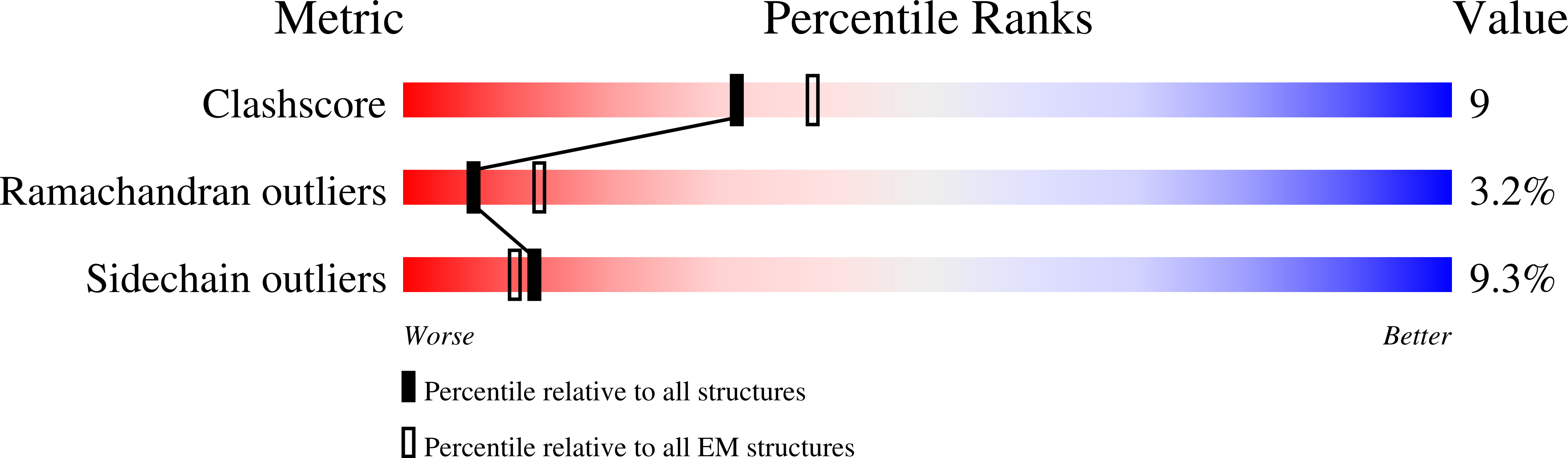
Macromolecular Entities
Structures with similar UniProt ID
Protein Blast
Polymer Type:polypeptide(L)
Molecule:Nicastrin
Gene (Uniprot):NCSTN
Chain IDs:A
Chain Length:709
Number of Molecules:1
Biological Source:Homo sapiens
Structures with similar UniProt ID
Protein Blast
Polymer Type:polypeptide(L)
Molecule:Presenilin-1
Gene (Uniprot):PSEN1
Chain IDs:B
Chain Length:467
Number of Molecules:1
Biological Source:Homo sapiens
Structures with similar UniProt ID
Protein Blast
Polymer Type:polypeptide(L)
Molecule:Gamma-secretase subunit APH-1A
Gene (Uniprot):APH1A
Chain IDs:C
Chain Length:265
Number of Molecules:1
Biological Source:Homo sapiens
Structures with similar UniProt ID
Protein Blast
Polymer Type:polypeptide(L)
Molecule:Gamma-secretase subunit PEN-2
Gene (Uniprot):PSENEN
Chain IDs:D
Chain Length:101
Number of Molecules:1
Biological Source:Homo sapiens
Polymer Type:polypeptide(L)
Molecule:POLY ALA CHAIN
Chain IDs:E (auth: G)
Chain Length:25
Number of Molecules:1
Biological Source:HOMO SAPIENS
Ligand Molecules
Primary Citation
Sampling the conformational space of the catalytic subunit of human gamma-secretase.
Elife 4 ? ? (2015)
PMID: 26623517 DOI: 10.7554/eLife.11182

Abstact

Human γ-secretase is an intra-membrane protease that cleaves many different substrates. Aberrant cleavage of Notch is implicated in cancer, while abnormalities in cutting amyloid precursor protein lead to Alzheimer's disease. Our previous cryo-EM structure of γ-secretase revealed considerable disorder in its catalytic subunit presenilin. Here, we describe an image classification procedure that characterizes molecular plasticity at the secondary structure level, and apply this method to identify three distinct conformations in our previous sample. In one of these conformations, an additional transmembrane helix is visible that cannot be attributed to the known components of γ-secretase. In addition, we present a γ-secretase structure in complex with the dipeptidic inhibitor N-[N-(3,5-difluorophenacetyl)-L-alanyl]-S-phenylglycine t-butyl ester (DAPT). Our results reveal how conformational mobility in the second and sixth transmembrane helices of presenilin is greatly reduced upon binding of DAPT or the additional helix, and form the basis for a new model of how substrate enters the transmembrane domain.

Legend

Protein

Chemical

Disease

Primary Citation of related structures
Feedback Form
Name
Email
Institute
Feedback